FREE WHITE PAPER

Heading

Date
This is some text inside of a div block.
FREE WHITE PAPER

Heading 1

Heading 2

Heading 3

Heading 4

Heading 5
Heading 6

Lorem ipsum dolor sit amet, consectetur adipiscing elit, sed do eiusmod tempor incididunt ut labore et dolore magna aliqua. Ut enim ad minim veniam, quis nostrud exercitation ullamco laboris nisi ut aliquip ex ea commodo consequat. Duis aute irure dolor in reprehenderit in voluptate velit esse cillum dolore eu fugiat nulla pariatur.

Block quote

Ordered list

  1. Item 1
  2. Item 2
  3. Item 3

Unordered list

  • Item A
  • Item B
  • Item C

Text link

Bold text

Emphasis

Superscript

Subscript

Heading 1

Heading 2

Heading 3

Heading 4

Heading 5
Heading 6

Lorem ipsum dolor sit amet, consectetur adipiscing elit, sed do eiusmod tempor incididunt ut labore et dolore magna aliqua. Ut enim ad minim veniam, quis nostrud exercitation ullamco laboris nisi ut aliquip ex ea commodo consequat. Duis aute irure dolor in reprehenderit in voluptate velit esse cillum dolore eu fugiat nulla pariatur.

Block quote

Ordered list

  1. Item 1
  2. Item 2
  3. Item 3

Unordered list

  • Item A
  • Item B
  • Item C

Text link

Bold text

Emphasis

Superscript

Subscript

Download Resource
Thank you! Your submission has been received!
Oops! Something went wrong while submitting the form.

CT Touchdown

Edited by
Date
February 8, 2024

As the Big Game approaches, it’s easy to focus on the teams and forget about the real powerhouse: the football itself. Industrial CT gives us a window into what lies beneath its leather exterior. Let’s take a look at the ball’s easily overlooked engineering and labor-intensive manufacturing process. 

To get started, give the football a spin in our Voyager window below.

Panels

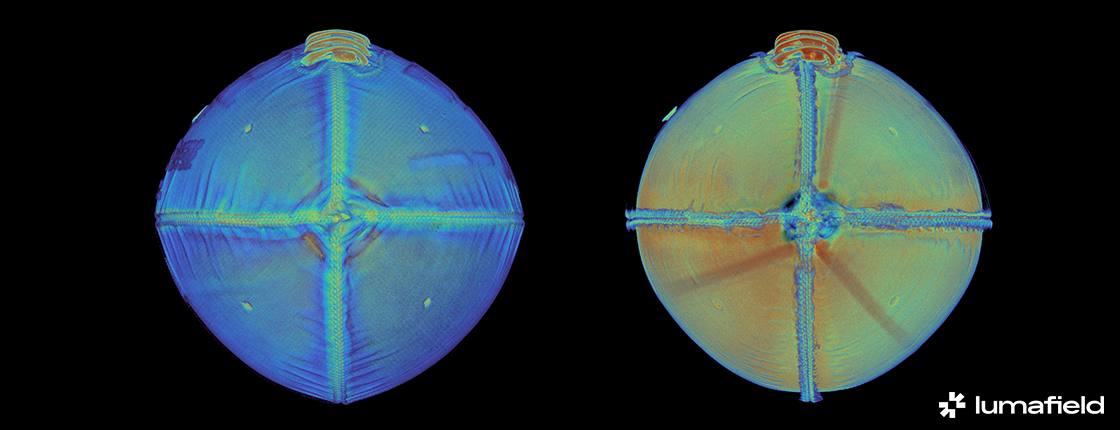
The pebbled leather panels of football are made of cowhide, which wears well over time and provides a grip that can withstand all weather conditions. A football’s manufacturing process is still largely manual. A worker cuts out the four panels with a die, sews cotton and vinyl linings onto the back of each one, and then stitches them all together before a roller flattens the seams. CT allows us to assess the consistency in the panel's thickness, the precision of the stitches, and how well the panels conform to the bladder, all of which contribute to the ball's aerodynamic properties and in-hand feel.
Bladder

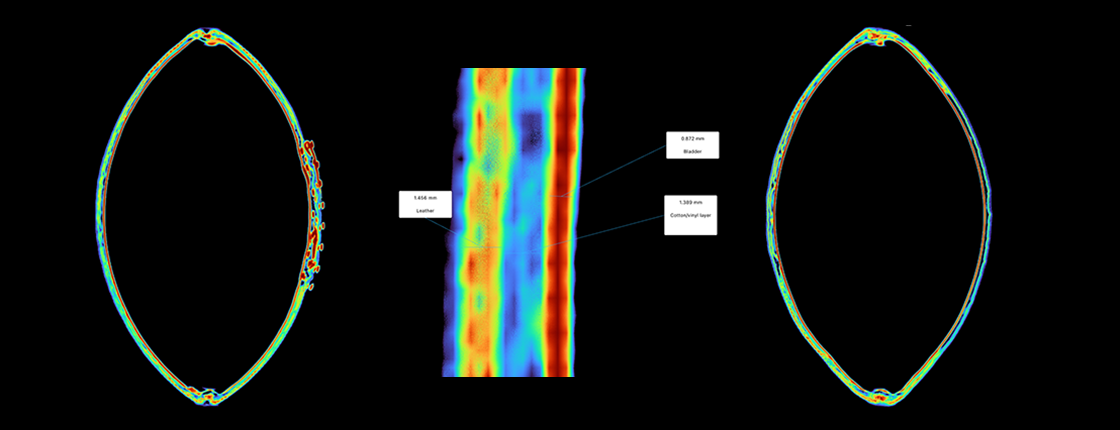
Enclosed within the four panels is a polyurethane bladder, a critical component that retains air and ensures the ball holds its shape and proper inflation. With Voyager’s dimensioning tools, we can measure the thickness of the layers and apply a color map that corresponds to the density of each material. The thickness of the polyurethane bladder (red, most dense) measures 0.872 mm, the cotton/vinyl layer (blue, least dense) is 1.389 mm, and the leather (yellow, density between the bladder and lining) is 1.456 mm.
Laces and Valve

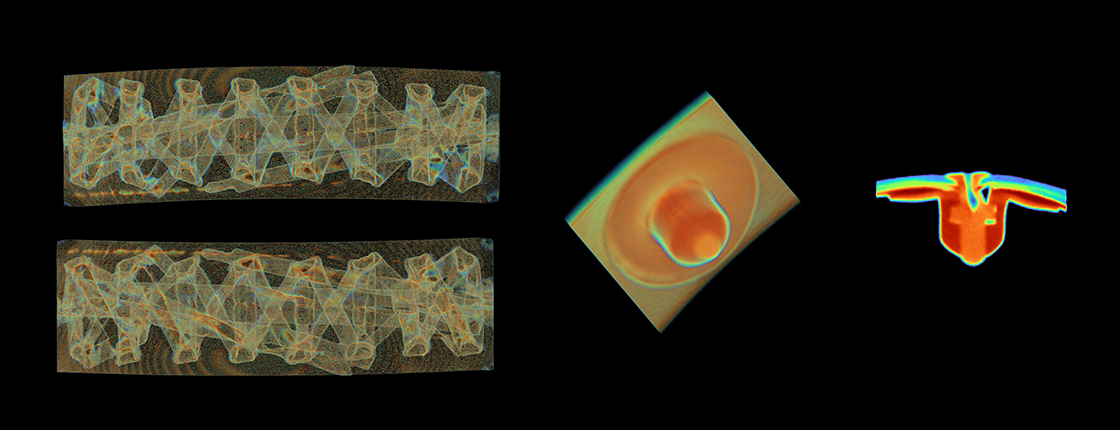
The laces on a football aren’t just there for show; they provide an essential grip for quarterbacks to throw spiral passes with accuracy. A worker inflates the ball to make it rigid, then steadies it with planks before using an awl to thread the single four-foot-long vinyl lace through the holes twice over.

While small and often unnoticed, the valve can make or break the football. A proper seal is needed for air retention, especially during a game as critical as the Super Bowl. A retaining flange embeds in a dense housing adhered to the bladder’s inner wall. The NFL requires that a football be inflated to between 12.5 and 13.5 psi. This is crucial, because a softer ball is easier to catch. Remember Deflategate?
Conclusion

CT helps us appreciate the unseen qualities that ensure footballs meet the highest standards of quality and performance. At this year’s Big Game, don’t lose sight of the precision design and craftsmanship at the heart of the sport. 

Discover how Trek Bicycle and other athletic equipment manufacturers are using Lumafield's industrial CT platform to accelerate their product development.

Read Case Study
Article
Article

CT Touchdown

February 8, 2024
Article

CT Touchdown

As the Big Game approaches, it’s easy to focus on the teams and forget about the real powerhouse: the football itself. Industrial CT gives us a window into what lies beneath its leather exterior. Let’s take a look at the ball’s easily overlooked engineering and labor-intensive manufacturing process. 

To get started, give the football a spin in our Voyager window below.

Panels

The pebbled leather panels of football are made of cowhide, which wears well over time and provides a grip that can withstand all weather conditions. A football’s manufacturing process is still largely manual. A worker cuts out the four panels with a die, sews cotton and vinyl linings onto the back of each one, and then stitches them all together before a roller flattens the seams. CT allows us to assess the consistency in the panel's thickness, the precision of the stitches, and how well the panels conform to the bladder, all of which contribute to the ball's aerodynamic properties and in-hand feel.

Bladder

Enclosed within the four panels is a polyurethane bladder, a critical component that retains air and ensures the ball holds its shape and proper inflation. With Voyager’s dimensioning tools, we can measure the thickness of the layers and apply a color map that corresponds to the density of each material. The thickness of the polyurethane bladder (red, most dense) measures 0.872 mm, the cotton/vinyl layer (blue, least dense) is 1.389 mm, and the leather (yellow, density between the bladder and lining) is 1.456 mm.

Laces and Valve

The laces on a football aren’t just there for show; they provide an essential grip for quarterbacks to throw spiral passes with accuracy. A worker inflates the ball to make it rigid, then steadies it with planks before using an awl to thread the single four-foot-long vinyl lace through the holes twice over.

While small and often unnoticed, the valve can make or break the football. A proper seal is needed for air retention, especially during a game as critical as the Super Bowl. A retaining flange embeds in a dense housing adhered to the bladder’s inner wall. The NFL requires that a football be inflated to between 12.5 and 13.5 psi. This is crucial, because a softer ball is easier to catch. Remember Deflategate?

Conclusion

CT helps us appreciate the unseen qualities that ensure footballs meet the highest standards of quality and performance. At this year’s Big Game, don’t lose sight of the precision design and craftsmanship at the heart of the sport. 

Discover how Trek Bicycle and other athletic equipment manufacturers are using Lumafield's industrial CT platform to accelerate their product development.

Read Case Study
Voyager Inspection Workflows
Introduction to Voyager
Introduction to Neptune
Introduction to Industrial CT
Introducing Mars for 100% Production Inspection
Advancing Automotive Inspection: Industrial CT for Better Outcomes
Introducing Neptune Performance and Triton Performance
Manufacturers Know Quality Costs Money. Most Don't Know How Much.
The Real Cost of a Product Recall and How to Prevent One
What Industrial CT Scanning Does for Manufacturing Quality
Explore more posts
Direkt zum Hauptinhalt
Mars: In-line arrayed X-ray system >
Platform
Branchen
Alle Branchen
Aerospace and Defense
Agriculture and Food
Athletic Equipment
Automotive
Batteries
Consumer Packaged Goods
Electronics
Medical Devices
Applications
Ressourcen
Whitepapers
Ressourcen
Webinare
Blog
Insights from lumafield
Go/No-Go
Manufacturing podcast
First Article
Editorial Publication
Firma
Über
Karriere
Drücken
Events
Starten Sie Voyager
Vertrieb kontaktieren
Speisekarte
ProdukteBranchen
Branchen
Alle Branchen
Medical Devices
Electronics
Consumer Packaged Goods
Automotive
Athletic Equipment
Batteries
Agriculture and Food
Aerospace and Defense
Applications
Ressourcen
Ressourcen
Whitepapers
101. OKTOBER
Webinars
Erster Artikel
Go/No-Go Podcast
First Article
Firma
Firma
Über
Karriere
Drücken
Events
Vertrieb kontaktieren
Starten Sie Voyager
© 2000 Lumafield. All Rights Reserved.
den Weg ändern
die Welt macht
alles
Branchen
Aerospace and Defense
Agriculture and Food
Athletic Equipment
Automotive
Batteries
Consumer Packaged Goods
Electronics
Medical Devices
Alle Branchen
Anwendungen
Assembly Verification
Competitive Benchmarking and Analysis
Defect Detection
Design Verification and Validation
Dimensional Measurement
Failure Analysis
First Article Inspection (FAI)
Material Characterization
Non-Destructive Testing (NDT)
Quality Assurance and Control (QA & QC)
Reverse Engineering
Supplier Qualification
All Applications
Produkte
NeptunTritonVoyagerMarsAtlas
Ressourcen
LernenErster ArtikelWhitepapersEreignisseWebinareUnterstützungFallstudien101. OKTOBERBlog der Ingenieure
Firma
EinloggenÜberKarriereDrückenBlogKontakt

Melde dich für unseren Newsletter an

info@lumafield.com
DatenschutzInformationssicherheitVereinbarung über Bereitstellungsdienste
© 2000 Lumafield. All Rights Reserved.