FREE WHITE PAPER

Heading

Date
This is some text inside of a div block.
FREE WHITE PAPER

Heading 1

Heading 2

Heading 3

Heading 4

Heading 5
Heading 6

Lorem ipsum dolor sit amet, consectetur adipiscing elit, sed do eiusmod tempor incididunt ut labore et dolore magna aliqua. Ut enim ad minim veniam, quis nostrud exercitation ullamco laboris nisi ut aliquip ex ea commodo consequat. Duis aute irure dolor in reprehenderit in voluptate velit esse cillum dolore eu fugiat nulla pariatur.

Block quote

Ordered list

  1. Item 1
  2. Item 2
  3. Item 3

Unordered list

  • Item A
  • Item B
  • Item C

Text link

Bold text

Emphasis

Superscript

Subscript

Heading 1

Heading 2

Heading 3

Heading 4

Heading 5
Heading 6

Lorem ipsum dolor sit amet, consectetur adipiscing elit, sed do eiusmod tempor incididunt ut labore et dolore magna aliqua. Ut enim ad minim veniam, quis nostrud exercitation ullamco laboris nisi ut aliquip ex ea commodo consequat. Duis aute irure dolor in reprehenderit in voluptate velit esse cillum dolore eu fugiat nulla pariatur.

Block quote

Ordered list

  1. Item 1
  2. Item 2
  3. Item 3

Unordered list

  • Item A
  • Item B
  • Item C

Text link

Bold text

Emphasis

Superscript

Subscript

Download Resource
Thank you! Your submission has been received!
Oops! Something went wrong while submitting the form.

Is this toner cartridge half empty or half full?

Edited by
Date
November 30, 2022

Everyone needs a printout occasionally. You rush to the office printer to pick it up, only to find that dreaded message: Replace Toner. But should we take the printer’s word for it? Lumafield’s Neptune industrial CT scanner says otherwise.

We grabbed a low toner cartridge from our office printer and popped it into our Neptune scanner. We did the same to a brand new one for comparison. What we found shocked us: not only was the empty one not really empty, but the full cartridge was far from full!

With the help of the automated measurements tool in Voyager—our browser-based industrial CT analysis software—we found that right out of the box, only about 20% of the space inside the cartridge reservoir is occupied by toner. A cartridge deemed "empty" by the printer has only slightly less toner, about 15%. That 5% range seems to represent the entire capacity of the cartridge. But what exactly is inside?

Whereas inkjet printers spray small drops of liquid ink onto paper, laser printers operate using plastics, electricity, and heat. They project an electrostatic charge onto a printing drum in the pattern of the images or text in the document. Each toner cartridge contains finely granulated plastic powder, which holds a static charge and clings to the oppositely-charged drum. The empty space in the cartridge hopper that we observed in our CT scans may be necessary for this powder distribution step of the process.

Finally, the printing drum transfers the powder to the paper, then hot fuser rolls melt and set it into place.  Remember the warmth of a freshly photocopied page? This process is known as xerography, where Xerox got its name. Even now, a stack hot off the laser printer briefly retains the fuser roll’s heat.

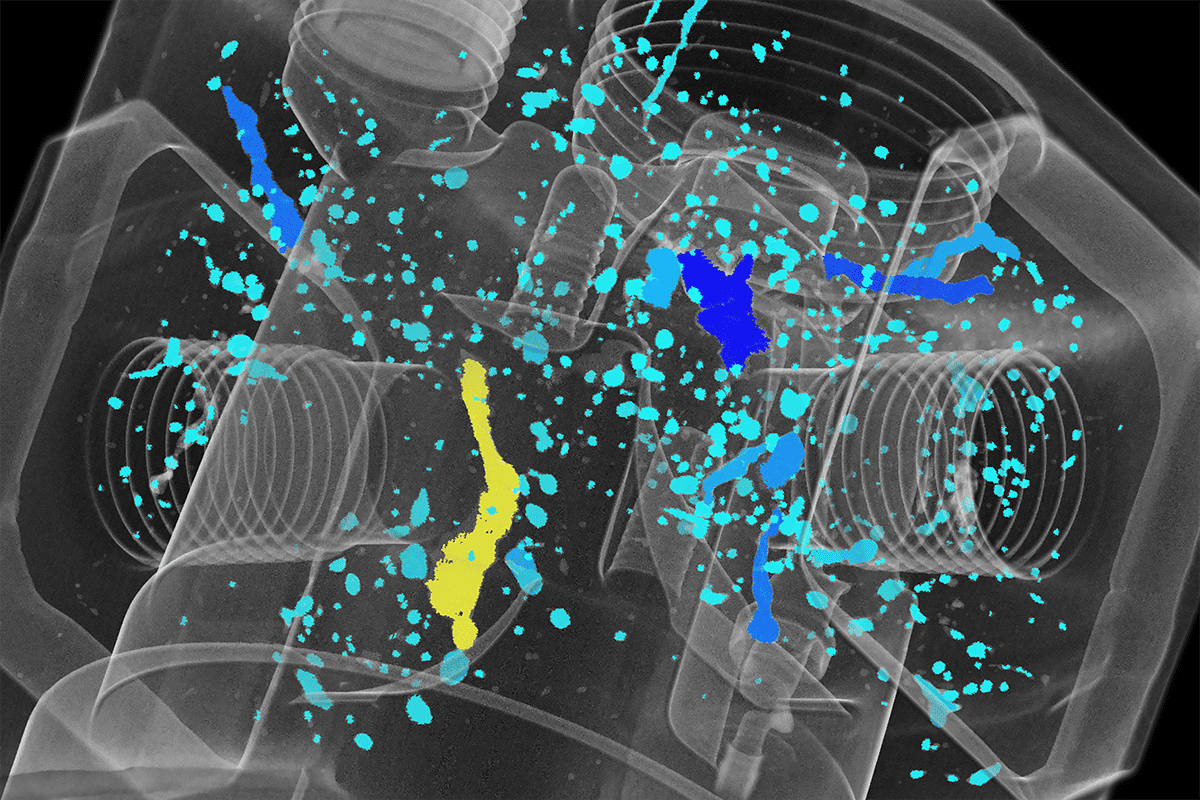
CT scans are able to distinguish materials of different density. As we adjust our visualization in Voyager to isolate only denser materials, the toner powder disappears quickly; it's mostly made of polyester and is much less dense than the cartridge's housing. After we completely exclude the toner, a very small amount of denser powder remains in the visualization. This could be a toner additive or a ferrous developer powder that helps distribute the toner.

Our CT scans transform the toner cartridge into an hourglass, showing powder settled like sand that tells you how much time is left before a replacement is needed. At the same time, we discover why the familiar home remedy of shaking your toner cartridge actually works in bringing it back to life. Once you redistribute the powder, the sensor will see that it’s not quite empty, and you’ll also be able to squeeze a few more pages out of it.

This is just one example of the constantly-expanding applications for industrial CT technology. Engineers at top companies use Lumafield’s Neptune scanner to gain insight into their manufacturing workflows at every stage from research and development to assembly inspection and validation.

You can explore these and other scans in detail on Voyager. Reach out to our team to learn how Lumafield’s accessible industrial CT technology can work for you.

‍

Article
Article

Is this toner cartridge half empty or half full?

November 30, 2022
Article

Is this toner cartridge half empty or half full?

Everyone needs a printout occasionally. You rush to the office printer to pick it up, only to find that dreaded message: Replace Toner. But should we take the printer’s word for it? Lumafield’s Neptune industrial CT scanner says otherwise.

We grabbed a low toner cartridge from our office printer and popped it into our Neptune scanner. We did the same to a brand new one for comparison. What we found shocked us: not only was the empty one not really empty, but the full cartridge was far from full!

With the help of the automated measurements tool in Voyager—our browser-based industrial CT analysis software—we found that right out of the box, only about 20% of the space inside the cartridge reservoir is occupied by toner. A cartridge deemed "empty" by the printer has only slightly less toner, about 15%. That 5% range seems to represent the entire capacity of the cartridge. But what exactly is inside?

Whereas inkjet printers spray small drops of liquid ink onto paper, laser printers operate using plastics, electricity, and heat. They project an electrostatic charge onto a printing drum in the pattern of the images or text in the document. Each toner cartridge contains finely granulated plastic powder, which holds a static charge and clings to the oppositely-charged drum. The empty space in the cartridge hopper that we observed in our CT scans may be necessary for this powder distribution step of the process.

Finally, the printing drum transfers the powder to the paper, then hot fuser rolls melt and set it into place.  Remember the warmth of a freshly photocopied page? This process is known as xerography, where Xerox got its name. Even now, a stack hot off the laser printer briefly retains the fuser roll’s heat.

CT scans are able to distinguish materials of different density. As we adjust our visualization in Voyager to isolate only denser materials, the toner powder disappears quickly; it's mostly made of polyester and is much less dense than the cartridge's housing. After we completely exclude the toner, a very small amount of denser powder remains in the visualization. This could be a toner additive or a ferrous developer powder that helps distribute the toner.

Our CT scans transform the toner cartridge into an hourglass, showing powder settled like sand that tells you how much time is left before a replacement is needed. At the same time, we discover why the familiar home remedy of shaking your toner cartridge actually works in bringing it back to life. Once you redistribute the powder, the sensor will see that it’s not quite empty, and you’ll also be able to squeeze a few more pages out of it.

This is just one example of the constantly-expanding applications for industrial CT technology. Engineers at top companies use Lumafield’s Neptune scanner to gain insight into their manufacturing workflows at every stage from research and development to assembly inspection and validation.

You can explore these and other scans in detail on Voyager. Reach out to our team to learn how Lumafield’s accessible industrial CT technology can work for you.

‍

Voyager Inspection Workflows
Introduction to Voyager
Introduction to Neptune
Introduction to Industrial CT
Introducing Mars for 100% Production Inspection
Advancing Automotive Inspection: Industrial CT for Better Outcomes
Introducing Neptune Performance and Triton Performance
Manufacturers Know Quality Costs Money. Most Don't Know How Much.
The Real Cost of a Product Recall and How to Prevent One
What Industrial CT Scanning Does for Manufacturing Quality
Explore more posts
Direkt zum Hauptinhalt
Mars: In-line arrayed X-ray system >
Platform
Branchen
Alle Branchen
Aerospace and Defense
Agriculture and Food
Athletic Equipment
Automotive
Batteries
Consumer Packaged Goods
Electronics
Medical Devices
Applications
Ressourcen
Whitepapers
Ressourcen
Webinare
Blog
Insights from lumafield
Go/No-Go
Manufacturing podcast
First Article
Editorial Publication
Firma
Über
Karriere
Drücken
Events
Starten Sie Voyager
Vertrieb kontaktieren
Speisekarte
ProdukteBranchen
Branchen
Alle Branchen
Medical Devices
Electronics
Consumer Packaged Goods
Automotive
Athletic Equipment
Batteries
Agriculture and Food
Aerospace and Defense
Applications
Ressourcen
Ressourcen
Whitepapers
101. OKTOBER
Webinars
Erster Artikel
Go/No-Go Podcast
First Article
Firma
Firma
Über
Karriere
Drücken
Events
Vertrieb kontaktieren
Starten Sie Voyager
© 2000 Lumafield. All Rights Reserved.
den Weg ändern
die Welt macht
alles
Branchen
Aerospace and Defense
Agriculture and Food
Athletic Equipment
Automotive
Batteries
Consumer Packaged Goods
Electronics
Medical Devices
Alle Branchen
Anwendungen
Assembly Verification
Competitive Benchmarking and Analysis
Defect Detection
Design Verification and Validation
Dimensional Measurement
Failure Analysis
First Article Inspection (FAI)
Material Characterization
Non-Destructive Testing (NDT)
Quality Assurance and Control (QA & QC)
Reverse Engineering
Supplier Qualification
All Applications
Produkte
NeptunTritonVoyagerMarsAtlas
Ressourcen
LernenErster ArtikelWhitepapersEreignisseWebinareUnterstützungFallstudien101. OKTOBERBlog der Ingenieure
Firma
EinloggenÜberKarriereDrückenBlogKontakt

Melde dich für unseren Newsletter an

info@lumafield.com
DatenschutzInformationssicherheitVereinbarung über Bereitstellungsdienste
© 2000 Lumafield. All Rights Reserved.