FREE WHITE PAPER

Heading

Date
This is some text inside of a div block.
FREE WHITE PAPER

Heading 1

Heading 2

Heading 3

Heading 4

Heading 5
Heading 6

Lorem ipsum dolor sit amet, consectetur adipiscing elit, sed do eiusmod tempor incididunt ut labore et dolore magna aliqua. Ut enim ad minim veniam, quis nostrud exercitation ullamco laboris nisi ut aliquip ex ea commodo consequat. Duis aute irure dolor in reprehenderit in voluptate velit esse cillum dolore eu fugiat nulla pariatur.

Block quote

Ordered list

  1. Item 1
  2. Item 2
  3. Item 3

Unordered list

  • Item A
  • Item B
  • Item C

Text link

Bold text

Emphasis

Superscript

Subscript

Heading 1

Heading 2

Heading 3

Heading 4

Heading 5
Heading 6

Lorem ipsum dolor sit amet, consectetur adipiscing elit, sed do eiusmod tempor incididunt ut labore et dolore magna aliqua. Ut enim ad minim veniam, quis nostrud exercitation ullamco laboris nisi ut aliquip ex ea commodo consequat. Duis aute irure dolor in reprehenderit in voluptate velit esse cillum dolore eu fugiat nulla pariatur.

Block quote

Ordered list

  1. Item 1
  2. Item 2
  3. Item 3

Unordered list

  • Item A
  • Item B
  • Item C

Text link

Bold text

Emphasis

Superscript

Subscript

Download Resource
Thank you! Your submission has been received!
Oops! Something went wrong while submitting the form.

Manufacturing Process: Blow Molding

Edited by
Date
March 27, 2025

Blow molding is a widely used manufacturing process for producing hollow plastic products, including bottles, containers, and industrial components. The process is valued for its ability to create lightweight, durable, and cost-effective parts with minimal material waste.

By inflating heated plastic inside a mold, manufacturers can achieve complex shapes and precise wall thicknesses quickly and at large production volumes. Different blow molding techniques offer varying levels of precision, strength, and flexibility, making each suited to different applications.

The three primary types of blow molding—Extrusion Blow Molding (EBM), Injection Blow Molding (IBM), and Injection Stretch Blow Molding (ISBM)—each offer unique advantages in terms of efficiency, precision, and material properties. While all three methods produce hollow plastic parts, they differ in how the plastic is formed, shaped, and finished, making each process better suited for specific applications ranging from industrial containers to medical vials and beverage bottles.

What is Extrusion Blow Molding (EBM)?

Extrusion Blow Molding (EBM) is the most versatile blow molding method, commonly used for detergent bottles, automotive ducts, industrial drums, and fuel tanks. It’s ideal for larger or more irregularly shaped hollow parts that don’t require extreme precision.

EBM products often have visible seam lines along the sides, where the mold halves met during processing. Many also have a pinch-off mark at the bottom, where excess plastic was trimmed after molding. If the bottle has an open, threaded neck but lacks a separate pre-molded finish, it was likely made using EBM.

The EBM process
‍

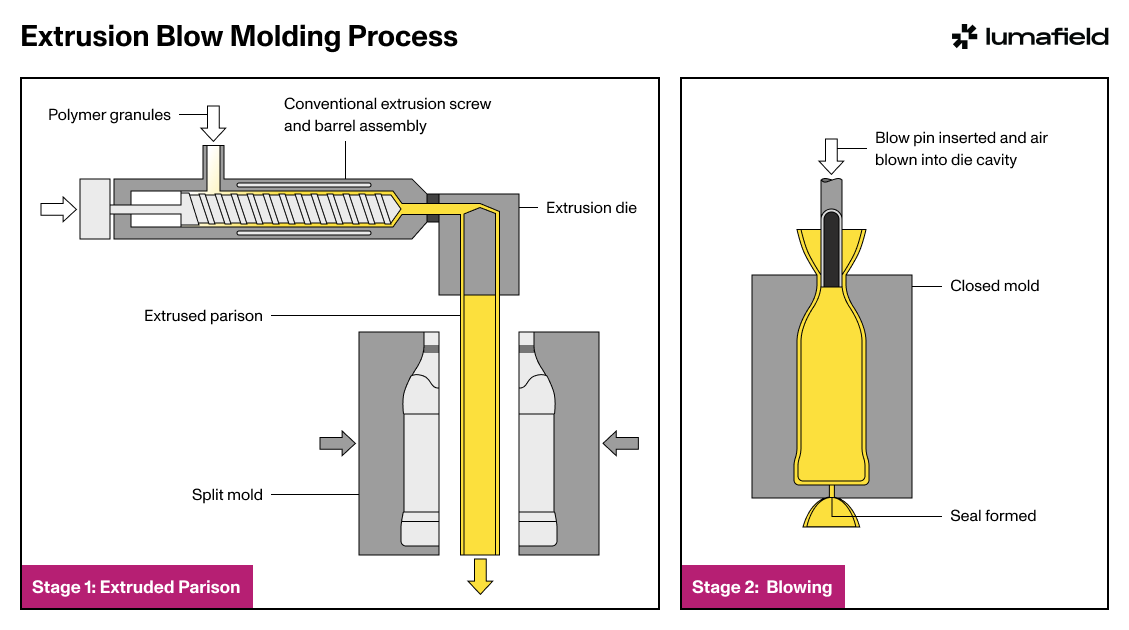
  1. Extruding the Parison: Plastic granules are melted and extruded through a die, forming a continuous, hollow plastic tube known as a parison. The material remains molten and flexible.
  2. Blowing and Forming: A mold clamps around the parison, and a blow pin is inserted at the top. Compressed air expands the parison, pressing it against the mold walls. Simultaneously, the bottom is sealed by pinching the material together.
  3. Demolding: Once the plastic cools and solidifies, the mold opens, and the newly formed part is released. The blow pin is removed, leaving a fully enclosed hollow structure.
  4. Trimming: Excess plastic, known as flash, is removed from the top and bottom using a profiled cutter, ensuring a clean final shape. The finished part is now ready for use or additional processing.

EBM is highly efficient for high-volume production of durable, multi-layer containers with variable wall thickness.

A color heat map visualization of wall thickness in an extrusion blow-molded detergent bottle. The analysis helps detect uneven material distribution, ensuring proper durability while minimizing excess plastic use.
What is Injection Stretch Blow Molding (ISBM)?

Injection Stretch Blow Molding (ISBM) is a high-performance process designed primarily for lightweight, impact-resistant PET bottles, such as water bottles, soda bottles, and juice containers. The key difference in ISBM is that the preform is stretched before blowing, enhancing material strength and clarity.

ISBM bottles are thin-walled, lightweight, and can be either clear or opaque with a well-defined neck and threads. Side seams are generally less visible, and bottles typically show stretch marks or flow lines in the material, indicating the preform was elongated before blowing.

The ISBM process
  1. Injection Molding the Preform: A PET preform is injection-molded with a finished neck and threads.
  2. Stretching and Pre-Blowing: The preform is heated and placed into a stretch-blow mold. A stretch rod extends the preform lengthwise, improving material orientation and increasing tensile strength.
  3. Final Blowing: Compressed air inflates the preform outward against the mold, finalizing the shape while maintaining the stretched structure.
  4. Demolding and Ejection: The mold separates, and the bottle is ejected, ready for filling.

ISBM produces high-strength, lightweight bottles with superior impact resistance and barrier properties, making it the go-to process for carbonated and non-carbonated beverage bottles.

This CT scan shows a thickness heat map of an injection stretch blow-molded PET water bottle, highlighting uniformity and potential weak points. Supplementing wall thickness maps with probed point measurements can be helpful when comparing, calibrating, and sharing analysis results for production consistency.
What is Injection Blow Molding (IBM)?

Injection Blow Molding (IBM) is used for producing small, precise, high-quality bottles, such as pharmaceutical vials, cosmetic containers, and lab bottles. It differs from EBM in that it starts with an injection-molded preform, leading to better dimensional accuracy and a polished surface.

IBM bottles have a smooth, seamless appearance, often with a precise, pre-formed neck and threads. Unlike EBM products, they lack visible side seams because the material is formed inside a closed mold rather than being pinched together.

The IBM process
  1. Injection Molding the Preform: Plastic is melted and injected into a mold to create a preform, a small tube with a finished neck and threads.
  2. Blowing and Expansion: The preform is transferred to a blow mold, where compressed air expands it to the final shape. Because the preform is already solidified, the material distribution is highly controlled.
  3. Stripping and Ejection: Once the part cools, it is removed from the mold. No trimming is required, as IBM does not produce flash or excess plastic.
  4. Final Product: The finished bottle is immediately ready for filling or secondary processing, requiring minimal post-molding adjustments.

IBM produces consistent, high-precision bottles with excellent clarity, making it ideal for medical and cosmetic applications.

A CT-based Wall Thickness Analysis of an injection blow-molded pill bottle reveals variations in material distribution, helping ensure structural integrity and proper sealing. Users can export CSV results from the analysis for further engineering evaluation and process optimization.
Design considerations for blow molding
  • Material Selection: HDPE and PP are common for EBM, while PET dominates ISBM for clarity and strength.
  • Wall Thickness Control: IBM and ISBM ensure uniform thickness, whereas EBM may require trimming.
  • Neck and Thread Precision: IBM and ISBM create high-accuracy necks, crucial for sealing with caps. This also allows companies to source bottles and caps from different sources, and be certain the threads will match up
  • Production Speed and Volume: All three processes enable high-speed, cost-effective production, but EBM excels in large-scale manufacturing of industrial and household containers, while IBM and ISBM provide tighter dimensional control, making them ideal for applications where precision and safety—such as medical vials and beverage bottles—are critical.
How industrial CT can improve blow molding

Industrial CT scanning is an essential tool for non-destructive quality inspection in blow molding.

  • Wall Thickness Analysis: CT scanning provides highly accurate measurements of wall thickness across all blow-molded products, ensuring uniformity, structural integrity, and optimized material usage. This data helps identify weak points that could lead to buckling or failure under load, supports engineering design improvements, and enables material reduction strategies for cost savings and sustainability.
  • Void and Defect Detection: Identifies air pockets, cracks, leaks, or inclusions in containers.
  • Neck and Thread Accuracy: Ensures proper cap fit and sealing integrity for bottles.
  • Preform and Stretch Ratio Evaluation: In ISBM, CT scanning assesses preform symmetry and material distribution, ensuring consistent material orientation for improved durability, stretch ratios, and weight reduction. This helps manufacturers refine heating, stretching, and blowing parameters to enhance bottle performance while minimizing material waste.

By detecting defects early and ensuring precision, CT scanning improves quality, reduces scrap, and enhances manufacturing efficiency.

Better bottles, faster

Blow molding has transformed how industries produce lightweight, durable plastic parts at scale. Whether it’s the high-speed efficiency of Extrusion Blow Molding, the precision of Injection Blow Molding, or the strength and versatility of Injection Stretch Blow Molding, each process plays a vital role in shaping the products we use every day—from detergent bottles to medical vials to beverage containers.

But even the most refined processes have room for improvement. Industrial CT scanning gives manufacturers a deeper level of insight, uncovering hidden defects, optimizing material distribution, and ensuring every part meets exacting standards. By embracing advanced inspection technologies, manufacturers can push the limits of performance, sustainability, and quality in blow-molded products, staying ahead in an ever-evolving market.

Resource
Article

Manufacturing Process: Blow Molding

March 27, 2025
Resource

Manufacturing Process: Blow Molding

Blow molding is a widely used manufacturing process for producing hollow plastic products, including bottles, containers, and industrial components. The process is valued for its ability to create lightweight, durable, and cost-effective parts with minimal material waste.

By inflating heated plastic inside a mold, manufacturers can achieve complex shapes and precise wall thicknesses quickly and at large production volumes. Different blow molding techniques offer varying levels of precision, strength, and flexibility, making each suited to different applications.

The three primary types of blow molding—Extrusion Blow Molding (EBM), Injection Blow Molding (IBM), and Injection Stretch Blow Molding (ISBM)—each offer unique advantages in terms of efficiency, precision, and material properties. While all three methods produce hollow plastic parts, they differ in how the plastic is formed, shaped, and finished, making each process better suited for specific applications ranging from industrial containers to medical vials and beverage bottles.

What is Extrusion Blow Molding (EBM)?

Extrusion Blow Molding (EBM) is the most versatile blow molding method, commonly used for detergent bottles, automotive ducts, industrial drums, and fuel tanks. It’s ideal for larger or more irregularly shaped hollow parts that don’t require extreme precision.

EBM products often have visible seam lines along the sides, where the mold halves met during processing. Many also have a pinch-off mark at the bottom, where excess plastic was trimmed after molding. If the bottle has an open, threaded neck but lacks a separate pre-molded finish, it was likely made using EBM.

The EBM process
‍

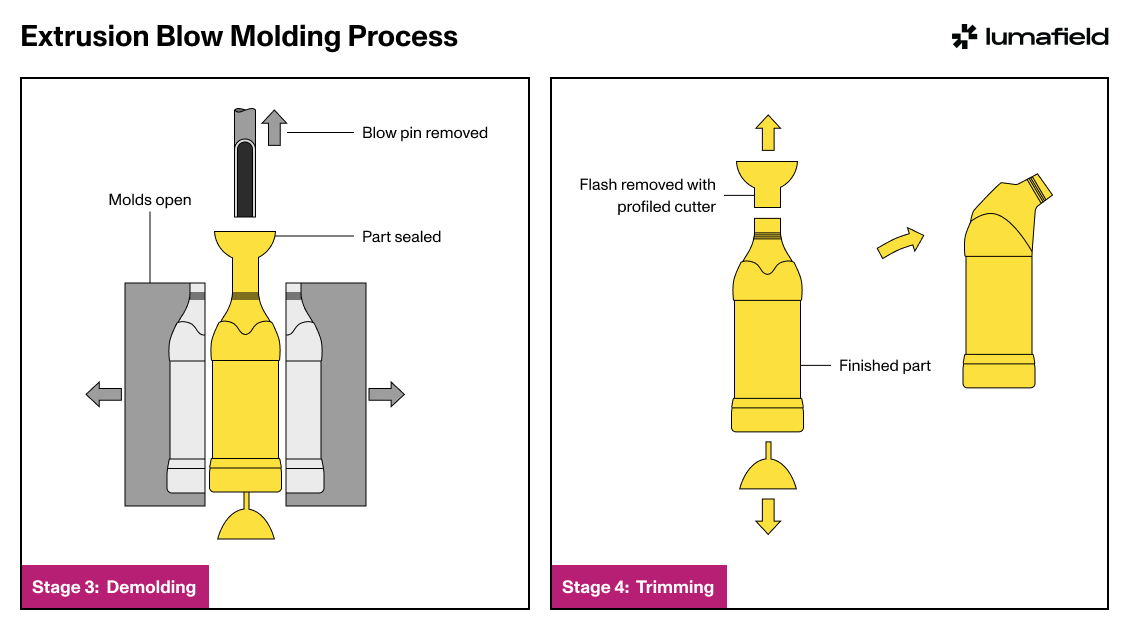
  1. Extruding the Parison: Plastic granules are melted and extruded through a die, forming a continuous, hollow plastic tube known as a parison. The material remains molten and flexible.
  2. Blowing and Forming: A mold clamps around the parison, and a blow pin is inserted at the top. Compressed air expands the parison, pressing it against the mold walls. Simultaneously, the bottom is sealed by pinching the material together.
  3. Demolding: Once the plastic cools and solidifies, the mold opens, and the newly formed part is released. The blow pin is removed, leaving a fully enclosed hollow structure.
  4. Trimming: Excess plastic, known as flash, is removed from the top and bottom using a profiled cutter, ensuring a clean final shape. The finished part is now ready for use or additional processing.

EBM is highly efficient for high-volume production of durable, multi-layer containers with variable wall thickness.
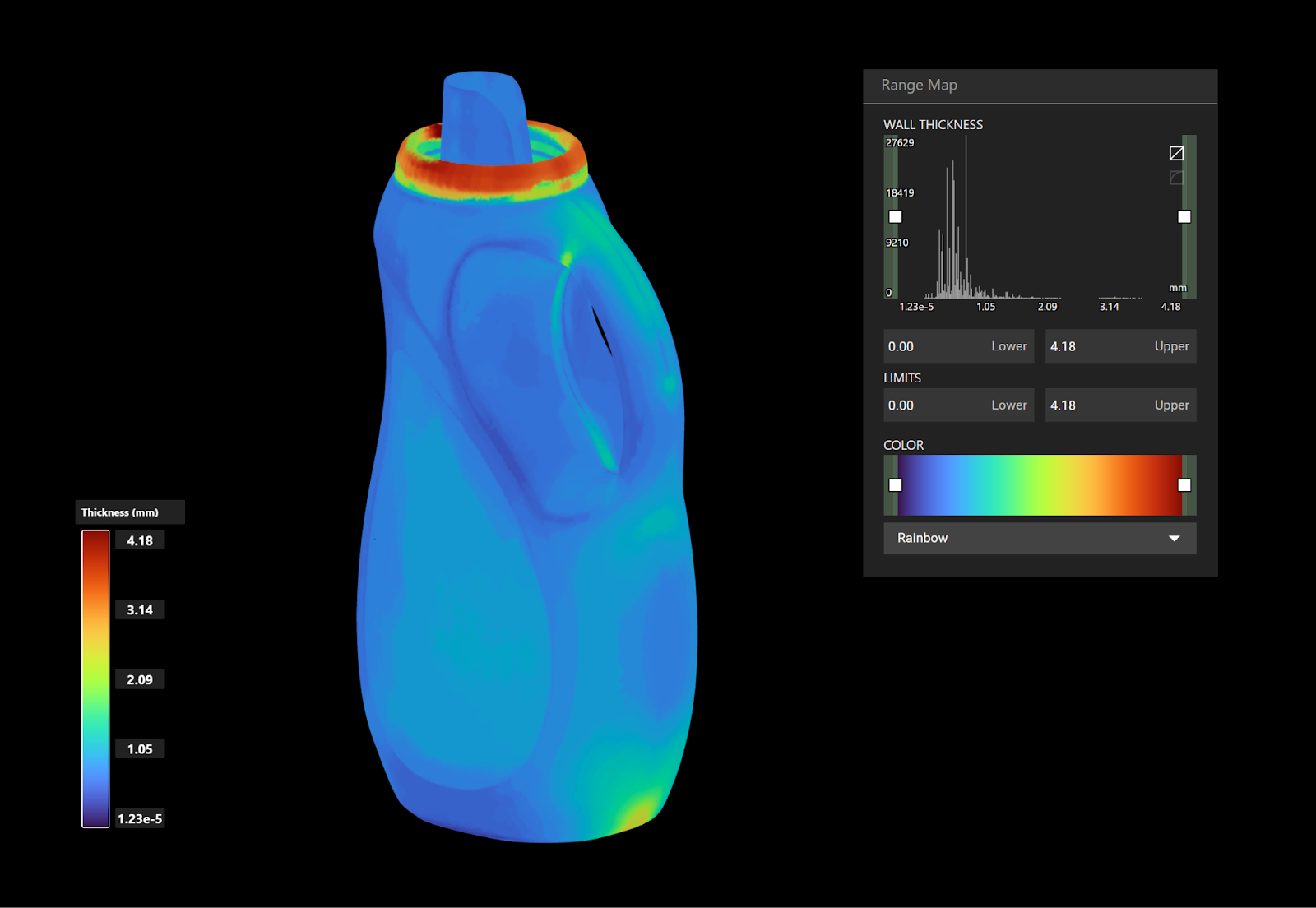
A color heat map visualization of wall thickness in an extrusion blow-molded detergent bottle. The analysis helps detect uneven material distribution, ensuring proper durability while minimizing excess plastic use.
What is Injection Stretch Blow Molding (ISBM)?

Injection Stretch Blow Molding (ISBM) is a high-performance process designed primarily for lightweight, impact-resistant PET bottles, such as water bottles, soda bottles, and juice containers. The key difference in ISBM is that the preform is stretched before blowing, enhancing material strength and clarity.

ISBM bottles are thin-walled, lightweight, and can be either clear or opaque with a well-defined neck and threads. Side seams are generally less visible, and bottles typically show stretch marks or flow lines in the material, indicating the preform was elongated before blowing.

The ISBM process
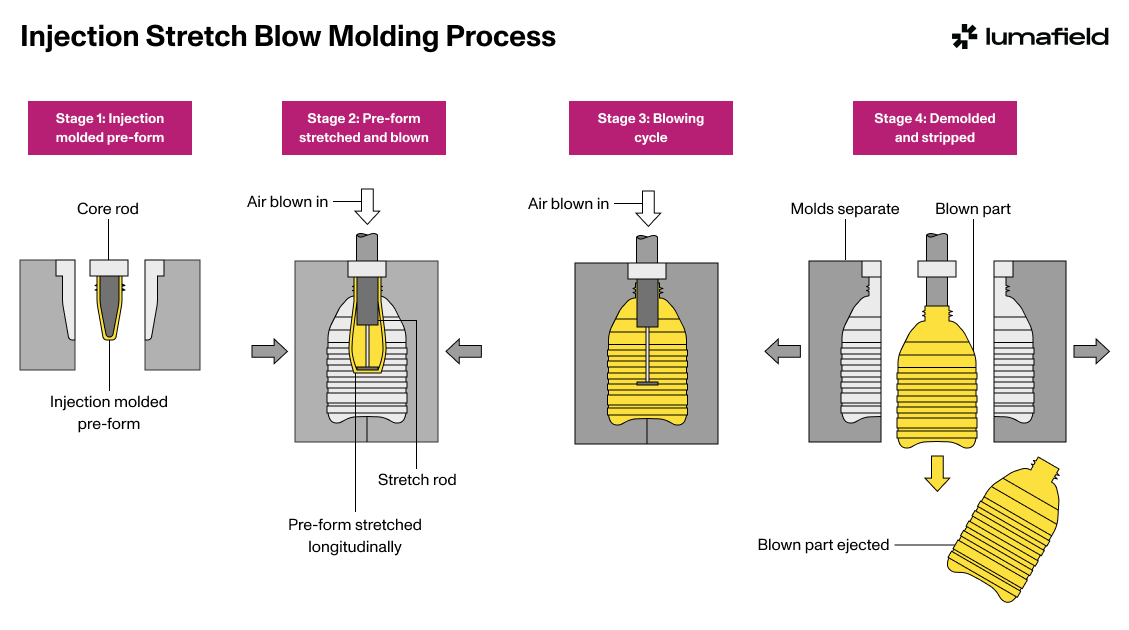
  1. Injection Molding the Preform: A PET preform is injection-molded with a finished neck and threads.
  2. Stretching and Pre-Blowing: The preform is heated and placed into a stretch-blow mold. A stretch rod extends the preform lengthwise, improving material orientation and increasing tensile strength.
  3. Final Blowing: Compressed air inflates the preform outward against the mold, finalizing the shape while maintaining the stretched structure.
  4. Demolding and Ejection: The mold separates, and the bottle is ejected, ready for filling.

ISBM produces high-strength, lightweight bottles with superior impact resistance and barrier properties, making it the go-to process for carbonated and non-carbonated beverage bottles.
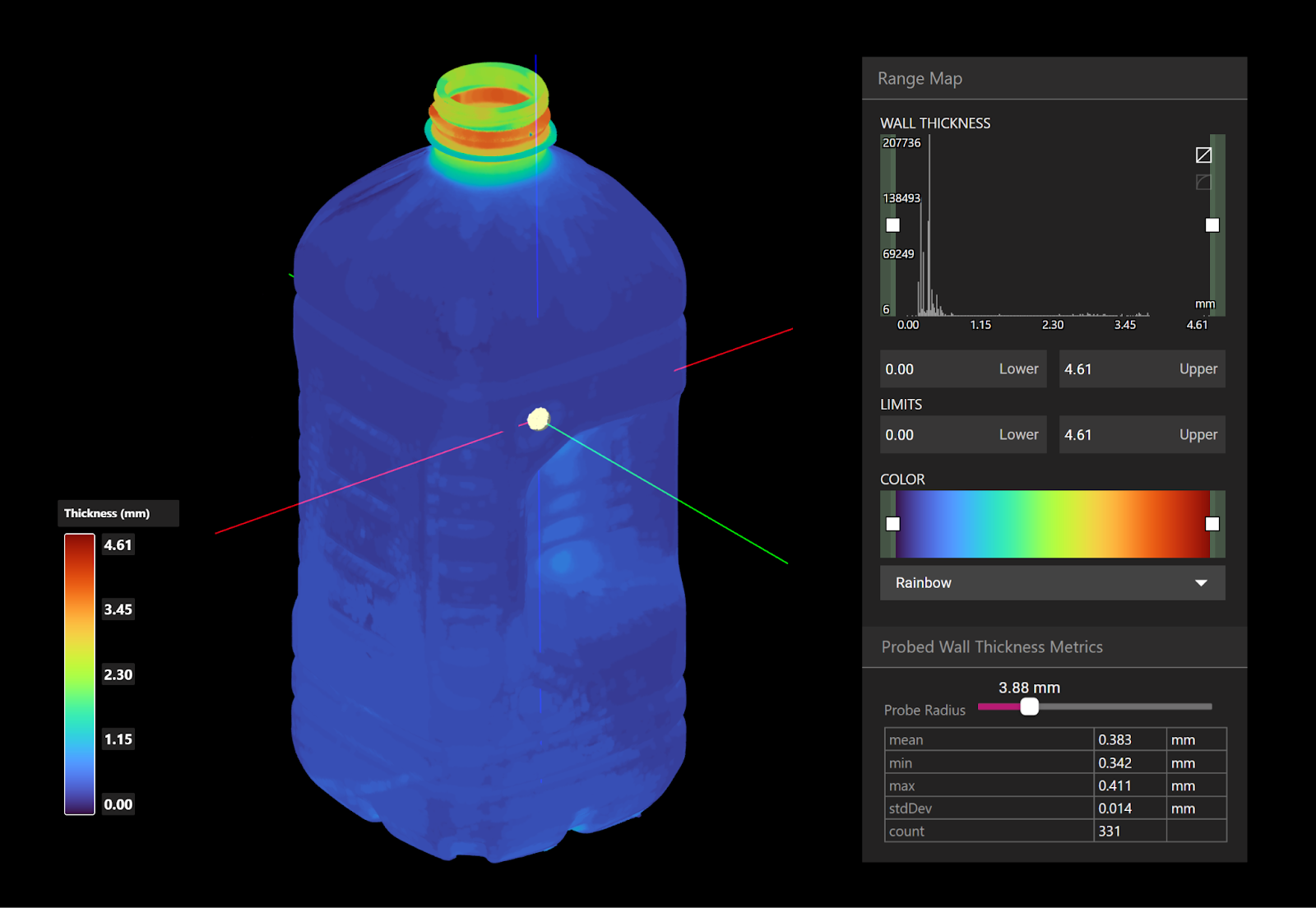
This CT scan shows a thickness heat map of an injection stretch blow-molded PET water bottle, highlighting uniformity and potential weak points. Supplementing wall thickness maps with probed point measurements can be helpful when comparing, calibrating, and sharing analysis results for production consistency.
What is Injection Blow Molding (IBM)?

Injection Blow Molding (IBM) is used for producing small, precise, high-quality bottles, such as pharmaceutical vials, cosmetic containers, and lab bottles. It differs from EBM in that it starts with an injection-molded preform, leading to better dimensional accuracy and a polished surface.

IBM bottles have a smooth, seamless appearance, often with a precise, pre-formed neck and threads. Unlike EBM products, they lack visible side seams because the material is formed inside a closed mold rather than being pinched together.

The IBM process
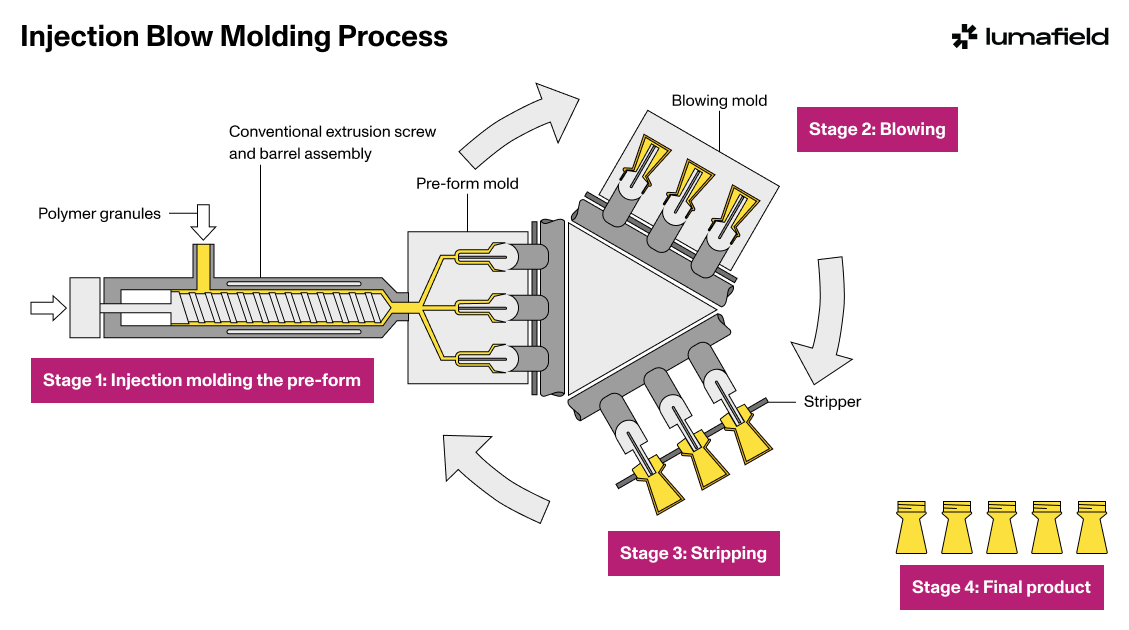
  1. Injection Molding the Preform: Plastic is melted and injected into a mold to create a preform, a small tube with a finished neck and threads.
  2. Blowing and Expansion: The preform is transferred to a blow mold, where compressed air expands it to the final shape. Because the preform is already solidified, the material distribution is highly controlled.
  3. Stripping and Ejection: Once the part cools, it is removed from the mold. No trimming is required, as IBM does not produce flash or excess plastic.
  4. Final Product: The finished bottle is immediately ready for filling or secondary processing, requiring minimal post-molding adjustments.

IBM produces consistent, high-precision bottles with excellent clarity, making it ideal for medical and cosmetic applications.
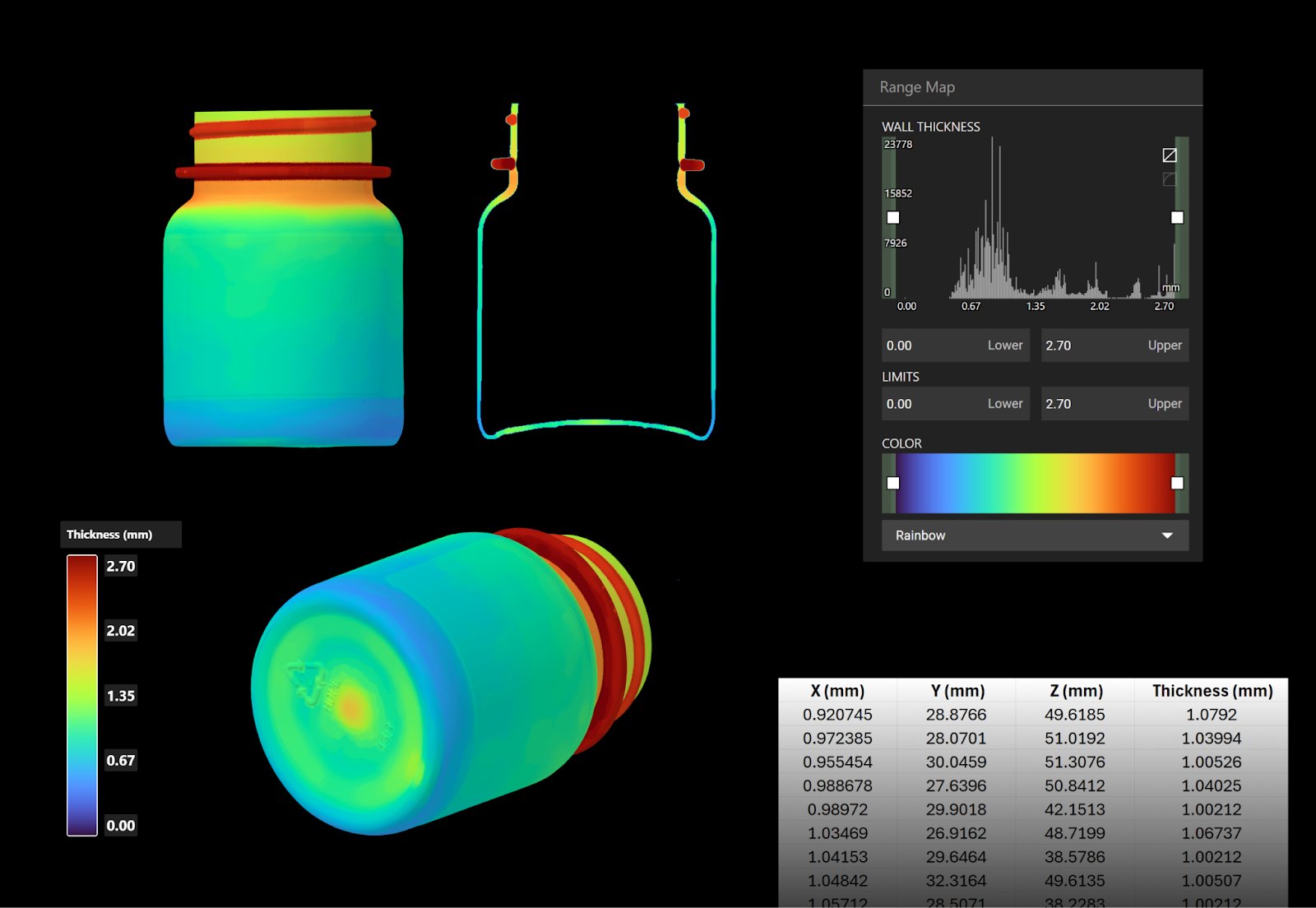
A CT-based Wall Thickness Analysis of an injection blow-molded pill bottle reveals variations in material distribution, helping ensure structural integrity and proper sealing. Users can export CSV results from the analysis for further engineering evaluation and process optimization.
Design considerations for blow molding
  • Material Selection: HDPE and PP are common for EBM, while PET dominates ISBM for clarity and strength.
  • Wall Thickness Control: IBM and ISBM ensure uniform thickness, whereas EBM may require trimming.
  • Neck and Thread Precision: IBM and ISBM create high-accuracy necks, crucial for sealing with caps. This also allows companies to source bottles and caps from different sources, and be certain the threads will match up
  • Production Speed and Volume: All three processes enable high-speed, cost-effective production, but EBM excels in large-scale manufacturing of industrial and household containers, while IBM and ISBM provide tighter dimensional control, making them ideal for applications where precision and safety—such as medical vials and beverage bottles—are critical.
How industrial CT can improve blow molding

Industrial CT scanning is an essential tool for non-destructive quality inspection in blow molding.

  • Wall Thickness Analysis: CT scanning provides highly accurate measurements of wall thickness across all blow-molded products, ensuring uniformity, structural integrity, and optimized material usage. This data helps identify weak points that could lead to buckling or failure under load, supports engineering design improvements, and enables material reduction strategies for cost savings and sustainability.
  • Void and Defect Detection: Identifies air pockets, cracks, leaks, or inclusions in containers.
  • Neck and Thread Accuracy: Ensures proper cap fit and sealing integrity for bottles.
  • Preform and Stretch Ratio Evaluation: In ISBM, CT scanning assesses preform symmetry and material distribution, ensuring consistent material orientation for improved durability, stretch ratios, and weight reduction. This helps manufacturers refine heating, stretching, and blowing parameters to enhance bottle performance while minimizing material waste.

By detecting defects early and ensuring precision, CT scanning improves quality, reduces scrap, and enhances manufacturing efficiency.

Better bottles, faster

Blow molding has transformed how industries produce lightweight, durable plastic parts at scale. Whether it’s the high-speed efficiency of Extrusion Blow Molding, the precision of Injection Blow Molding, or the strength and versatility of Injection Stretch Blow Molding, each process plays a vital role in shaping the products we use every day—from detergent bottles to medical vials to beverage containers.

But even the most refined processes have room for improvement. Industrial CT scanning gives manufacturers a deeper level of insight, uncovering hidden defects, optimizing material distribution, and ensuring every part meets exacting standards. By embracing advanced inspection technologies, manufacturers can push the limits of performance, sustainability, and quality in blow-molded products, staying ahead in an ever-evolving market.

Voyager Inspection Workflows
Introduction to Voyager
Introduction to Neptune
Introduction to Industrial CT
Introducing Mars for 100% Production Inspection
Advancing Automotive Inspection: Industrial CT for Better Outcomes
Introducing Neptune Performance and Triton Performance
Manufacturers Know Quality Costs Money. Most Don't Know How Much.
The Real Cost of a Product Recall and How to Prevent One
What Industrial CT Scanning Does for Manufacturing Quality
Explore more posts
Direkt zum Hauptinhalt
Mars: In-line arrayed X-ray system >
Platform
Branchen
Alle Branchen
Aerospace and Defense
Agriculture and Food
Athletic Equipment
Automotive
Batteries
Consumer Packaged Goods
Electronics
Medical Devices
Applications
Ressourcen
Whitepapers
Ressourcen
Webinare
Blog
Insights from lumafield
Go/No-Go
Manufacturing podcast
First Article
Editorial Publication
Firma
Über
Karriere
Drücken
Events
Starten Sie Voyager
Vertrieb kontaktieren
Speisekarte
ProdukteBranchen
Branchen
Alle Branchen
Medical Devices
Electronics
Consumer Packaged Goods
Automotive
Athletic Equipment
Batteries
Agriculture and Food
Aerospace and Defense
Applications
Ressourcen
Ressourcen
Whitepapers
101. OKTOBER
Webinars
Erster Artikel
Go/No-Go Podcast
First Article
Firma
Firma
Über
Karriere
Drücken
Events
Vertrieb kontaktieren
Starten Sie Voyager
© 2000 Lumafield. All Rights Reserved.
den Weg ändern
die Welt macht
alles
Branchen
Aerospace and Defense
Agriculture and Food
Athletic Equipment
Automotive
Batteries
Consumer Packaged Goods
Electronics
Medical Devices
Alle Branchen
Anwendungen
Assembly Verification
Competitive Benchmarking and Analysis
Defect Detection
Design Verification and Validation
Dimensional Measurement
Failure Analysis
First Article Inspection (FAI)
Material Characterization
Non-Destructive Testing (NDT)
Quality Assurance and Control (QA & QC)
Reverse Engineering
Supplier Qualification
All Applications
Produkte
NeptunTritonVoyagerMarsAtlas
Ressourcen
LernenErster ArtikelWhitepapersEreignisseWebinareUnterstützungFallstudien101. OKTOBERBlog der Ingenieure
Firma
EinloggenÜberKarriereDrückenBlogKontakt

Melde dich für unseren Newsletter an

info@lumafield.com
DatenschutzInformationssicherheitVereinbarung über Bereitstellungsdienste
© 2000 Lumafield. All Rights Reserved.