Point of Entry: Inside the Surgical Trocar Supply Chain
Single-use medical devices are a market worth over $100 billion a year, made in enormous runs, opened once, and thrown away. Many laparoscopic procedures begin with three to five trocars, and the features that decide how each one performs sit inside a sealed assembly where no caliper can reach.
15
trocar models scanned
188
units analyzed
$100 billion
Single-use/disposable medical device market
0.26%
variation observed in machined metal components
1.12%
variation observed for molded plastic components
5.77%
variation observed for cast elastomer components
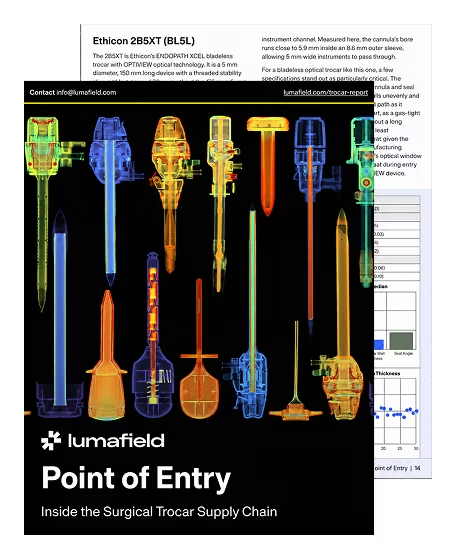
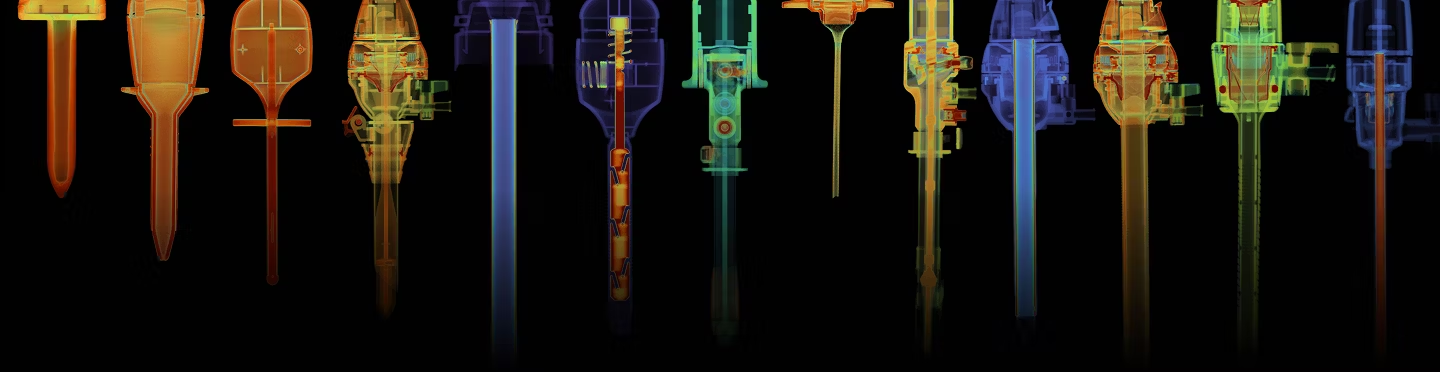
We CT scanned 188 surgical trocars across 15 models from five manufacturers. The set runs from 2 mm miniports to 15 mm thoracic ports and covers bladeless, blunt, optical, radially expanding, balloon, and robotic designs. Most devices were scanned assembled. That let us measure obturator centering, seal wall thickness, and the fit between molded parts in the state a surgeon holds them. Where a model could be bought in quantity, we scanned 10 or 30 units to see how consistent they are from one to the next.
The results sort cleanly by manufacturing process, and they show where storage and assembly leave a mark. Most of the devices came from the secondary market and were past their expiration dates. That makes the study a survey of what is measurable inside this class of device rather than a verdict on any manufacturer. For a team deciding which features to control and inspect, it is a map of where the variation concentrates.
What the scans showed:

Process sets the spread
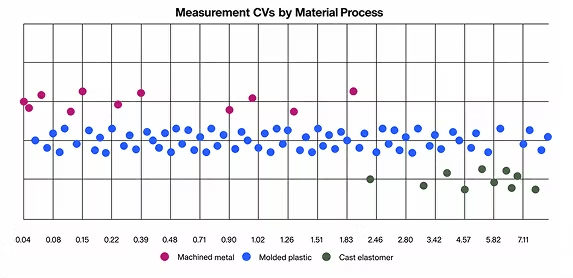
Machined metal varied least, with a median coefficient of variation of 0.26%. Molded plastic followed at 1.12%, and the cast elastomer seals that hold the gas seal on abdominal ports varied most, at 5.77%.

Storage leaves a mark
New units of one thoracic port measured 0.05 to 0.06 mm from flat at the base, while four of seven expired units read 0.37 to 0.52 mm. The sample is small, but it hints at why sealed plastic devices carry expiration dates.

Assembly is harder than molding
On single molded parts, an established brand and a low-cost import landed within 0.02 mm of each other on median concentricity. In two-part assemblies, the import’s worst unit reached 0.35 mm, against a worst case of 0.04 mm for one established-brand port. Every established-brand unit was expired, while the imports were new.
Download Point of Entry to discover:
- How variation compares across machined metal, molded plastic, and cast elastomer features, measured on a common scale across 15 trocar models.
- What CT reveals about devices that have spent years in storage.
- Concentricity data for single molded parts and two-part assemblies, from established manufacturers and low-cost imports.
- Device-by-device results for every model, with annotated scans and key measurements.
See what nondestructive measurement reveals inside an assembled surgical device.