FREE WHITE PAPER

Heading

Date
This is some text inside of a div block.
FREE WHITE PAPER

Heading 1

Heading 2

Heading 3

Heading 4

Heading 5
Heading 6

Lorem ipsum dolor sit amet, consectetur adipiscing elit, sed do eiusmod tempor incididunt ut labore et dolore magna aliqua. Ut enim ad minim veniam, quis nostrud exercitation ullamco laboris nisi ut aliquip ex ea commodo consequat. Duis aute irure dolor in reprehenderit in voluptate velit esse cillum dolore eu fugiat nulla pariatur.

Block quote

Ordered list

  1. Item 1
  2. Item 2
  3. Item 3

Unordered list

  • Item A
  • Item B
  • Item C

Text link

Bold text

Emphasis

Superscript

Subscript

Heading 1

Heading 2

Heading 3

Heading 4

Heading 5
Heading 6

Lorem ipsum dolor sit amet, consectetur adipiscing elit, sed do eiusmod tempor incididunt ut labore et dolore magna aliqua. Ut enim ad minim veniam, quis nostrud exercitation ullamco laboris nisi ut aliquip ex ea commodo consequat. Duis aute irure dolor in reprehenderit in voluptate velit esse cillum dolore eu fugiat nulla pariatur.

Block quote

Ordered list

  1. Item 1
  2. Item 2
  3. Item 3

Unordered list

  • Item A
  • Item B
  • Item C

Text link

Bold text

Emphasis

Superscript

Subscript

Download Resource
Thank you! Your submission has been received!
Oops! Something went wrong while submitting the form.

Looking inside vacuum tubes with Adam Savage

Edited by
Date
November 29, 2022

Adam Savage loves to “peel the curtain back on the world,” and there’s no better way to do that than with an industrial CT scanner. When he wanted to understand a pair of giant vacuum tubes from his collection, Adam and his Tested team visited Lumafield and met Scott Johnston, our co-founder and head of engineering.

Industrial CT uses a series of X-ray images taken from different angles to build a 3D model of an object's external and internal structures. Engineers use the technology to refine their designs and troubleshoot their manufacturing processes for a wide variety of products like medical devices and lithium-ion batteries.

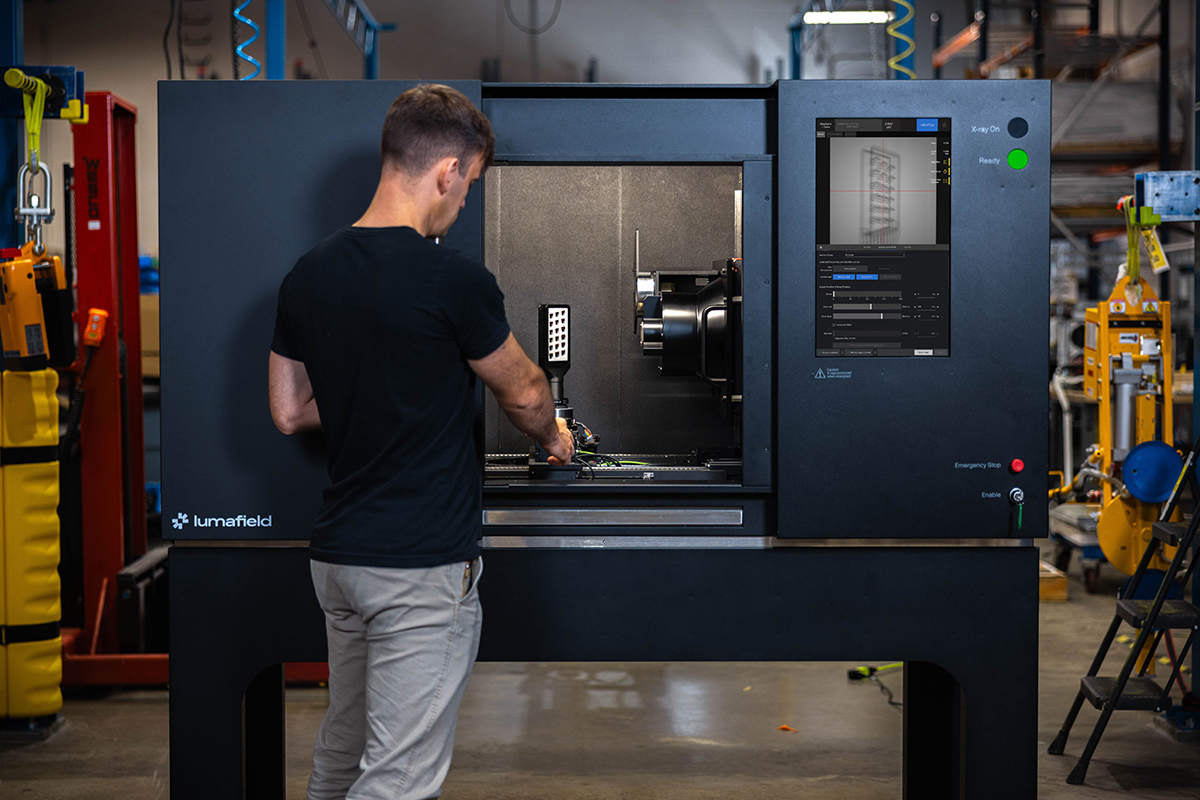
Scott and Adam used our Neptune industrial CT scanner to study two remarkable pieces of analog engineering: a Philips XP3422 photomultiplier and an EEV CX1538 hydrogen tetrode thyratron tube.

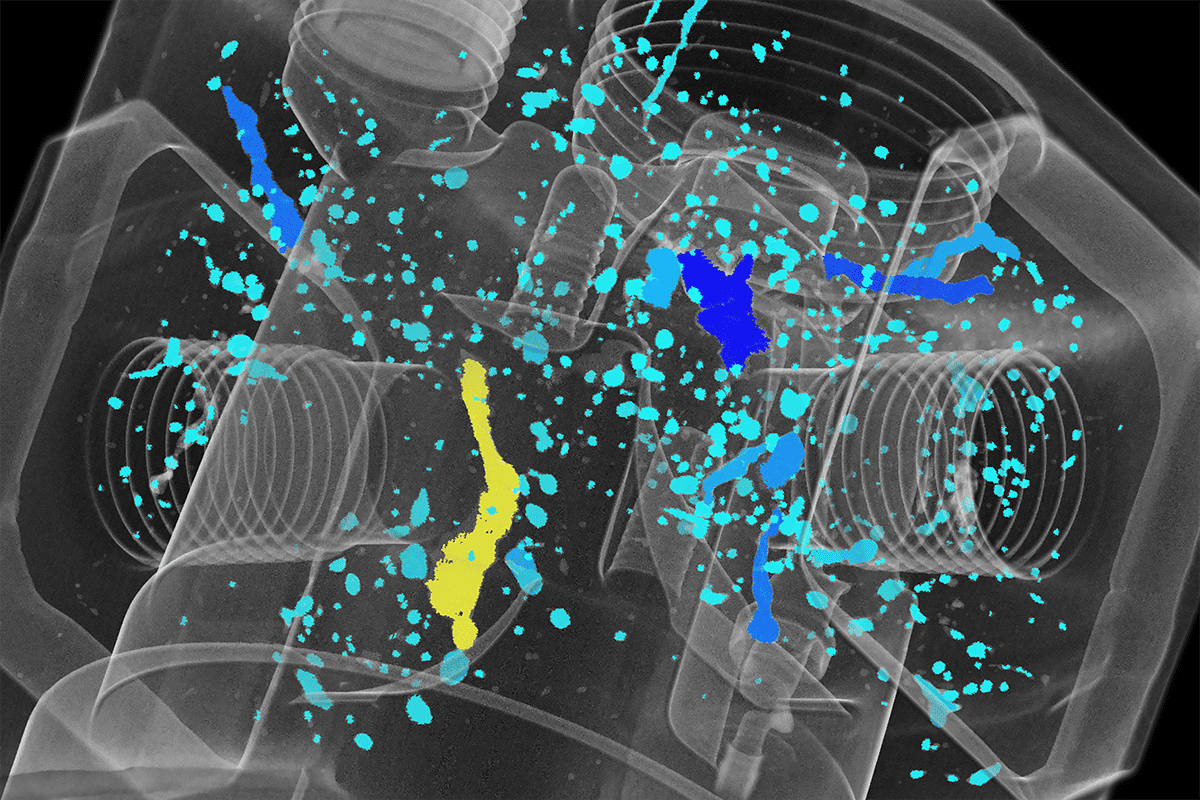
The photomultiplier turns light into a measurable electrical current. It’s a predecessor to the image sensors found in contemporary digital cameras. This one is so sensitive that it can even detect individual photons. Our CT scans illuminate the internal structure of a curved dinode path that multiplies the input photons into electrons until they hit the anode at the back to generate a signal. You can explore the photomultiplier scan in Lumafield's free Voyager software; just create a free account when prompted.

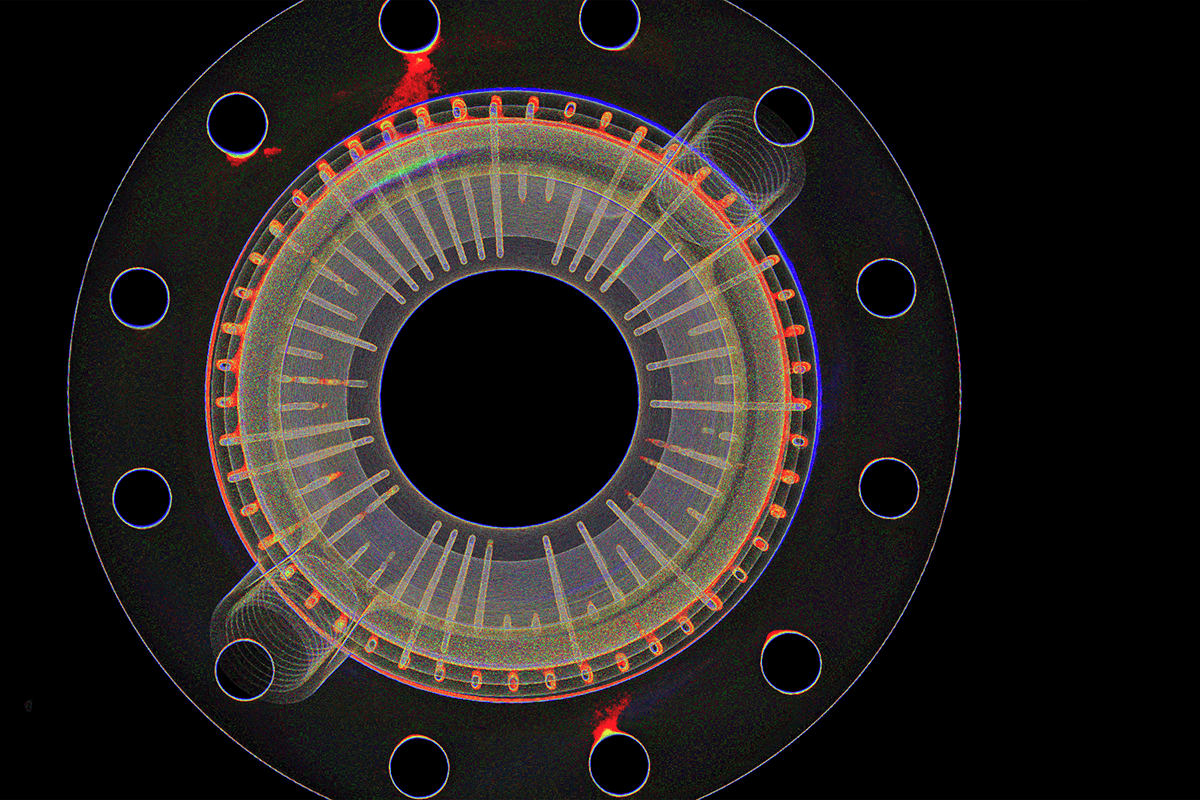
Adam’s powerful thyratron tube is a switch that can handle up to 25,000 volts and 1,000 amps of current. Tubes like this one manage high volumes of energy in pulsed gas lasers and linear accelerators, used in radiation treatment for cancer. Once a tube like this kicks on, it can’t be turned off, and it has to generate its own hydrogen to keep the plasma between the anode and cathode ignited. Lumafield’s scan shows the double helix structure of the all-important cathode, hidden behind a protective shield.

To bring things up to the present, Adam and Scott look inside a more modern power element, a switch module with a pair of IGBTs (Insulated Gate Bi-polar Transistors) optimized for heat extraction. Along the way, they also explore one of Scott’s favorite scans, a 3D printed shoe.

In everything from exotic electronics to shoes, industrial CT helps engineers take their designs to the next level and streamline manufacturing. It's also a fascinating way to pull back the curtain and gain a deeper understanding of the world around us.

Watch the video

‍

Explore the scans and learn more

Industrial CT can help engineers in any industry perfect their products. Want to learn more? Watch our videos on medical devices and lithium-ion batteries to see how industrial CT catches small issues before they become big problems. If you're interested in exploring industrial CT for your application, contact us!

‍

Article
Article

Looking inside vacuum tubes with Adam Savage

November 29, 2022
Article

Looking inside vacuum tubes with Adam Savage

Adam Savage loves to “peel the curtain back on the world,” and there’s no better way to do that than with an industrial CT scanner. When he wanted to understand a pair of giant vacuum tubes from his collection, Adam and his Tested team visited Lumafield and met Scott Johnston, our co-founder and head of engineering.

Industrial CT uses a series of X-ray images taken from different angles to build a 3D model of an object's external and internal structures. Engineers use the technology to refine their designs and troubleshoot their manufacturing processes for a wide variety of products like medical devices and lithium-ion batteries.

Scott and Adam used our Neptune industrial CT scanner to study two remarkable pieces of analog engineering: a Philips XP3422 photomultiplier and an EEV CX1538 hydrogen tetrode thyratron tube.

The photomultiplier turns light into a measurable electrical current. It’s a predecessor to the image sensors found in contemporary digital cameras. This one is so sensitive that it can even detect individual photons. Our CT scans illuminate the internal structure of a curved dinode path that multiplies the input photons into electrons until they hit the anode at the back to generate a signal. You can explore the photomultiplier scan in Lumafield's free Voyager software; just create a free account when prompted.

Adam’s powerful thyratron tube is a switch that can handle up to 25,000 volts and 1,000 amps of current. Tubes like this one manage high volumes of energy in pulsed gas lasers and linear accelerators, used in radiation treatment for cancer. Once a tube like this kicks on, it can’t be turned off, and it has to generate its own hydrogen to keep the plasma between the anode and cathode ignited. Lumafield’s scan shows the double helix structure of the all-important cathode, hidden behind a protective shield.

To bring things up to the present, Adam and Scott look inside a more modern power element, a switch module with a pair of IGBTs (Insulated Gate Bi-polar Transistors) optimized for heat extraction. Along the way, they also explore one of Scott’s favorite scans, a 3D printed shoe.

In everything from exotic electronics to shoes, industrial CT helps engineers take their designs to the next level and streamline manufacturing. It's also a fascinating way to pull back the curtain and gain a deeper understanding of the world around us.

Watch the video

‍

Explore the scans and learn more

Industrial CT can help engineers in any industry perfect their products. Want to learn more? Watch our videos on medical devices and lithium-ion batteries to see how industrial CT catches small issues before they become big problems. If you're interested in exploring industrial CT for your application, contact us!

‍

Voyager Inspection Workflows
Introduction to Voyager
Introduction to Neptune
Introduction to Industrial CT
Introducing Mars for 100% Production Inspection
Advancing Automotive Inspection: Industrial CT for Better Outcomes
Introducing Neptune Performance and Triton Performance
Manufacturers Know Quality Costs Money. Most Don't Know How Much.
The Real Cost of a Product Recall and How to Prevent One
What Industrial CT Scanning Does for Manufacturing Quality
Explore more posts
Direkt zum Hauptinhalt
Mars: In-line arrayed X-ray system >
Platform
Branchen
Alle Branchen
Aerospace and Defense
Agriculture and Food
Athletic Equipment
Automotive
Batteries
Consumer Packaged Goods
Electronics
Medical Devices
Applications
Ressourcen
Whitepapers
Ressourcen
Webinare
Blog
Insights from lumafield
Go/No-Go
Manufacturing podcast
First Article
Editorial Publication
Firma
Über
Karriere
Drücken
Events
Starten Sie Voyager
Vertrieb kontaktieren
Speisekarte
ProdukteBranchen
Branchen
Alle Branchen
Medical Devices
Electronics
Consumer Packaged Goods
Automotive
Athletic Equipment
Batteries
Agriculture and Food
Aerospace and Defense
Applications
Ressourcen
Ressourcen
Whitepapers
101. OKTOBER
Webinars
Erster Artikel
Go/No-Go Podcast
First Article
Firma
Firma
Über
Karriere
Drücken
Events
Vertrieb kontaktieren
Starten Sie Voyager
© 2000 Lumafield. All Rights Reserved.
den Weg ändern
die Welt macht
alles
Branchen
Aerospace and Defense
Agriculture and Food
Athletic Equipment
Automotive
Batteries
Consumer Packaged Goods
Electronics
Medical Devices
Alle Branchen
Anwendungen
Assembly Verification
Competitive Benchmarking and Analysis
Defect Detection
Design Verification and Validation
Dimensional Measurement
Failure Analysis
First Article Inspection (FAI)
Material Characterization
Non-Destructive Testing (NDT)
Quality Assurance and Control (QA & QC)
Reverse Engineering
Supplier Qualification
All Applications
Produkte
NeptunTritonVoyagerMarsAtlas
Ressourcen
LernenErster ArtikelWhitepapersEreignisseWebinareUnterstützungFallstudien101. OKTOBERBlog der Ingenieure
Firma
EinloggenÜberKarriereDrückenBlogKontakt

Melde dich für unseren Newsletter an

info@lumafield.com
DatenschutzInformationssicherheitVereinbarung über Bereitstellungsdienste
© 2000 Lumafield. All Rights Reserved.