





Every storage format is a physical answer to the same question: how do you keep a pattern intact long enough to read it back? The pattern might be a magnetic domain, a charge trapped in a transistor, or a pit pressed into polycarbonate. The material it lives in determines how dense the storage can be, how long it lasts, how fast it can be read, and whether the format survives contact with a dusty shelf, a power outage, or a decade of neglect.
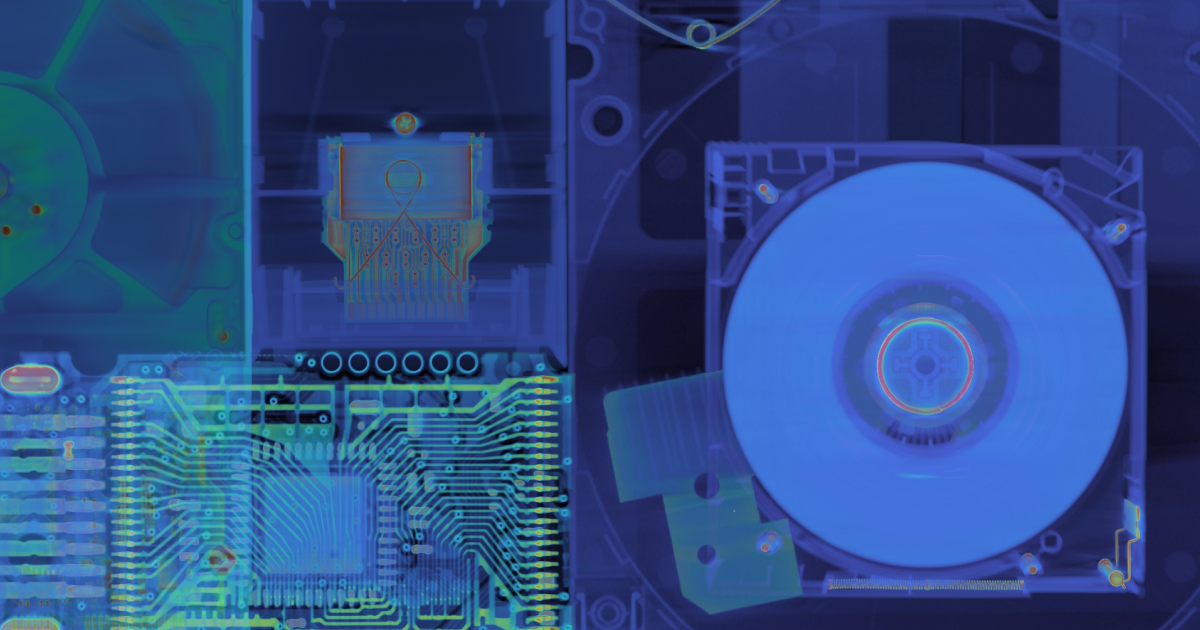
We CT scanned five formats that shaped how computing stores information. The scans reveal what the outside doesn't: layer counts, mechanical tolerances, material boundaries, and the engineering decisions that separate a format that lasted two years from one that is still setting shipment records in 2025.
Magnetic tape
Tape looks like the wrong answer until you understand what it's optimizing for. A PET film substrate, coated in magnetic particles, written to by aligning domains with a read/write head. Sequential access only. No random reads. The mechanism is simple enough to have worked in mainrooms in the 1950s and in cassette-based home computers in the 1980s, where machines like the VIC-20 stored data as modulated audio tones at around 50 bytes per second.
What kept tape alive while every other format on this list faded is the physics of the coating itself. Magnetic particle density has kept climbing. LTO-9 cartridges hold up to 45 terabytes compressed, and cartridges retain data for up to 30 years under the right conditions. The cartridge, once written and ejected, uses no power and remains offline, physically disconnected from any network. That air gap, which looked like a limitation in the era of always-on storage, turns out to be a significant security property in the era of ransomware. As IBM's Mark Lantz has noted, the technology hasn't been frozen in time. In 2024, LTO shipments hit a record 176.5 exabytes, 15.4% growth over 2023, the fourth consecutive year of records. Amazon, Google, and CERN rely on it for long-term archival. The material never stopped being right for the job.
Floppy disks
The floppy's design story is mostly about the enclosure catching up to the media. The original 8-inch disk, introduced in 1971, was physically floppy: a magnetic-coated polyester film disc in a paper sleeve, vulnerable to contamination and handling damage. By the late 1970s the 5.25-inch format had reduced size and added a stiffer sleeve. The 3.5-inch disk, which arrived in the 1980s and remained in common use into the early 2000s, finally solved the enclosure problem properly.
The CT scan shows what made the 3.5-inch format work: a rigid polycarbonate shell, a spring-loaded metal shutter that closes automatically when the disk is ejected, and a precise read-write aperture with minimal clearance between moving parts. The magnetic film inside is the same basic material as earlier formats. The engineering that extended the format's useful life was entirely in the housing. The disk stayed the same. The protection around it got better.
Iomega's Zip and PocketZip formats attempted to extend this logic further, reaching 750 megabytes and 40 megabytes respectively by packing more surface area into a cartridge that handled like an oversized floppy. Alignment issues and media wear cut that effort short, and USB flash drives made the entire category obsolete within a few years.
ROM cartridges
ROM cartridges solved a different problem than magnetic storage: they needed to be read, not written to, and they needed to survive thousands of insertions into consumer hardware. Mask ROM chips, used in consoles like the Atari 2600 and the Nintendo Entertainment System, held program data burned in at fabrication. There were no moving parts, no magnetic coatings, nothing to degrade.
The scan shows the architecture clearly: a ROM chip mounted directly to a PCB, clean solder joints, and precisely spaced edge connectors designed to mate with spring-loaded contacts in the console slot and maintain electrical contact through repeated use. The simplicity is the point. A cartridge that holds data in silicon and connects through a physical edge connector has almost nothing that can fail.
The ritual of blowing into cartridges to fix loading failures is worth noting here. It was ineffective and often counterproductive: moisture from breath could corrode the gold or nickel-plated contacts over time. The actual failure mode was oxide buildup on the connector surfaces, which a cleaning kit addressed far better than a breath. The cartridge was more reliable than its reputation suggested. What failed was the connector interface, not the storage medium itself.
Magneto-optical discs
Magneto-optical storage is the most mechanically complex format on this list. Writing requires two simultaneous physical processes: a laser heats a spot on the ferromagnetic recording layer to its Curie point, at which magnetic coercivity drops to near zero, and a magnetic write head on the opposite side of the disc sets the domain orientation at that moment. Reading uses a lower-power laser and detects the polarization shift that occurs when polarized light reflects from a magnetized surface, an effect called Kerr rotation.
The 3.5-inch MO cartridge appeared in 1991 with capacities from 128 MB up to 1.3 GB, and the format became a trusted medium in enterprise archives for legal, medical, and media libraries. The CT scan shows why: a thick ferromagnetic recording layer enclosed in a robust polycarbonate cartridge, with a precisely toleranced guide system for laser alignment and careful spacing for the write head. The cartridge physically protects the media surface from dust and fingerprints. The write-verify cycle, which confirmed data integrity after every write, made it among the most reliable rewritable media available before affordable CD-R arrived. That reliability came at a cost in write speed, and once writable optical formats became cheap enough, the economic case for the complexity disappeared.
Hard drives and solid-state storage
Hard drives hold data on aluminum or glass platters coated in a cobalt alloy film. Read/write heads hover nanometers above the platter surface, floating on a thin cushion of air generated by the disc's rotation, and flip magnetic domains as the platters spin at 5,400 or 7,200 RPM. Multi-platter configurations multiply capacity by stacking surfaces. It is the most mechanically elaborate format in everyday use, and that mechanism is the source of its vulnerability: shock, vibration, and wear all eventually reach the heads.
Solid-state drives replace that mechanism with NAND flash memory, where floating-gate transistors retain charge without power. The scan of a Lite-On SSD shows NAND packages arranged around a central controller, with dense surface-mount components and multilayer routing on a board with no moving parts. The controller manages wear leveling, data distribution, and error correction across the flash cells. NVMe models route data directly over PCIe, reaching transfer speeds beyond 7 GB/s. Five years of reliability data from Backblaze show that SSDs fail far less often than hard drives over time. The tradeoff is cost per terabyte, which remains substantially higher than either hard drive or tape at scale.
What the formats share
Looking across all five formats, the engineering logic is consistent. Each one reached its practical limits not when the storage mechanism failed but when the surrounding constraints changed: a faster, cheaper alternative arrived, or a use case the format wasn't designed for became dominant. Tape survived because the constraints it was designed for, density, offline durability, and cost at scale, turned out to matter more over time, not less. ROM cartridges survive in industrial and embedded applications for the same reason: nothing fails. MO discs disappeared when the reliability premium they offered stopped justifying their cost.
The material inside each format encodes those tradeoffs as precisely as the data it stores.