



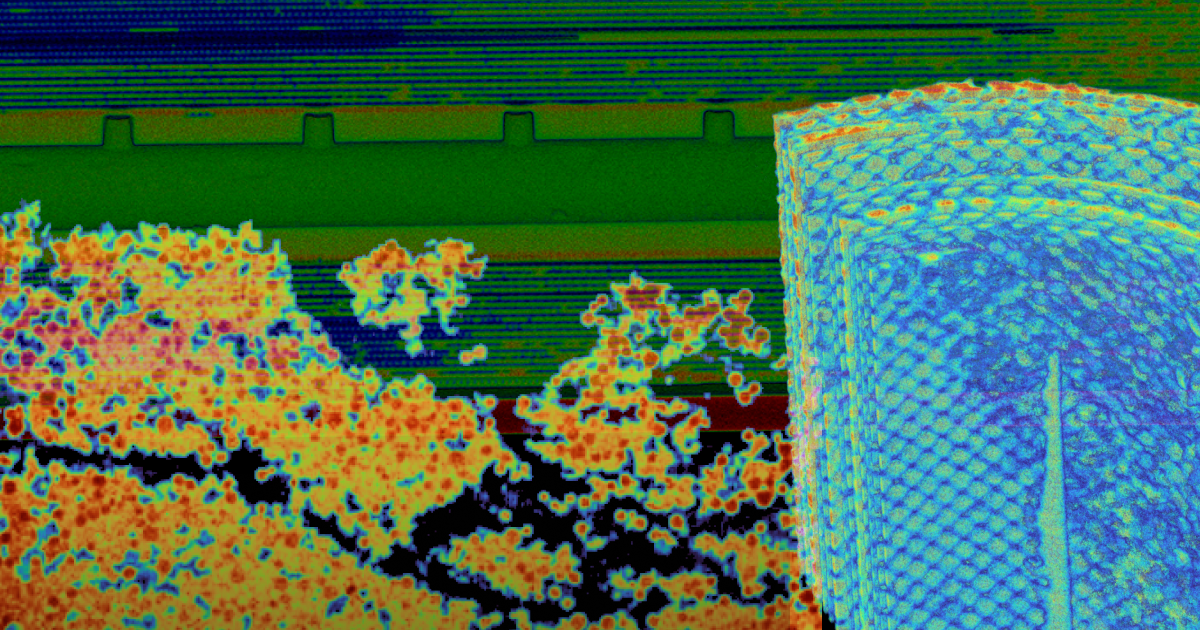


Most people replace their water filters according to the manufacturer's schedule, or when they remember to, or when the indicator light turns red. Very few replace them because they have seen what happens inside a filter over time. That gap between recommended practice and informed decision is exactly what these scans address.
We CT scanned four types of water filters, a Brita pitcher filter, a refrigerator filter, a reverse osmosis membrane, and a LifeStraw, before and after extended use. The before-and-after comparison shows something that no filter packaging communicates: what a filter actually looks like when it is working, and what it looks like when it is done.
What CT shows that a filter test can't
Filter certifications from NSF International are the standard most consumers encounter on packaging. NSF/ANSI 53 covers health-related contaminants like lead, cysts, and volatile organic compounds. NSF/ANSI 58 covers reverse osmosis systems. NSF/ANSI 42 covers aesthetic improvements like chlorine taste and odor. These certifications test performance at the beginning of a filter's rated life under controlled conditions.
What they don't show is what happens inside a filter as it accumulates contaminants over weeks and months of real-world use. CT scanning fills that gap. By rotating the X-ray source around the object and reconstructing a three-dimensional density map, it produces a model you can slice in any plane and analyze for both geometry and material density. A denser area means more mass in that location, and in a water filter, more mass means more accumulated contaminants.
Pitcher water filters
A new Brita filter in CT shows a porous, uniform core of activated carbon and ion-exchange resin. The activated carbon traps chlorine, sediment, and some heavy metals through adsorption: contaminants adhere to the enormous surface area of the carbon particles as water passes through. The ion-exchange resin works differently, attracting specific ions and substituting less harmful ones in their place.

The used filter tells a different story. Flow channels have formed through the media, defined paths where water has repeatedly followed the same route through the cartridge. That preferential flow matters: water moving through established channels bypasses the full filter media, reducing contact time with the carbon and limiting how thoroughly contaminants get captured. Denser particles have also migrated toward the outer edges of the core, visible evidence of accumulated sediment strained from the water supply over time.
Lumafield's inclusion analysis tool isolates the densest material in the scan and highlights it as distinct specks against the surrounding media. The filter's accumulated load is visible. So is the fact that its remaining capacity is uneven across the cartridge.
Refrigerator water filters
Refrigerator filters use a dense activated carbon core enclosed in a plastic housing, connected directly to a water line. They filter continuously rather than in batches, and most manufacturers recommend replacement every six months.
The new filter scan shows the plastic casing as the densest element, with the carbon core registering as less dense and more porous. In the used filter, left in service for more than two years, that relationship has reversed. The carbon core has become markedly denser than the outer shell as it absorbed contaminants day after day. The filter media has changed its material properties in a way that is entirely invisible from the outside.

The water's flow pattern is also visible in the used filter: water enters along the outer edges of the cartridge, passes through the carbon medium toward a central channel, and exits toward the ice maker. That flow geometry is embedded in the structure of the used media in a way that is absent in the new one.
Reverse osmosis water filters
Reverse osmosis filters operate on a different principle than activated carbon. A semi-permeable membrane, wound in tight spiral layers, forces water molecules through microscopic pores while blocking dissolved contaminants including salts, minerals, and many chemicals. The new scan looks almost like a lithium-ion battery cross-section: clean, regular, tightly wound layers surrounding a central core, with clear pathways for water to move through the membrane structure.

We worked with the GEAR Lab at MIT to run this filter for two months on a hard water supply high in mineral content, alternating 12 hours on and 12 hours off, then scanned it again. The used membrane shows visible scaling deposits throughout the wound layers. Minerals that precipitated out of solution as water passed through the membrane have accumulated in the gaps between layers, partially blocking the pores and restricting flow. The geometry that was open and regular in the new scan is interrupted and dense in the used one. This is what reduced filtration efficiency looks like from the inside.
Reverse osmosis is also the most effective filter type for PFAS, the so-called forever chemicals that the EPA established its first national drinking water standard for in April 2024, removing 95 to 99 percent of PFAS across chain lengths where activated carbon performance is more variable.
LifeStraw
The LifeStraw uses hollow fiber membranes rather than activated carbon or a semi-permeable membrane. Microscopic pores in the fiber walls physically block bacteria, parasites, and microplastics while allowing water molecules through. It requires no electricity and no installation, which makes it the filter of choice for field use, emergency preparedness, and travel in areas where water quality is unreliable.

The new LifeStraw scan shows open, uniform hollow fibers throughout the membrane. The used scan shows the degradation pattern specific to this filter type: clogging begins at the inlet end, where water and its suspended contaminants first contact the membrane, and progresses inward. The fibers near the inlet are visibly more restricted than those further along the flow path. That progressive clogging explains why backflushing, blowing air through the filter from the outlet end, is the recommended maintenance step for restoring flow rate. It physically dislodges the accumulated debris from the inlet fibers.
Recommendations exist for a reason
NSF certifications test performance at the start of a filter's rated life under laboratory conditions. What the scans show is that real-world performance depends on what is actually in your water, how much water has run through the filter, and whether the specific degradation mode of that filter type has begun to compromise effectiveness.
The refrigerator filter left in service for two years had clearly exceeded its useful life in ways that were invisible from the outside. The reverse osmosis membrane showed mineral scaling that restricts flow before the membrane's rated life was reached. The Brita filter showed flow channeling that limits contact with the full filter media. None of these conditions are detectable by looking at the filter, smelling the water, or waiting for an indicator light.
The standard recommendation, replace filters on schedule, is the right advice for exactly this reason. The scans show what is at stake when you don't.