






There are many things worse than being woken up by a false smoke alarm, but in the moment, alarms blaring and the recorded voice reciting “fire, fire” at three in the morning, it’s hard to keep things in perspective. You think you’ve solved it, but it happens again not even an hour later, and as all the alarms are interconnected it’s a horrible game of whack-a-mole. I’m traumatized, the cat’s traumatized, and I’ve ripped the smoke detectors off the ceiling to CT scan them.
My home was remodeled just a couple of years ago, and the smoke alarms had been going off periodically, but twice in one morning was just too much. In my efforts to understand what was happening I learned a bit about modern smoke alarm regulation. These smoke alarms weren’t the kind I remembered from my previous homes, where, if annoyed, you could just pull out the battery and disable the thing. That behavior is, of course, extremely unsafe, and it’s exactly what current regulations are trying to prevent. In California, smoke alarms must comply with the National Fire Protection Association (NFPA) 72 section R314, and that carbon monoxide alarms comply with R315. The major requirements are that devices should be hardwired, interconnected so they all sound if one is triggered, and all newly installed smoke alarms should have a ten-year battery.
I noticed that whoever remodeled my home must’ve bought a grab-bag of random devices from Kidde. All of the alarms in my home are one brand, but there are four different models spread throughout, differing in whether they use AA, 9V alkaline, or 10-year non-removable lithium-ion batteries for backup power. My first thought was to just replace all the smoke alarms in my house, suspecting a better brand must be out there. But I quickly learned that for hardwired smoke alarms the only viable alternative is Resideo, which owns the BRK and First Alert brands. And among those of us who have been rudely disturbed at odd hours and find ourselves on Reddit, a deep hatred of both manufacturers can be found. Perhaps given the duopoly nature of the hardwired smoke alarm device space, I got the sense that one just has to accept a certain level of misery.
In the various Reddit threads, and some assorted electrician/handyman Facebook discussions, I found one brand that people seemed to have better experiences with — a Chinese brand called X-Sense. I immediately ordered one on Amazon, to scan and consider installing in my home. I also removed and scanned the two Kidde units I suspected were my primary troublemakers.
Let’s take a look at the scans.

Inside the alarms
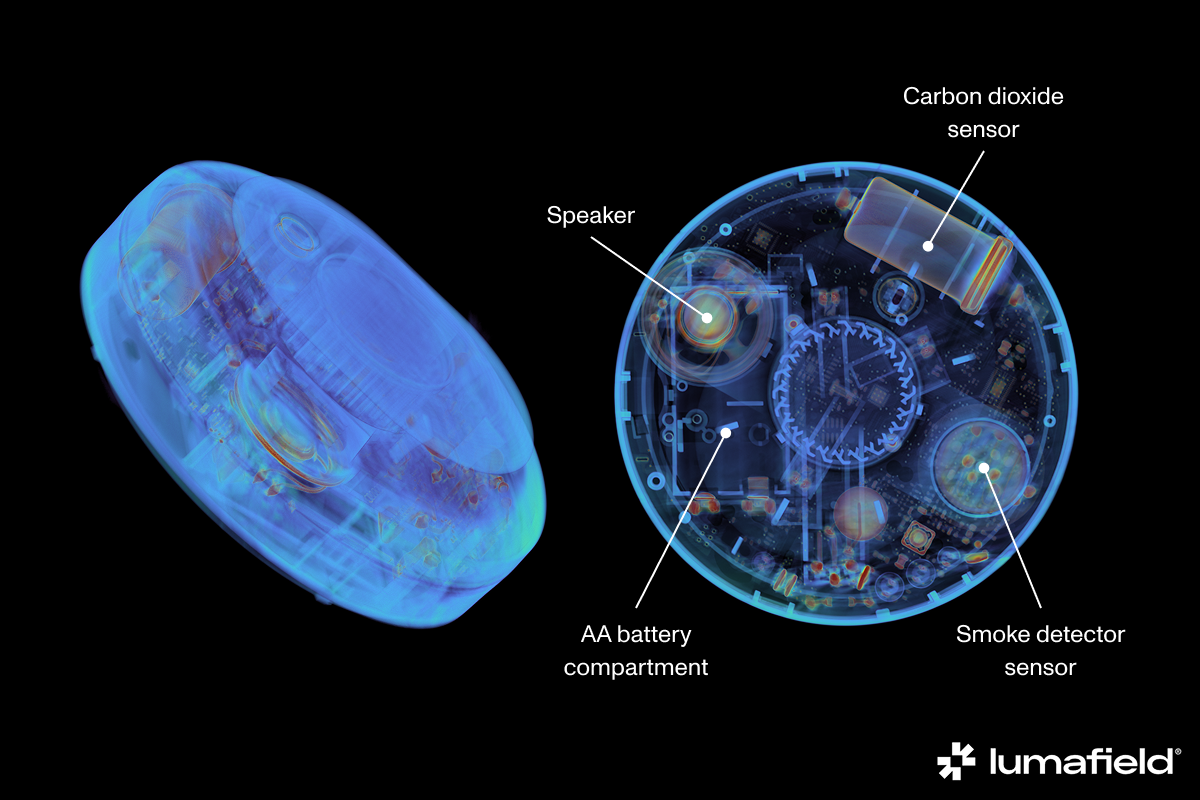
First up, we have the Kidde Model 900-CUAR-V Combination photoelectronic Smoke/CO Alarm with Voice, AA battery backup. When I removed the device, the underside said to replace the batteries every year. The plastic grid on this thing is pretty wide, so it’s conceivable a gnat crawled in there, but the metal in the scan might make it hard to see any potential low-density contamination. Truthfully, the one-year battery replacement warning seems a very likely potential cause of the false alarm behavior.
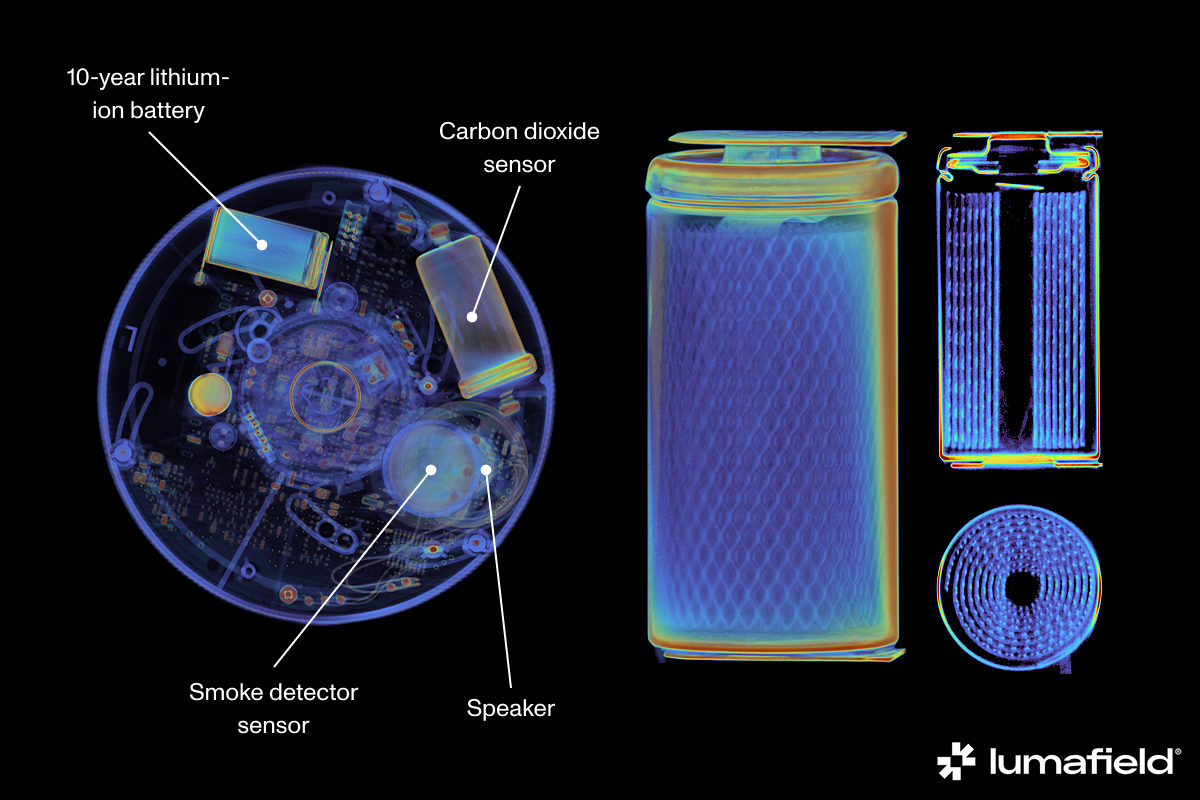
Next, I scanned the Kidde Model P4010ACSCO Multi-Criteria Photoelectric Smoke/CO Alarm with Voice. This unit has a ten year battery. The battery features a mesh structure within the wound active material. This structure is the current collector, which functions as a support scaffold for the electrodes. The mesh, usually copper or nickel, is embedded in the lithium electrode to extend the battery’s lifespan. This type of battery structure can be found in other industrial and infrastructure sensing applications that require long-term monitoring.
In terms of the opening, the device has a finer metal mesh around its outer circumference which may help keep insects out, though it’s unclear whether it does anything for dust.
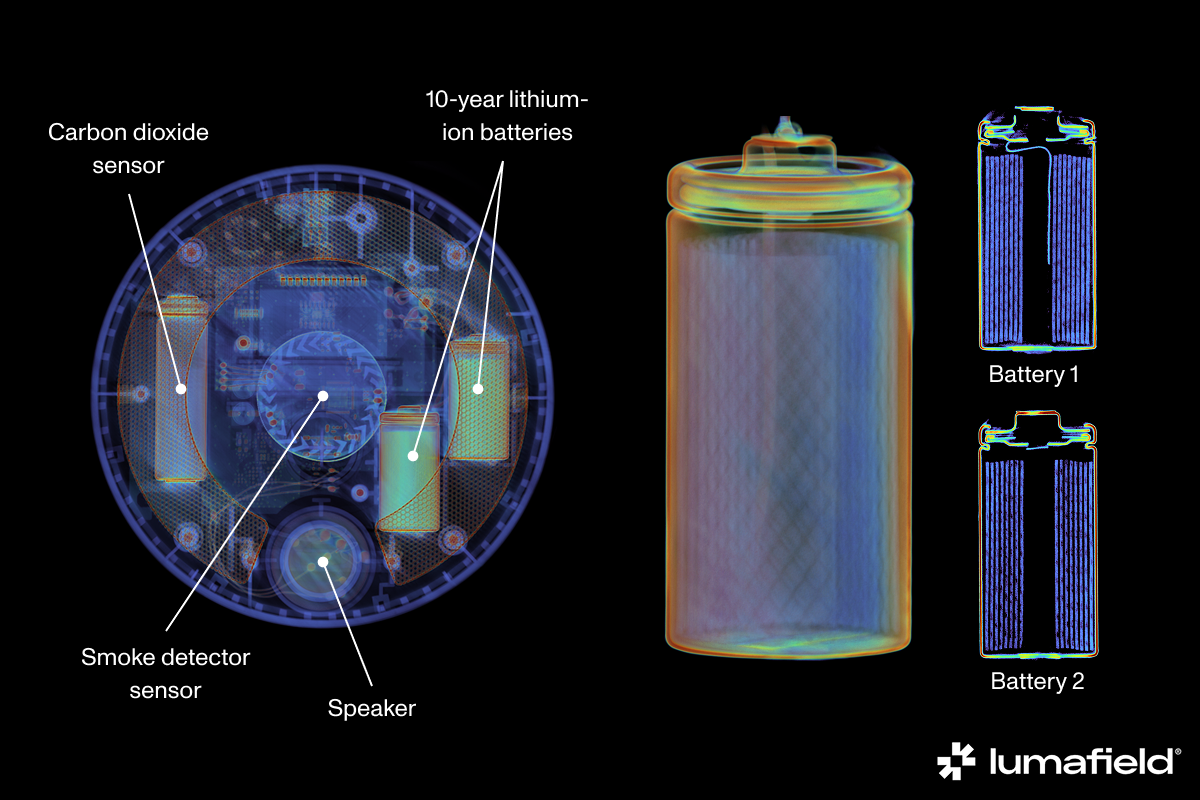
Lastly, we have the X-Sense XP0H-SN. There are two of the same mesh-type 10-year lithium-ion batteries inside. The mesh structure is noticeably different from the Kidde units, clearly indicating a different supplier, though it uses the same underlying principle to extend battery life. It has a fine metal mesh on the front face of the device.
What the scans don't settle
I vacuum and use compressed air in my smoke alarms regularly. The mornings these alarms went off were entirely unremarkable, with no cooking, smoke, or unusual humidity. A spider would be low-density and hard to spot on a CT scan if one had gotten in, but in my heart, I suspect the recurring problem comes down, as it usually does, to the batteries. And the batteries in these smoke alarms were unlike anything I'd seen before.
Could the problem simply be that the “ten-year batteries” in these units aren’t all they’re cracked up to be? Anecdotal evidence from my pre-sunrise forum trawling suggests that failure at the two-year mark is quite common, which happens to be right around how old my alarms are. Could the superior performance of the X-Sense simply come down to having two batteries instead of one?
Unfortunately, I cannot confidently endorse the X-Sense smoke alarm, as tempted as I was to replace everything in my house with them. They aren’t hard-wired, so wouldn’t be up to code. There are also open questions about certification — late last year, the New York Times reported that X-Sense devices, along with others available for sale on Amazon, were not properly UL certified. The SC07-W model appears to have addressed this per an April press release, but it’s unclear what the certification status is across the other product lines, or how accurate any current listings may be.
In the end, I have to balance managing the future false-alarm trauma of my cat (who disappeared and didn’t eat for an entire day — extremely unusual for him), against the importance of staying safe in the case of an actual fire or carbon monoxide leak. Ultimately I’ve landed on the following. I’ve replaced the Kidde units I removed with the same models, set a calendar reminder to clean all the alarms every 6 months, and set another reminder to replace the batteries on the ones with removable alkaline batteries, whether AA or 9V, every year. I’ve also set a 2-year reminder for the new “10-year” unit I installed. There are more of that model throughout the house, but they cost a fortune, so I'll just wait for them to fail before replacing the rest. But if you hear of something better out there, please let me know.