



.png)


The new year has kicked off with a wide swathe of recalls. Compact electronics carried more energy than their housings could tolerate. Ceiling hardware relied on connections that shifted dangerously under real installs. Helmets and pedals failed at the exact points meant to carry impact and torque. In hospitals, small discontinuities in breathing circuits and needles became patient events. Across categories, these recalls remind us that quality must run through the whole product development and ramp cycle, from first drawings to production proof.
Compact, closed, and cooking
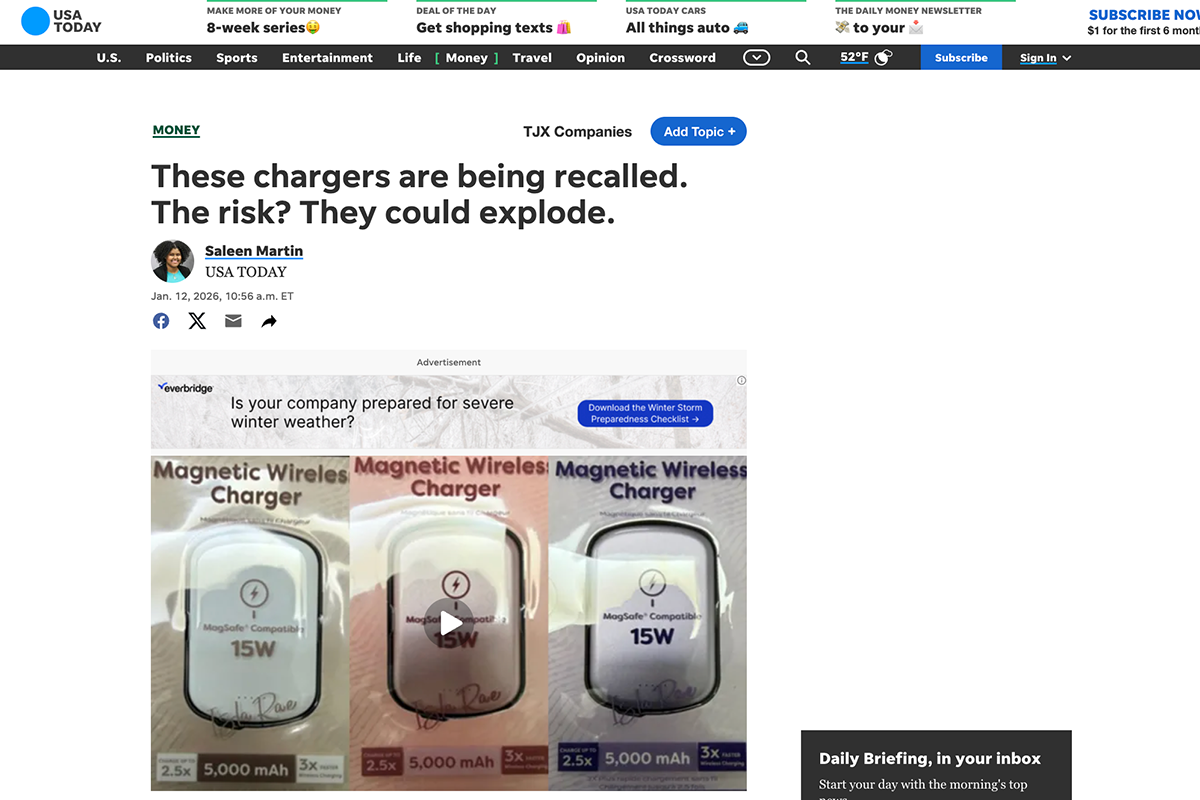
Hazardous batteries have shipped to consumers yet again. Energizer’s rechargeable lanterns can overheat inside a sealed handheld body, a small item with a field count of about 4,100. TJX’s Isla Rae magnetic wireless chargers raise the same flag at a larger scale, with about 13,200 sold in the U.S. and 7,000 in Canada. On the wiring side, Curtis International’s expanded recall of Frigidaire-brand minifridges due to an internal short circuit that can ignite the plastic housing has been expanded to include an additional, 330,000 units, on top of the 634,000 previously recalled in 2024. Two power strip lines failed at fundamentals. HEZI’s metal enclosure lacks a ground path across roughly 1,320 strips. ANNQUAN power strips omit supplementary overcurrent protection at a scale of about 11,200. The common cause across these electronics recalls is unmanaged fault energy in tight spaces, where design must decide where heat and current go during real failures.
Childproofing challenges
Three beard serums from RootStim (~16,900), Ruahouine (~25,000), and Feel The Beard (~840) contain minoxidil yet shipped without child-resistant packaging, and Plantimex’s Mamisan lidocaine jars show the same gap across roughly 50,330 containers. Under the Poison Prevention Packaging Act, packaging is defined by the active ingredient, which means closures must resist repeated child-opening attempts and continue to perform after real handling and wear. In these cases, the packaging did not meet that requirement, turning a labeling problem into an access problem that puts children at risk.
Backyard breakdown
Three very different products share the same setting and the same test of endurance. DR Power’s leaf vacuums continue to surface material ejection during use, with pieces breaking loose inside the impeller path or debris piercing the chute. The campaign now spans about 60,250 units in the U.S. plus 1,023 in Canada, an expansion from a larger family first flagged in 2024. The campaign now spans about 60,250 units in the U.S. and 1,023 in Canada, an expansion of the 2024 recall. The failure concentrates at the chute, where repeated hits in one spot thin the wall, start cracks, and open a path for fragments. When that happens, chips leave the machine at speed toward the operator. It is a durability problem at a single hot spot.
Across the yard, patio seating failed under routine loads. Adams Manufacturing’s Adirondack chairs can crack and collapse across roughly 6,100 units, and Academy Sports + Outdoors’ Magellan Odyssey Rocker chairs have legs that can break on about 35,300 units. The stress lives at leg and seat interfaces that see point loads, twisting, and outdoor exposure. UV and cold change how plastic and fasteners behave, and rocker motions drive cyclic bending at the same locations. If prototypes and production parts are not tested in that combined environment, the rib that looks stout on paper becomes the crack starter in the field.
Faulty fixtures overhead
Two chandelier families failed at the ceiling interface. RH’s Natural Antler units can detach when installed on vaulted or sloped ceilings, a rare mode but meaningfully dangerous at ~320 units. Currey & Company’s Electra chandeliers use a connection component with improper threads across about 260 fixtures, which can let the assembly drop. Real ceilings are rarely level, which shifts weight across the hardware, and thread form decides how much metal is truly engaged. In both cases, a small part at the canopy sets the outcome.
Questionable cycling
PNW Components’ Loam Pedal Gen 2 uses an axle that can crack and release the pedal from the crank, a focused field count near 1,200 that still matters because failure happens at speed. Pedego’s Fat Tire Trikes can develop a hairline fracture near a weld that progresses to tube separation across ~400 units. R.X.Y bicycle helmets fail the mandatory standard on impact attenuation, positional stability, and required labeling and certification for about 170 helmets. These are classic weak points. Axles concentrate stress at thread roots, weld toes gather cyclic strain, and helmets that do not hold position or manage impact energy leave the head underprotected. Fatigue testing, notch control, and retention checks are needed to prevent ordinary rides from turning into failure demonstrations.
Risks on the road
Several RV campaigns point to simple electrical controls that did not hold up. Winnebago and Newmar found water tank heating pads that can develop high resistance and fail. Forest River’s Freelander routed a solar panel lead to a breaker without proper over-current protection. Gulf Stream Coach reversed wires in a taillight harness, so a turn signal can point the wrong way. These are the kinds of issues that routine polarity checks, protection-device validation, and functional lamp tests should catch before a vehicle ships.
Ford reported engine block heaters that can crack and leak coolant, then short when the heater is plugged in. The behavior appears during use, which puts the focus on thermal cycling and material choice in the heater assembly. Wanli Tire Corporation recalled Aptany Eco Sendero M/T2 tires in size LT265/75R16, a fitment common to Toyota Tacoma, for sidewalls that can separate and fail to meet FMVSS 139, with the risk of rapid air loss and poor handling. In each case the basics decide outcomes, from correct wiring and working fault cutoffs to sidewalls that stay bonded under load.

Medical material mishaps
Olympus broadened its action on ViziShot 2 FLEX 19G EBUS-TBNA needles after reports that parts of the needle assembly can eject or detach during use, including one death. The weak point sits at the sleeve–hypotube interface, which can break down and lead to fluid leakage, poor sample movement, or a loose fragment in the airway. Olympus traced contributors to heat-shrink degradation and use factors, which makes this a design-and-materials issue across all lots rather than a limited batch problem.
Draeger found supplier residues inside certain Vapor 2000 and Vapor 3000 anesthetic vaporizers. Metal left after soldering can react with volatile fluorinated anesthetics and enter the patient circuit, with risks that include airway irritation, lung injury, and pulmonary edema. Fortunately, as of early December, no serious injuries or deaths had been reported. Meanwhile, Medline identified cracks and leaks in 120-inch expandable anesthesia circuit tubing used in some kits. A leak in that circuit can drop ventilation and dilute anesthetic delivery at the patient, and it can also vent anesthetic vapor into the room. The FDA has seven reports tied to oxygen desaturation from this issue. Across these cases, safety turns on small interfaces and material compatibility under temperature, motion, and anesthetic gases. When those details slip, patient care can change in seconds.
Takeaways
January ties one idea through very different products. Reliability is earned where everyday forces meet small parts. In compact electronics that means heat and fault current have a defined way to escape. Move to the ceiling and the same rule applies, with brackets and threads that keep their grip when the mount sits on a slope instead of a test stand. On bikes and trikes it shows up at axle roots and weld toes that take thousands of small hits instead of one big pull, and on the road it depends on wiring that matches the drawing every time with joints tightened to values you can prove. In clinical tools it becomes materials and seals that stay stable with the gases, temperatures, and motions seen in practice. Design for the conditions products live in, validate under those conditions during ramp, and keep watching as volume grows so routine use stays routine.