





In 2017, Nike released the Vaporfly, the first commercial running shoe with a carbon-fiber plate embedded in the midsole. Before it, only 19 women had ever run a marathon in under two hours and twenty minutes. In 2023 alone, 26 did. The performance shift was significant enough that World Athletics introduced regulations in 2020 limiting sole thickness and requiring competition footwear to be commercially available before use in elite races.
Every major brand has since developed its own version of the super shoe. To understand what separates the leading models, Lumafield worked with the Financial Times visual storytelling team to CT scan two of them: the Nike Alphafly 3 and the Adidas Adizero Adios Pro Evo 1. The FT used the scans as the evidential foundation for a reported investigation into the technology driving record-breaking marathon performance. What follows is a detailed account of what the scans revealed.
Why CT scanning
A running shoe is a layered object. The components that matter most for performance, the carbon plate, the foam geometry, the air chambers, sit inside a midsole that is sealed and opaque. You can cut a shoe in half (which reviewers do regularly) but you can only cut it one way, you destroy the shoe in the process, and you see a single cross-section. CT scanning rotates the X-ray source around the object, reconstructing a full three-dimensional density map from hundreds of two-dimensional images. The result is a model you can slice in any plane, isolate by material density, and examine without touching the object.
If you’re interested in what’s actually inside these shoes, and whether the manufactured product matches the design intent, CT offers the only way to see the whole picture.
Tradeoffs at every turn
Every foot strike in a long-distance race is an energy transaction. Force travels down through the shoe, and some fraction of that energy returns to the runner as forward momentum rather than dissipating as heat. Over 26.2 miles, the cumulative difference between a shoe that returns measurably more energy and one that doesn't ultimately translates to finish time.
The engineering challenge is that the three variables runners care about—energy return, cushioning, and weight—compete against each other. More foam means more cushioning and potentially more energy return, but also a heavier shoe. A stiffer plate improves propulsion but changes how the shoe interacts with different foot-strike patterns. Every design decision involves a tradeoff, and those evident in these two shoes speak to the divergent philosophies behind them.
Nike Alphafly 3: perfect synergy
Nike's answer is accumulation. The Alphafly 3 is built around three technologies working together: a full-length carbon-fiber Flyplate, two Air Zoom pods embedded in the forefoot, and a continuous ZoomX foam midsole connecting heel to forefoot. The stack height is 40mm at the heel and 32mm at the forefoot. The shoe weighs in at 218 grams.
The scans show how those components relate spatially inside the assembled shoe, something a simple cutaway illustration can’t provide. The carbon plate runs the full length of the shoe at a consistent depth within the foam and is curved rather than flat. That curvature has a purpose: a flat plate would shift the point of force application toward the toe, increasing calf strain. The curved plate keeps it under the ball of the foot and directs propulsion forward.
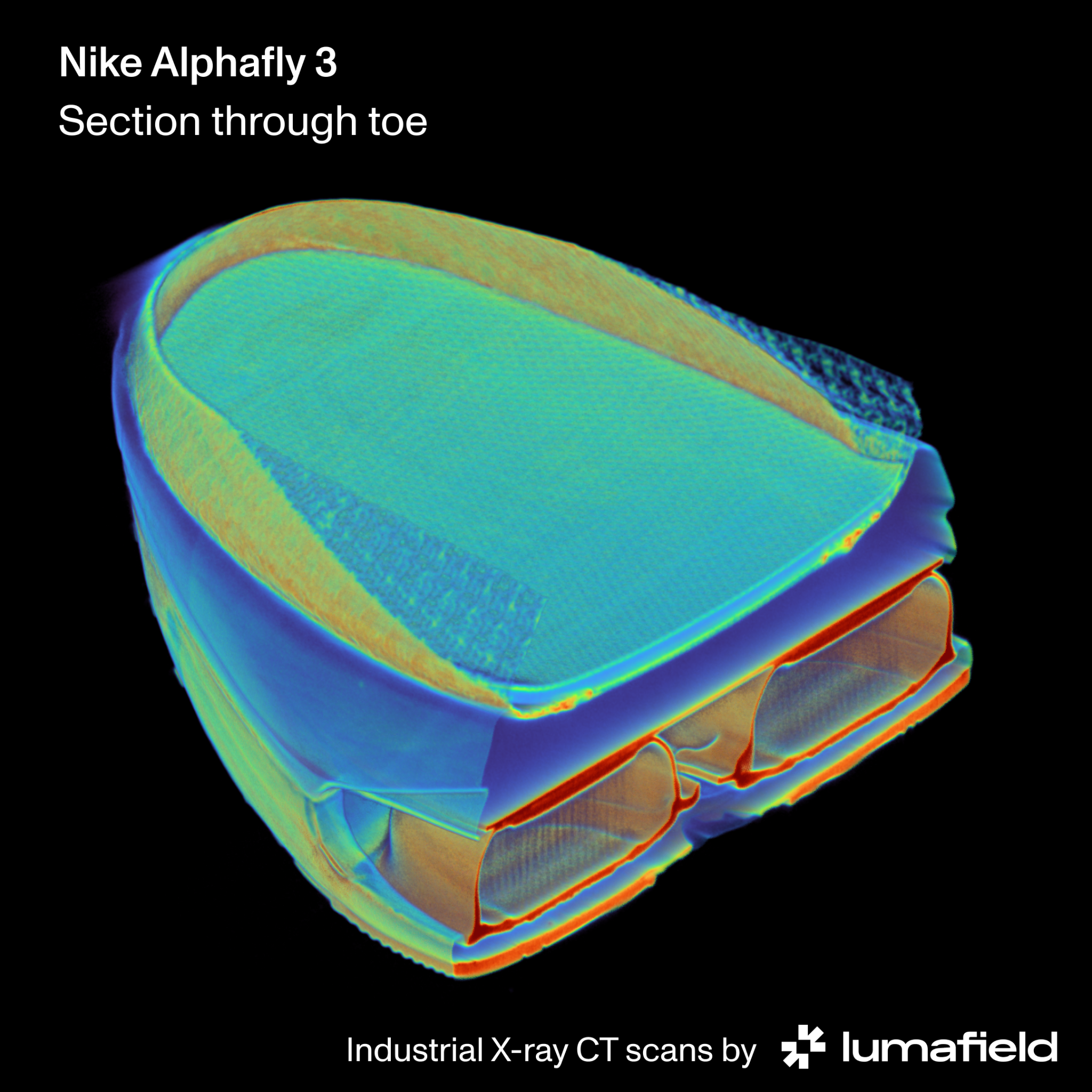
The two Air Zoom pods sit in the forefoot above the plate, enclosed in foam on all sides. Inside the pods, we see a division of the air volume into smaller cells. Those fibers limit radial expansion under load, which increases the pressure the pod sustains and improves the energy it returns per compression cycle. This detail is invisible from the outside and does not appear in any published cutaway of the shoe.
The continuous midsole, a change from the Alphafly 2 which had a gap between the heel and forefoot sections, shows in the scan as a single uninterrupted foam body from heel to toe, with the plate and pods embedded within it. The geometry confirms what Nike describes as a smoother heel-to-toe transition.
Adidas Pro Evo 1: less is more
Adidas took the opposite approach. Where Nike added components, Adidas removed them. The Pro Evo 1 weighs 140 grams (78 grams less than the Alphafly 3), and much of that reduction comes from eliminating material instead of replacing it with lighter versions.
Instead of a full-length carbon plate, Adidas embedded eleven carbon-composite rods, each 5.5mm thick, running longitudinally through the midsole and mapped to the metatarsals. The intent is to target propulsion under specific joints, including the big toe, rather than distributing it across the full foot. Two pieces of Lightstrike Pro foam are bonded around the rods. The outsole is not a separate rubber component but a liquid rubber coating applied directly to the foam surface, removing approximately 20 grams compared to a conventional outsole. The upper is a single-layer transparent mesh with no sock liner.
The scans confirmed the rod placement and bonded foam geometry. They also found something Adidas had not publicized.
Inside the Adidas rods
Several of the carbon-composite rods contain internal porosity, visible in the density mapping as voids within what should be solid carbon composite.
The FT shared this finding with Adidas directly. The company described the voids as minor irregularities that can occur during the manufacturing process without affecting the performance or durability of the rods, and said it was not aware of any rods breaking in competition. That response is plausible. Carbon composite fabrication at complex geometries routinely produces small internal voids, and the rods have indeed performed at the highest level of marathon competition without reported failures.
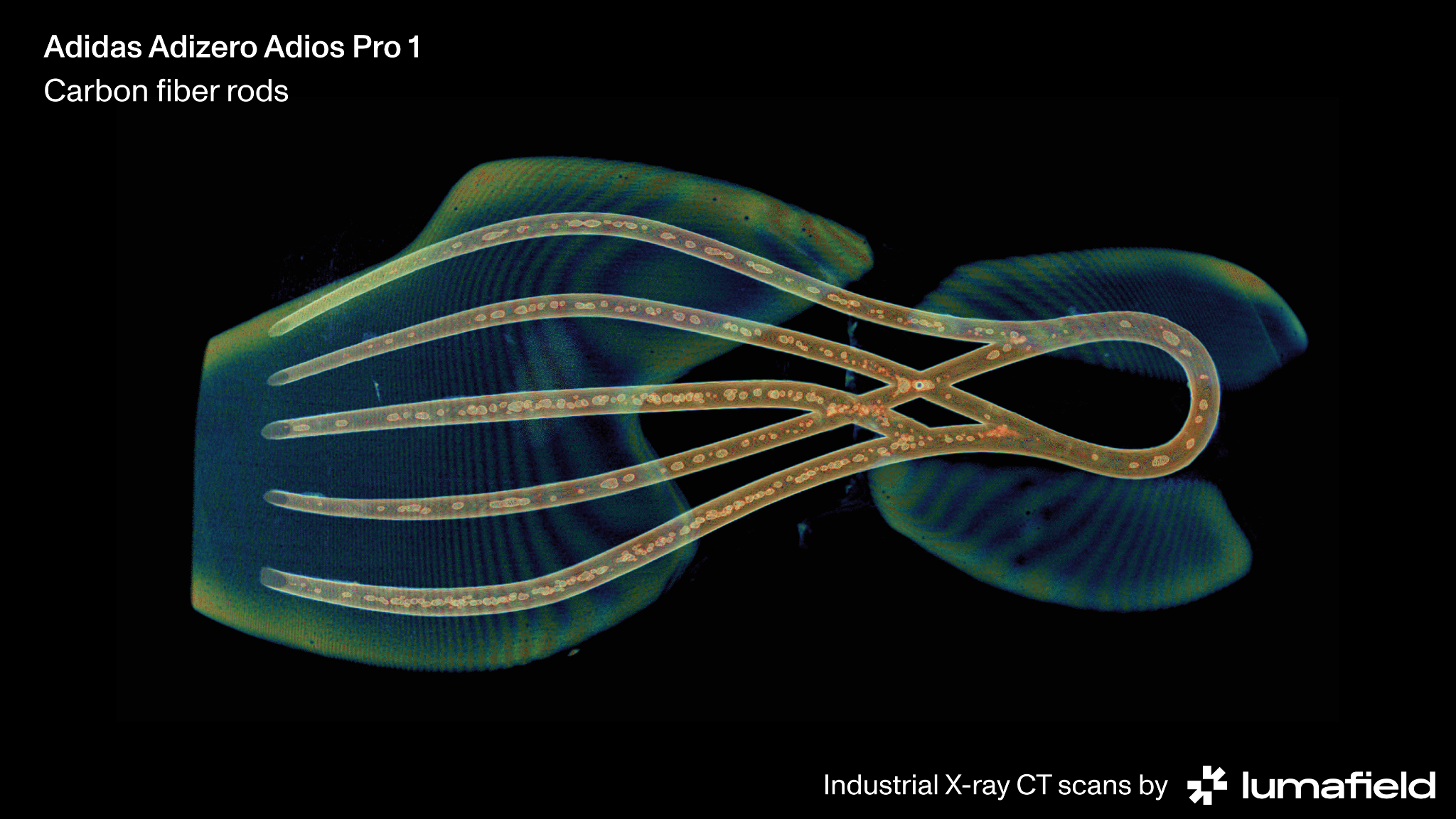
But the finding points to crucial particularities of performance footwear manufacturing. The Pro Evo 1 is largely assembled by hand, a consequence of the precision required to position the rods correctly. Adidas has acknowledged the shoe does not generate direct profit at its $500 retail price. It serves as an engineering platform: learnings about rod placement, foam bonding, and wear behavior at the elite level feeds into higher-volume models. A scan that surfaces manufacturing variation in that platform is exactly the kind of evidence that drives the next iteration.
CT produces quantitative density data rather than surface images, which means it can measure the difference between a solid rod and one with a void, between a foam layer bonded as designed and one with a gap, between a component that meets spec and one that doesn't. The same thing CT insight contributed to this investigation is exactly what makes it so critical to the manufacturing process more broadly.
Differences that make a difference
The two shoes represent different theories about where the performance gains in marathon footwear come from. Nike's idea is a tuned system of interacting components, each refined over multiple generations, designed to work across a range of foot-strike patterns and runner profiles. Adidas bets that weight is the primary variable and that the structural function of a plate can be distributed through discrete rods positioned anatomically, eliminating material rather than optimizing it.
Both approaches have produced marathon world records. What the scans add is a precise account of what each shoe conceals, what the manufacturing process delivered against the design intent, and where the gap between those two things becomes visible. The distance between design intent and manufactured reality is where quality is won or lost, and where visibility matters most.