



.jpg)


The numbers on U.S. manufacturing investment are large and getting larger. The Reshoring Initiative counted 244,000 announced manufacturing jobs tied to reshoring and foreign direct investment in 2024 alone. Bain found that 81% of CEOs and COOs reported onshoring, near-shoring, or split-shoring plans that year, up from 63% just two years earlier. The capital is moving, and the facilities are being built.
What the announcements tend to underspecify is what exactly companies are (re)building when they reshore. Physical infrastructure is the tractable part, as you can site a facility, install equipment, and run a production line on a predictable timeline. It’s much harder to rebuild the quality infrastructure and correlate institutional knowledge, and most reshoring plans underestimate this aspect.
The judgment bottleneck
After decades of offshoring, tacit manufacturing expertise in the United States is thinner than it once was. Toolmakers, metrology specialists, process engineers with deep experience in a specific process family, quality managers who have run the same line through a thousand failure modes: these people exist, but are hard to come by. Plants that have rebuilt their production infrastructure often find sophisticated automation and reasonably stable processes, but quality emerges as the bottleneck. The line may be healthy, but without somebody to read it, one can’t be sure.
This creates a specific problem for inspection. Traditional quality tools work well when an expert operates them. A CMM reading, a dye penetrant test, an ultrasonic scan: each produces useful but partial data, and the synthesis required to turn those incomplete assessments into confident decisions about part condition is exactly the kind of judgment that takes years to develop. An aluminum casting that passes dimensional checks can still conceal porosity that becomes relevant downstream. An injection-molded housing can meet external tolerances while internal features drift with tool wear. Each of those failures demands a specialist's attention, which leads to a backlog for quality. The more specialists a program needs to function, the more exposed it is when they are unavailable, overloaded, or simply not yet hired.
Encoding inspection knowledge
The standard response to a quality expertise gap is to hire carefully, train aggressively, and accept that early ramp periods will be bumpy. Those are reasonable responses, but they address the symptom rather than the root of the problem.
The structural question is whether inspection can be designed to carry expert judgment forward, rather than requiring that judgment to be present at every decision point. There is a meaningful difference between extending expert judgment and encoding it. Extending it means routing every difficult question to a qualified person. Encoding it means defining the question precisely enough that the answer does not require an expert to read it.
One approach to this is inspection that examines a part's full internal geometry rather than sampling only its accessible surfaces. Industrial computed tomography, also called X-ray CT, works by rotating a part between an X-ray source and a detector, capturing projections at multiple angles, and reconstructing a three-dimensional model whose values correspond to material density. From that model, engineers can measure internal features, map porosity relative to load-bearing geometry, and track wall thickness at sections that have no external analog. Most importantly, the analysis can be codified. Thresholds, regions of interest, measurement sequences, pass/fail criteria can all become recipes that run on every subsequent part. A senior engineer writes it once, then the line runs it without her. At a new facility still building its quality organization, that leverage is far from marginal.
What faster cycles unlocks
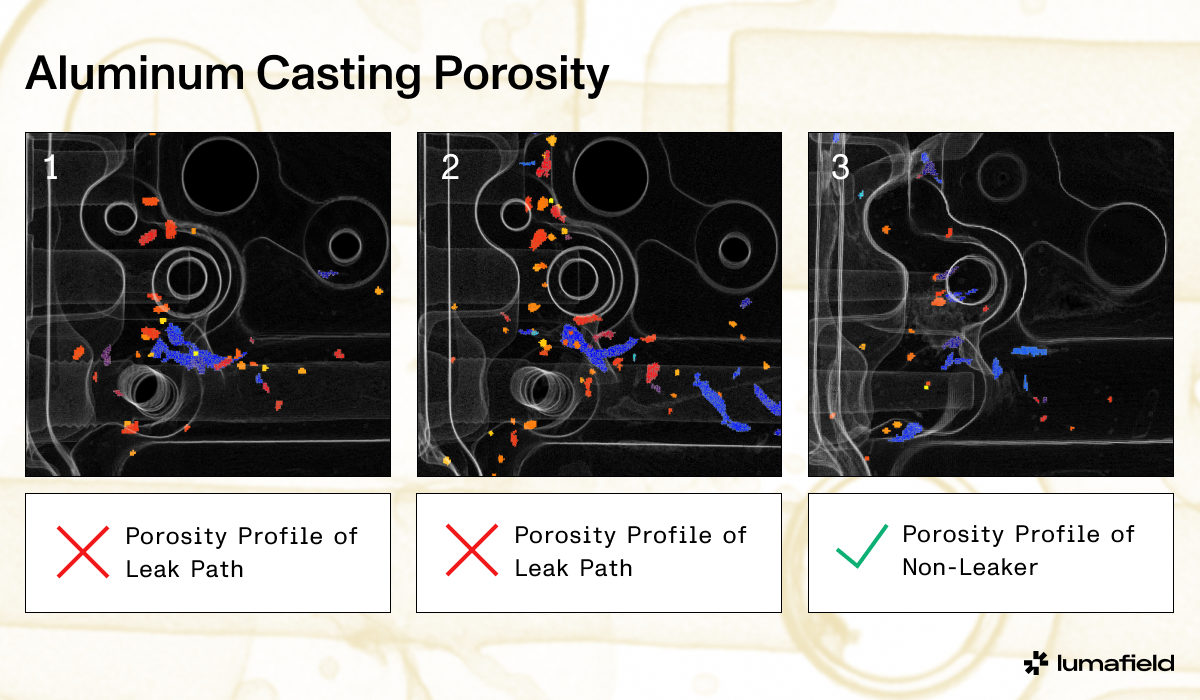
When Nemak, a high-pressure die casting manufacturer, adopted CT for porosity evaluation, they saw a way to drastically condense their usual workflow. Before CT, characterizing porosity in a casting required lab sectioning, metallographic preparation, and a formal reporting cycle. The process involved 4 specialists, 11-12 hours of work, and a 2-3 day turnaround. With CT, a pair of engineers reached a complete porosity characterization in only 3 hours of a single day. The faster cycle was a welcome improvement, but the more consequential change was in who could act on the findings.
A spatial porosity map aligned to CAD puts the engineering question in a form that a process engineer, a quality engineer, and a manufacturing engineer can evaluate simultaneously from the same file. Arguments about whether a finding is relevant become resolvable by measurement. At new facilities where relationships between functions are still forming, that shared evidentiary basis shortens conversations that would otherwise run for days. Corrective action gets implemented in the cycle where the problem was identified, instead of the one after it.
Ramp periods and the feedback problem
Early in a reshoring ramp, or any new production program, yields can be volatile while tools wear in, gauges settle, and operators develop fluency with machines they haven’t run before. The gap between when a parameter drifts and when an engineer detects it is where scrap accumulates. A team that can pull a sample, run a scan, and review results the same day closes that gap faster than a team sending samples to an outside lab and waiting.
CT also gives engineers a way to measure drift that surface inspection can’t catch. Wall thickness distributions, porosity location relative to stress-bearing features, and dimensional change at internal geometries are all qualities that can shift before the part fails a functional test. Seeing this drift in progress allows process adjustments before yield losses compound, and creates a documented record that ties parameter changes to outcomes. Over multiple programs, that record becomes a body of institutional knowledge with a different character than accumulated individual experience. It can be searched, shared across sites, and reviewed by engineers who were not present when the decisions were made.
Building the infrastructure for quality
Reshoring is a capacity-building exercise, and the constraint on capacity is quality judgment applied consistently at scale. New domestic facilities face this acutely: the inspection expertise global customers expect is not uniformly available, supplier ecosystems are being reestablished from scratch, and tolerance for extended ramp periods is low. Inspection infrastructure that encodes expert judgment, compresses feedback cycles, and produces evidence that travels across organizational boundaries is so much more than just a feature of a reshoring program. Without it, you’re getting off on the wrong foot.
Done well, inspection infrastructure becomes invisible. That’s not because it stops mattering, but because the problems it prevents never happen in the first place.