



Airpods Max 2
Apple, 2026

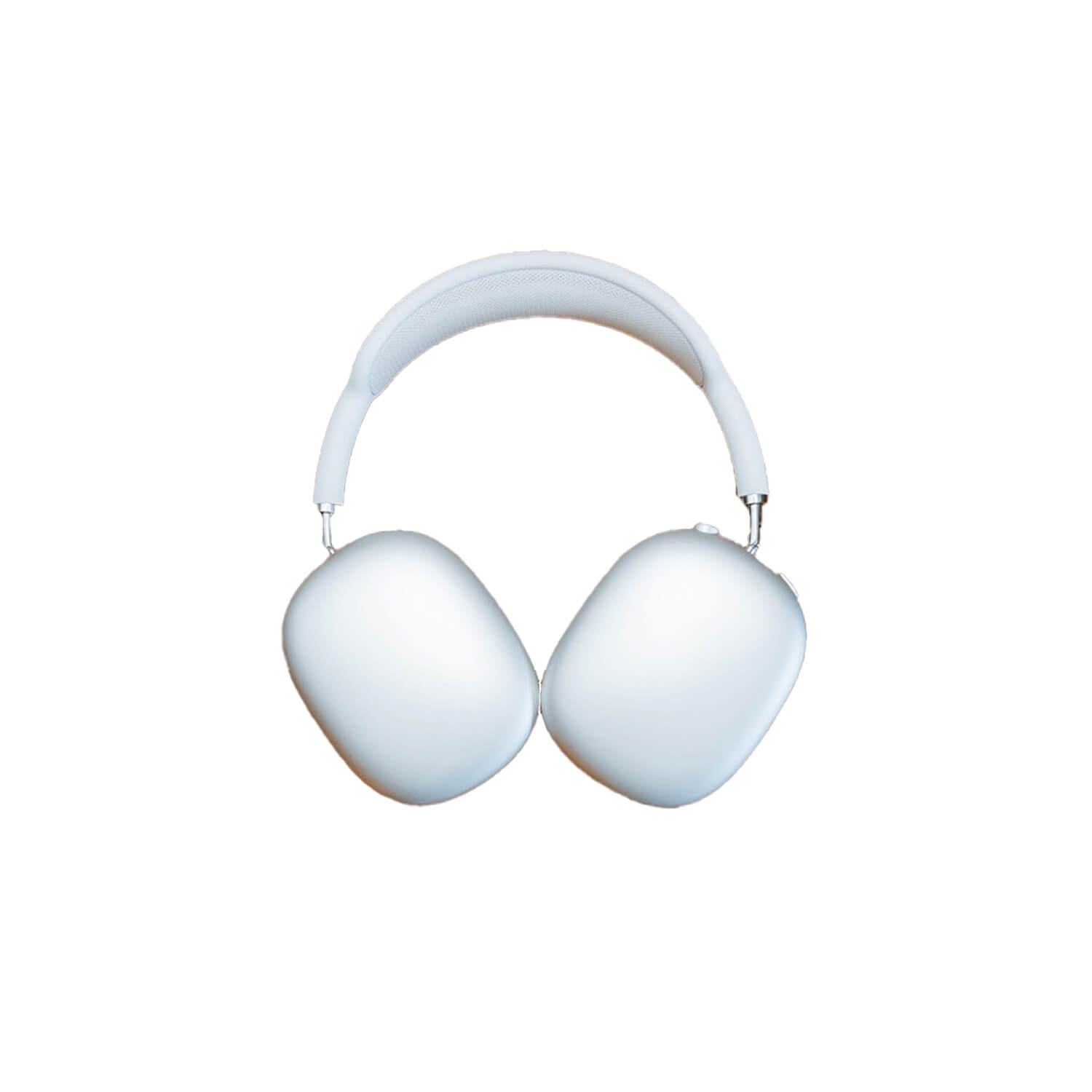
The AirPods Max arrived in December 2020 at $549, a price that clearly announced Apple's intentions to create a luxury object that just happened to play audio. CNC-machined aluminum earcups, a stainless steel headband, and magnetic ear cushions placed it above every plastic-shelled competitor. Two revisions later, the architecture is unchanged: asymmetric earcups, one carrying the battery and port, one carrying the driver, both running their own logic boards.
The 40mm driver fills the left earcup, secured to its sub-baffle by four screws rather than adhesive. Components and wiring pack the space between the driver housing and the outer aluminum wall. The acoustic chamber is formed by the cup shell itself, with the driver facing inward toward the ear.
Both battery cells sit in the right earcup, encased in a plastic shell screwed into the aluminum frame. The dual-cell pack, rated 2.53 Wh combined, is unchanged across all three AirPods Max generations. iFixit confirms the connector and form factor are cross-compatible between them.
The right earcup carries the primary logic board: H2 chip front and center, 32-bit ARM microcontroller along the outer edge, USB-C port at the bottom secured by four screws. The left earcup carries its own H2 and ARM controller, the two boards linked by an interconnect cable handling power and communication. Six years in, the layout tracks closely with the 2020 original.
The telescoping stainless steel arm enters the right earcup through a multi-part yoke assembly. The yoke allows the cup to rotate and tilt independently of the headband, distinguishing the AirPods Max from every folding competitor. The arm slides within a stainless steel track for size adjustment, distributing load across the pivot rather than concentrating it at a single wear point.

WH-1000XM6
Sony, 2025
Sony has owned the noise-cancelling category for the better part of a decade. The WH-1000XM series set the benchmark at XM3, refined it at XM4, and stumbled at XM5 when a hinge redesign drew complaints. The XM6 corrects that, returning to a folding design and adding Sony's new QN3 processor. The scan shows two earcups with distinctly asymmetric layouts: the left carrying the primary electronics, the right consolidating the battery.
The XM6 uses a 30mm carbon fiber composite driver, smaller than the 40mm units in the other three headphones. Sony mounts the PCB directly around the driver motor, components and wiring wrapping the magnet structure in a single dense module. Flex cables loop outward to the cup perimeter. The arrangement trades spatial separation for integration.
A single pouch cell occupies most of the right cup interior, large relative to the available volume and consistent with Sony's 30-hour ANC runtime claim. A smaller secondary board sits alongside it. The arrangement leaves the left earcup free for the main PCB and driver assembly.
The left earcup carries a large, densely populated main board running nearly the full cup height. The QN3 processor sits at its core, with shielding cans over the RF sections and flex cables routing to the cup perimeter. Concentrating the primary electronics here keeps the right cup available for a battery large enough to back Sony's runtime claims.
The XM6 hinge is a compact folding assembly: a multi-part metal bracket connects the headband arm to the cup, allowing rotation and inward folding. Cable routing through the joint is visible, looping to accommodate the pivot range. The mechanism is smaller and lighter than the XM5's, consistent with Sony's stated redesign intent.

Headphone (A)
Nothing, 2024
Nothing entered the headphone market in 2024 with a design philosophy borrowed from its phone line: visible internals, exposed screws, and a transparency that makes the object's construction part of its appeal. The Headphone (1) sits at $199, developed with driver tuning input from KEF. Inside, the scan shows a notably symmetric right earcup: two battery cells flank the driver on either side, a layout found nowhere else in this comparison.
The 40mm driver sits at the center of a relatively open acoustic chamber, with noticeably more empty space around the motor structure than either the Apple or Sony assemblies. A PCB runs along the left wall, separated from the driver rather than integrated around it.
Nothing splits the battery across two cells, one on each side of the driver within the right earcup. Rather than consolidating capacity in one location, the two cells balance the cup's weight distribution symmetrically. At 1,060mAh combined, it is the largest battery pack in this comparison.
The electronics run as a continuous arc along the inner perimeter of the cup, wrapping the wall rather than occupying the center. Components are distributed at regular intervals around this arc. The driver sits in open space at the center, structurally isolated from the board entirely, an arrangement found in none of the other three headphones.
The Nothing hinge is the most mechanically elaborate of the four. A coil spring sits at the joint between the headband arm and the cup bracket, providing tension and return force across the pivot range. The surrounding bracket is metal, with multiple fastener points visible. The spring-loaded mechanism distributes stress differently than the friction-fit sliding track of the Soundcore or the rotating yoke of the AirPods Max.

Space One
Soundcore, 2023
Soundcore's Space One sits at $79.99, the most affordable headphone in this comparison by a significant margin. Where Apple machines aluminum and Sony engineers a dedicated noise-cancelling processor, Anker's priority is value: ANC and wireless at a price that undercuts the competition by hundreds of dollars. The scan reflects that calculus. Both earcups are sparse relative to their volume, with components concentrated in a small footprint and considerable empty space surrounding them.
The driver sits at the center of a notably open acoustic chamber, smaller in apparent footprint relative to the cup volume than any other headphone in this comparison. A single lead wire trails from the motor. The surrounding space is largely empty, with no integrated PCB, no dense component ring, and none of the wiring complexity visible in the Apple or Sony assemblies. The cup volume is doing little acoustic work beyond housing the driver.
A single rectangular pouch cell occupies the upper portion of the left cup interior, with a wire routing up and out toward the headband. Below it, a small arc of PCB carries the electronics for this cup. Battery and board sit in the same cup but are clearly separated rather than integrated.
The right earcup carries the main board, a densely populated assembly occupying most of the lower half of the cup. Component density here is higher than the driver frame suggested. The contrast with the near-empty driver chamber above it tells the story of how Anker allocated the available volume.
The adjustment mechanism includes a coil spring at the top of the arm feeding into a slender sliding track that terminates at a folding pivot connecting to the cup. The spring and track are the dominant structural elements, with minimal surrounding hardware compared to the multi-part metal assemblies in the Sony and Nothing hinges. The mechanism is plastic throughout, and the scan shows why documented cracking in adjacent Soundcore models tends to concentrate at exactly this joint.
Headphones are one of the few consumer products where the experience is almost entirely decoupled from the object. You put it on, you close your eyes, and the thing itself disappears. Manufacturers understand this better than anyone, and that the interior of a headphone is where the quality of that understanding plays out, one product generation at a time.