





April's list is defined by repetition. Six pressure washers were recalled for the same missing safety component, while three children's tower stool recalls were filed in the same week for structurally identical failures. A power bank was recalled for the second time after a first action that didn't reach everyone who needed it. When the same problem shows up across multiple companies in the same month, it usually indicates an underlying pattern. It means something in how these products get sourced, qualified, and brought to market consistently skipped the step that would have caught it.
Shortcuts at the source

Six electric pressure washer brands had recalls this month for the same reason. Sweetcrispy (2,300 units), Fengrong Tool (500 units), Agiiman (80 units), Patoolio Direct (2,066 units), BAYOTAK USA (360 units), and Le Hao Tool (3,100 units) all shipped products without a ground-fault circuit-interrupter, a component that has been required on outdoor electric equipment for decades and exists specifically to prevent electrocution when water and electricity meet. None of these recalls had reported injuries, which means the enforcement action preceded the harm in every case, and that is the best possible version of how this works. But the fact that six companies reached consumers with the same omission points to something structural, a sourcing and qualification environment where a well-established safety requirement can be skipped repeatedly without anyone catching it before the product ships.
Collapsing children's chairs
Three separate tower stool recalls landed in the same week, covering Wiifo (9,700 units), TOETOL HOME (3,000 units), and AMZCMJ DGD (130 units), for structural collapse or tip-over combined with openings large enough for a child's torso to pass through. Combined, the three generated 47 reported incidents and 21 injuries. It is likely not a coincidence that these actions were filed together. The TOETOL version had 11 injuries from 18 incidents, and both it and the Wiifo had been on the market for multiple years before the actions were filed. One recall in a product category tends to draw regulatory attention to similar products, and when the category is small enough that the same failure mode recurs across multiple suppliers, scrutiny tends to surface more than one problem at once.
Burning batteries
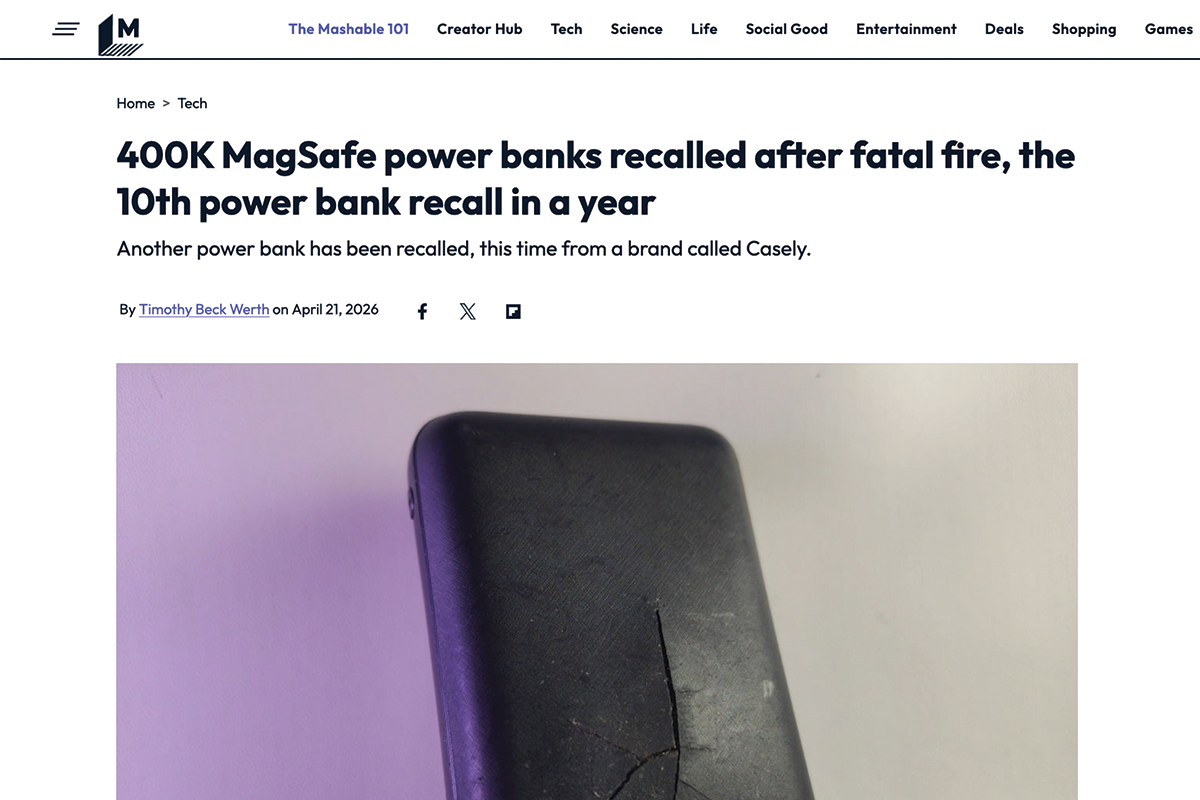
Three separate lithium-ion battery recalls this month range from inconvenient to fatal. The Casely power bank reannouncement is the most serious, with 429,200 units recalled a second time after continued incidents following an April 2025 action. Since the first recall, 28 additional incidents have been reported, including one fatality and one fire on a commercial aircraft. A 75-year-old woman in New Jersey suffered second and third degree burns in August 2024 and later died from complications, and the product that caused it was still in circulation because the first recall did not reach everyone who needed to be reached. The VEEKTOMX VT103 power bank recall covers 8,000 units with three fire reports and minor property damage, and the Osprey and S1 robotic pool vacuums recall covers 5,000 units with ten overheating incidents and nine instances of property damage, all occurring during or after charging. Across the three, the failure mode is consistent, but the contexts span a lap, a desktop, and a backyard pool. Low-quality batteries pose a serious hazard everywhere they are used.
Lacerations and leaks
The FitRx SmartBell adjustable dumbbell recall covers 50,000 units where weight plates can dislodge from the handle during use, with more than 115 reports and at least six injuries including broken toes and lacerations. The selection dial mechanism that determines which plates are locked to the handle appears not to hold its engagement under dynamic load. The Generac portable generator recall covers about 149,400 units where fuel can leak from the carburetor during first fill. The company's own guidance distinguishes between units that have previously been filled without incident and those that have not, which effectively makes the first fueling event a field test for whether the defect is present. For both these products, real-world use reveals gaps in design.
Road risks

April's automotive recalls span a wide variety of failure modes. Toyota is recalling certain 2025 RAV4 vehicles where front seat bracket welds may be improper, a structural failure in a component that exists to keep occupants in position during a crash. This recall only affected four vehicles, but the increased risk of injury in those few units is serious. Chrysler is recalling engines with two specific part numbers where internal debris can cause engine failure and loss of drive power, with the risk of an engine compartment fire in the worst cases. Altec Industries is recalling certain 2025 and 2026 Digger Derrick and Aerial Device vehicles where improperly installed front-end radar can interfere with the adaptive cruise control and active brake assist systems. The broadest action covers certain model year 2019 through 2024 Jaguar Land Rover vehicles across eight nameplates, where a DC-DC converter microchip fault can cause loss of 12-volt system charging and potentially complete loss of drive power and exterior lighting, a remedy for which is still under development. Across all four, the failure is in a system the driver depends on without thinking about it, and the consequences arrive without warning.
Deployment disconnects
The Aligned Medical Solutions recall covers two angio pack kit configurations containing a Medline Namic angiographic rotating adapter syringe where the rotating adapter can unwind during use, creating the potential for a loose or complete disconnection between the syringe and manifold during an interventional procedure. The affected kits were distributed between October 2024 and November 2025. The consequences of that disconnection include biohazard exposure, blood loss, infection, and air embolism. Three instances of inadvertent air injection into patients have been reported to Medline, along with one biohazard exposure incident, none resulting in death.
Takeaways
Several of this month's recalls share the same basic shape. Multiple companies shipped products with the same deficiency through the same channels, and the problem only became visible when enough of them accumulated to draw a response. The tower stool filings and the six concurrent GFCI omissions are the clearest examples, but the pattern extends into the automotive and medical recalls as well, where individual components failed under conditions that were entirely predictable. The difference is scale and visibility. A category-wide qualification gap produces a cluster of simultaneous recalls. A single component that wasn't validated against real use conditions produces one. But the underlying logic is the same, and in both cases something about how the product would actually be used wasn't part of how it was verified.