World Cup Scan of the Month >
Platform
Solutions
All Industries
Aerospace and Defense
Agriculture and Food
Athletic Equipment
Automotive
Batteries
Consumer Packaged Goods
Electronics
Medical Devices
Applications
Resources
White Papers
Case Studies
Webinars
Blog
Insights from lumafield
Go/No-Go
Manufacturing podcast
First Article
Editorial Publication
Company
About
Careers
Press
Events
Launch Voyager
Contact Sales
Menu
PlatformSolutions
Industries
All Industries
Agriculture and Food
Electronics
Aerospace and Defense
Automotive
Athletic Equipment
Consumer Packaged Goods
Medical Devices
Batteries
Applications
Resources
Resources
White Papers
Case Studies
Webinars
Blog
Go/No-Go Podcast
First Article
Company
Company
About
Careers
Press
Events
Contact Sales
Launch Voyager
© 2000 Lumafield. All Rights Reserved.
Application

Dimensional Measurement

Measure what's inside, exactly as built, without cutting anything open.

Traditional measurement tools reach surfaces. Industrial CT reaches everything. Wall thickness, internal channel geometry, electrode spacing, cooling passage dimensions, and feature positions deep inside an assembly are all measurable from a single scan, with the part intact and undisturbed. Where manual sectioning destroys the evidence and CMMs can only touch what they can reach, industrial CT produces a complete three-dimensional record of every internal and external feature simultaneously.

The industries where dimensional measurement is hardest are the ones where CT delivers the most. Aerospace manufacturers measure cooling channel geometry and wall thickness in turbine blades where no probe can reach. Battery engineers measure anode overhang, electrode spacing, and case uniformity in assembled cells where any other method requires destructive disassembly. Medical device teams measure internal features of implants and surgical instruments that are geometrically inaccessible by any conventional tool. In each case, CT produces actual dimensions rather than estimates, against which every feature can be compared to CAD nominal.

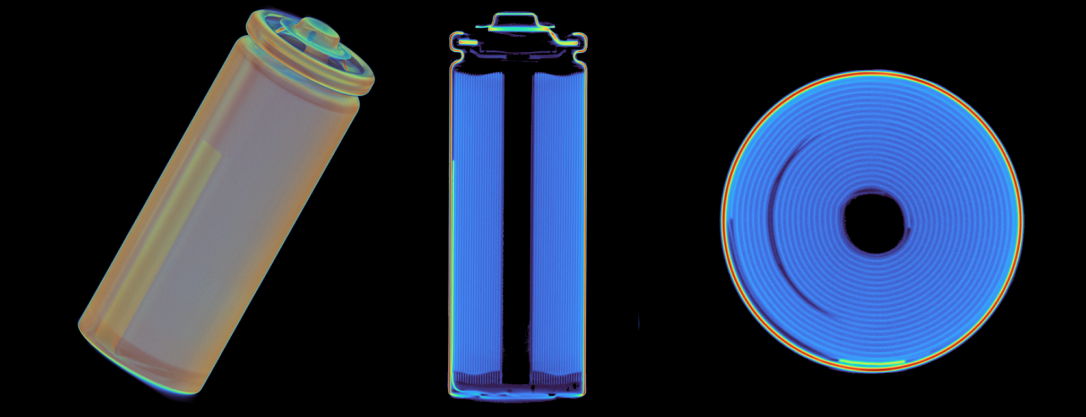
The Battery Analysis Module automatically takes Anode Overhang measurements within cells and presents intuitive visualizations.
Industrial CT enables in-situ inspection of internal geometries to verify dimensions within assembled components, such as in this medical connector.

For automotive and electronics manufacturers running high-volume inspection, Lumafield's platform extends CT-based dimensional measurement from the lab to the production line. Consumer packaged goods teams use the same capability to measure wall thickness and closure geometry in packaging components where consistency directly affects seal integrity and shelf performance. Across every application, the measurement record is digital, traceable, and shareable without manual transcription or reformatting.

CT dimensional measurement also replaces manual sectioning as the default method for internal feature verification. Sectioning destroys the part, introduces cut-plane error, and produces a single cross-section where CT produces thousands. The data is more complete, the part survives, and the record is permanent.

Assess your inspection program

Contact our team

Assess your inspection program

Contact our team

Internal geometries traditional tools can't reach

Cooling channels, internal threads, recessed features, and enclosed cavities are measurable with CT at the same precision as external surfaces. No probing, no sectioning, no guessing at features that are geometrically inaccessible. CT resolves internal dimensions in three dimensions against CAD nominal, with the part fully intact.

Learn More

In-situ measurement inside assembled components

CT measures component positions, interface gaps, and internal feature dimensions inside a fully assembled product without disassembly. For medical connectors, battery packs, and complex electromechanical assemblies, this is the only method that produces actual assembled dimensions rather than predicted ones derived from individual component measurements.

Learn More

Automated dimensioning at production scale

Manual measurement is slow, operator-dependent, and difficult to scale. Lumafield's auto-dimensioning capability applies AI to extract dimensional measurements from CT scans automatically, producing consistent, repeatable results across large part populations without manual intervention. What used to take hours of analyst time now runs in the background, with results that feed directly into quality reporting.

Learn More
Dowload

What’s a Rich Text element?

What’s a Rich Text element?

The rich text element allows you to create and format headings, paragraphs, blockquotes, images, and video all in one place instead of having to add and format them individually. Just double-click and easily create content.

The rich text element allows you to create and format headings, paragraphs, blockquotes, images, and video all in one place instead of having to add and format them individually. Just double-click and easily create content.

Static and dynamic content editing

Static and dynamic content editing

A rich text element can be used with static or dynamic content. For static content, just drop it into any page and begin editing. For dynamic content, add a rich text field to any collection and then connect a rich text element to that field in the settings panel. Voila!

A rich text element can be used with static or dynamic content. For static content, just drop it into any page and begin editing. For dynamic content, add a rich text field to any collection and then connect a rich text element to that field in the settings panel. Voila!

How to customize formatting for each rich text

How to customize formatting for each rich text

Headings, paragraphs, blockquotes, figures, images, and figure captions can all be styled after a class is added to the rich text element using the "When inside of" nested selector system.

Headings, paragraphs, blockquotes, figures, images, and figure captions can all be styled after a class is added to the rich text element using the "When inside of" nested selector system.

Heading

This is some text inside of a div block.

Related Features

No items found.

Related Applications

No items found.

Featured Resources

No items found.
Featured Case study
Case Study:
350% ROI on Lithium Battery Testing

A global CPG leader streamlined battery quality control by replacing costly outsourced inspection.

View Featured Case Study
Featured Case study
Customer Story: Eaton

Eaton inspects critical parts 8x faster and achieves significant ROI with Lumafield’s industrial CT platform.

View Featured Case Study

Never ship another bad product.

Protect your reputation and bottom line with CT inspection.

Contact our team
changing the way
the world makes
everything
Solutions
Aerospace and Defense
Agriculture and Food
Athletic Equipment
Automotive
Batteries
Consumer Packaged Goods
Electronics
Medical Devices
All Industries
Applications
Assembly Verification
Competitive Benchmarking and Analysis
Defect Detection
Design Verification and Validation
Dimensional Measurement
Failure Analysis
First Article Inspection (FAI)
Material Characterization
Non-Destructive Testing (NDT)
Quality Assurance and Control (QA & QC)
Reverse Engineering
Supplier Qualification
All Applications
Products
NeptuneTritonVoyagerAtlas
Resources
LearnFirst ArticleWhite PapersEventsWebinarsSupportCase StudiesCT 101Engineers' Blog
Company
LoginAboutCareersPressBlogContact

Sign up for our newsletter

info@lumafield.com
PrivacyInformation SecurityDeployment Services Agreement
© 2000 Lumafield. All Rights Reserved.