Webinar: Inspecting electronics with industrial X-ray CT

Edited by
Date
August 12, 2025
On-demand webinar
What CT scanning is and how it works

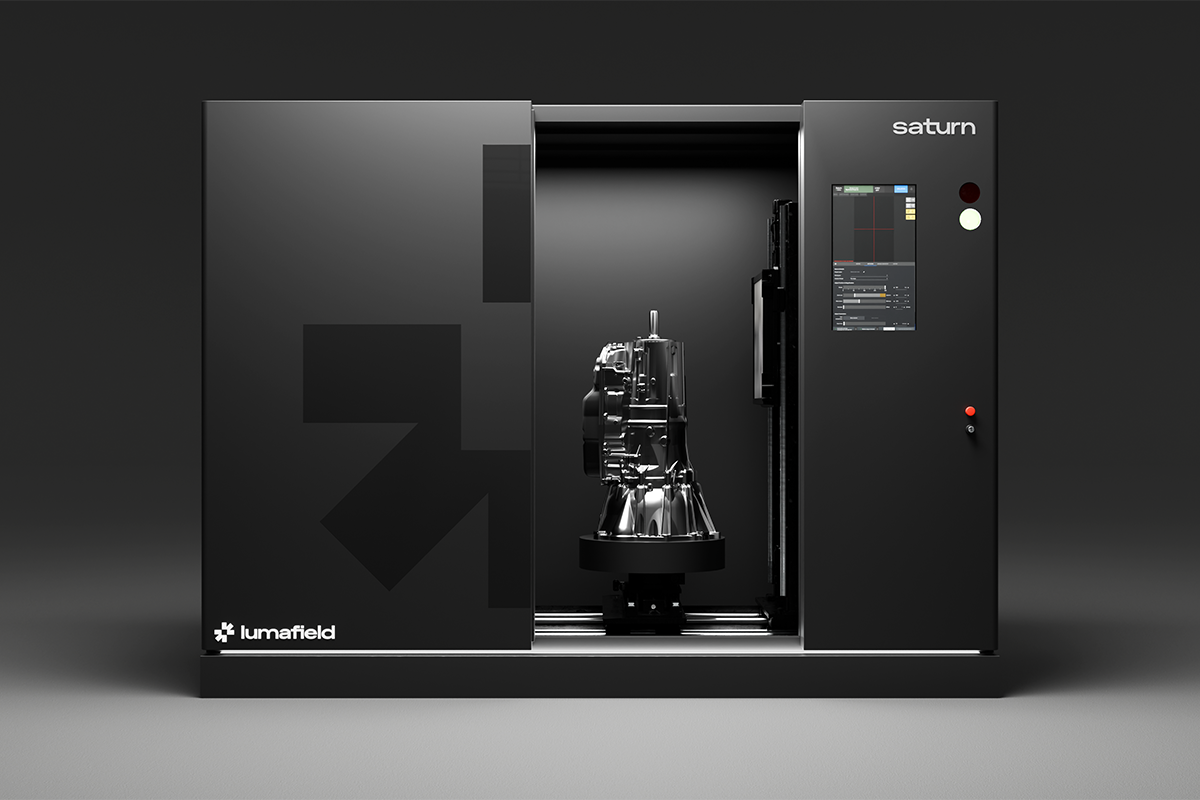
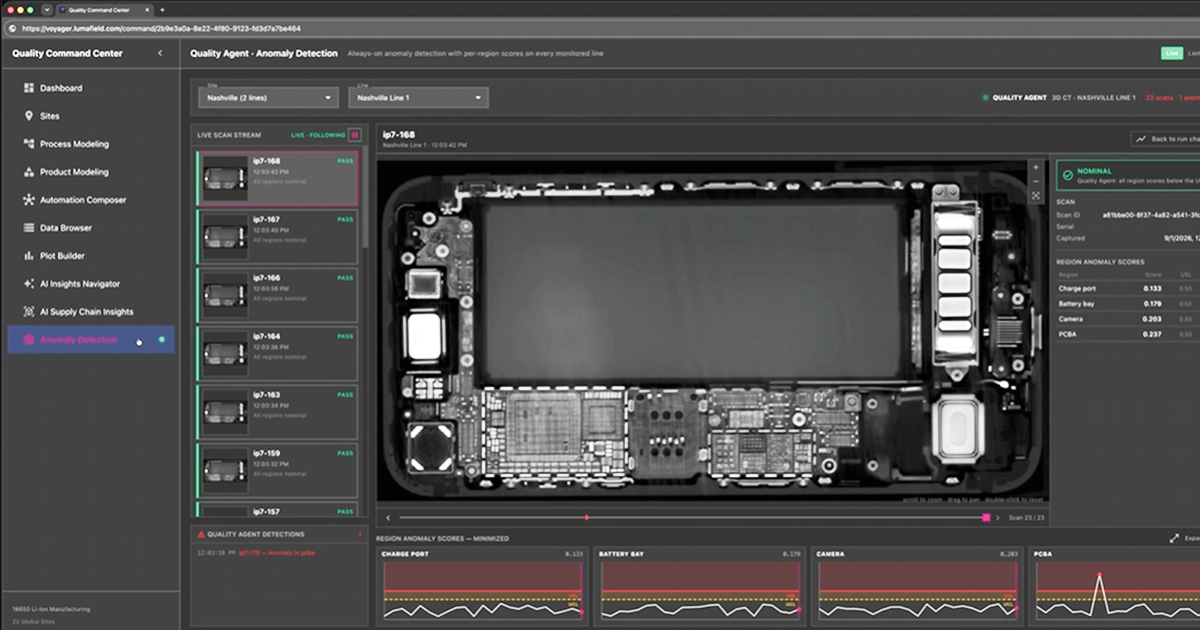
CT scanning builds a three-dimensional volume from two-dimensional X-ray images taken as the part rotates through a full 360 degrees. An X-ray source, a turntable, and a detector are the core components. The resulting model captures every internal feature of the part, including geometry, material density, and structural continuity, in a form that can be measured, annotated, and shared. Lumafield's Voyager software handles reconstruction and analysis in the browser, without requiring specialized hardware or a local install.

CT across the product development lifecycle

The applications change as a product matures, but the underlying need stays consistent: evidence of what's actually inside.

In R&D and early builds, CT is most useful for design validation and first article inspection. Engineers can compare a physical part against its CAD model, identify tooling issues before they compound across a production run, and catch assembly errors early enough to fix them without rework costs spiraling. The Whoop fitness tracker is a case study in this approach. CT analysis of prototypes in an assembled state revealed misassembled components and gave the team specific, visual evidence to share with the supplier before volume production began.

In mass production, the question shifts from "is the design right" to "is every unit coming off the line the way we designed it." CT reduces the dependence on destructive testing, which has an obvious limitation: the unit you cut open isn't the unit you ship. Non-destructive CT gives quality teams the ability to inspect finished goods, investigate field returns, and compare flagged units against known-good samples.

PCBAs, connectors, and batteries

The webinar covers three component categories in depth.

For printed circuit board assemblies, CT reveals defects that are invisible to optical inspection and difficult to characterize with 2D X-ray: wire bond geometry in three dimensions, voids and delamination within BGA layers, solder joint integrity at the connection level. These are the kinds of failures that pass visual inspection and surface electrical test before showing up as field failures.

For connectors, accurate measurement of contact surfaces matters for stable electrical connections. CT identifies misalignments in pin geometry and exposes voids and gaps in solder joints that reduce both mechanical strength and conductivity.

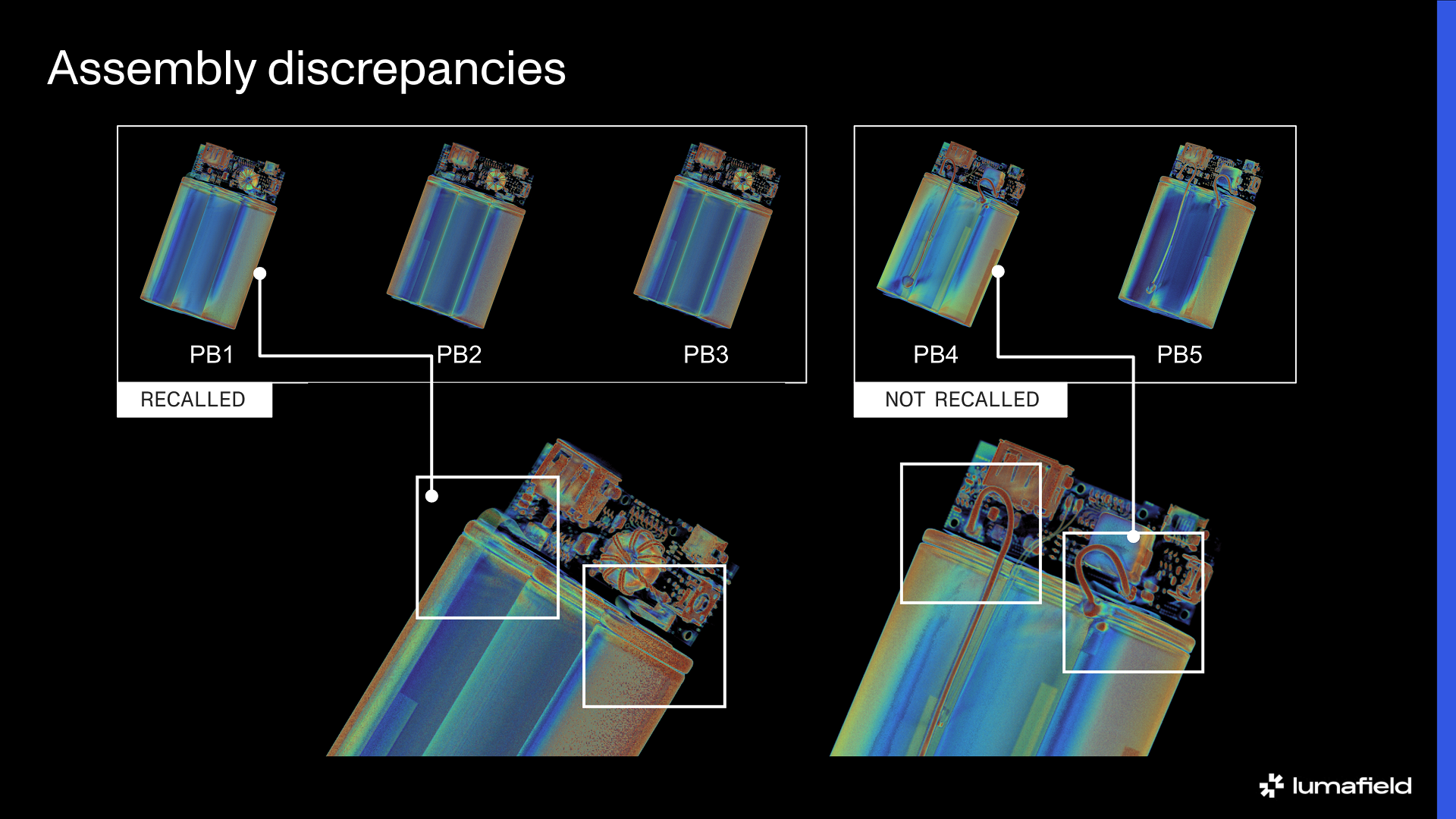
For batteries, CT is used to detect foreign object debris and measure anode overhang, a dimensional parameter with direct implications for dendrite formation and long-term safety. The Anker power bank recall is examined as a real-world example: CT inspection of recalled and non-recalled units revealed tab wire deformation, assembly discrepancies, and signs of different cell suppliers across the product line.
Lumafield's product lineup

Neptune is Lumafield's R&D and laboratory CT scanner. It is the right tool for failure analysis, first article inspection, and dimensional metrology where resolution and precision are the primary requirements. Triton is built for production-scale throughput, handling volume inspection without sacrificing the detail quality teams need. Voyager ties both together in a single software platform, handling reconstruction, measurement, comparison, and workflow management, and connecting results to existing enterprise systems.

About the presenter

Alex Hao leads the Product Marketing team at Lumafield. Previously, she worked in product and research roles in photonics and additive manufacturing. Hao received her BFA from the Rhode Island School of Design and her MBA from the New York University Stern School of Business. She is based in San Francisco.

Webinar
Article

Webinar: Inspecting electronics with industrial X-ray CT

August 12, 2025

Webinar: Inspecting electronics with industrial X-ray CT

On-demand webinar
What CT scanning is and how it works

CT scanning builds a three-dimensional volume from two-dimensional X-ray images taken as the part rotates through a full 360 degrees. An X-ray source, a turntable, and a detector are the core components. The resulting model captures every internal feature of the part, including geometry, material density, and structural continuity, in a form that can be measured, annotated, and shared. Lumafield's Voyager software handles reconstruction and analysis in the browser, without requiring specialized hardware or a local install.

CT across the product development lifecycle

The applications change as a product matures, but the underlying need stays consistent: evidence of what's actually inside.

In R&D and early builds, CT is most useful for design validation and first article inspection. Engineers can compare a physical part against its CAD model, identify tooling issues before they compound across a production run, and catch assembly errors early enough to fix them without rework costs spiraling. The Whoop fitness tracker is a case study in this approach. CT analysis of prototypes in an assembled state revealed misassembled components and gave the team specific, visual evidence to share with the supplier before volume production began.

In mass production, the question shifts from "is the design right" to "is every unit coming off the line the way we designed it." CT reduces the dependence on destructive testing, which has an obvious limitation: the unit you cut open isn't the unit you ship. Non-destructive CT gives quality teams the ability to inspect finished goods, investigate field returns, and compare flagged units against known-good samples.

PCBAs, connectors, and batteries

The webinar covers three component categories in depth.

For printed circuit board assemblies, CT reveals defects that are invisible to optical inspection and difficult to characterize with 2D X-ray: wire bond geometry in three dimensions, voids and delamination within BGA layers, solder joint integrity at the connection level. These are the kinds of failures that pass visual inspection and surface electrical test before showing up as field failures.

For connectors, accurate measurement of contact surfaces matters for stable electrical connections. CT identifies misalignments in pin geometry and exposes voids and gaps in solder joints that reduce both mechanical strength and conductivity.

For batteries, CT is used to detect foreign object debris and measure anode overhang, a dimensional parameter with direct implications for dendrite formation and long-term safety. The Anker power bank recall is examined as a real-world example: CT inspection of recalled and non-recalled units revealed tab wire deformation, assembly discrepancies, and signs of different cell suppliers across the product line.

Lumafield's product lineup

Neptune is Lumafield's R&D and laboratory CT scanner. It is the right tool for failure analysis, first article inspection, and dimensional metrology where resolution and precision are the primary requirements. Triton is built for production-scale throughput, handling volume inspection without sacrificing the detail quality teams need. Voyager ties both together in a single software platform, handling reconstruction, measurement, comparison, and workflow management, and connecting results to existing enterprise systems.

About the presenter

Alex Hao leads the Product Marketing team at Lumafield. Previously, she worked in product and research roles in photonics and additive manufacturing. Hao received her BFA from the Rhode Island School of Design and her MBA from the New York University Stern School of Business. She is based in San Francisco.

メインコンテンツへスキップ