Unilever Packaging Quality Report
Every year, Apple ships hundreds of millions of iPhones across more than 60 countries, each one dependent on a battery that performs exactly as specified. As third-party repair ecosystems grow and the refurbished device market expands, the question of what is actually inside a replacement battery becomes more consequential.
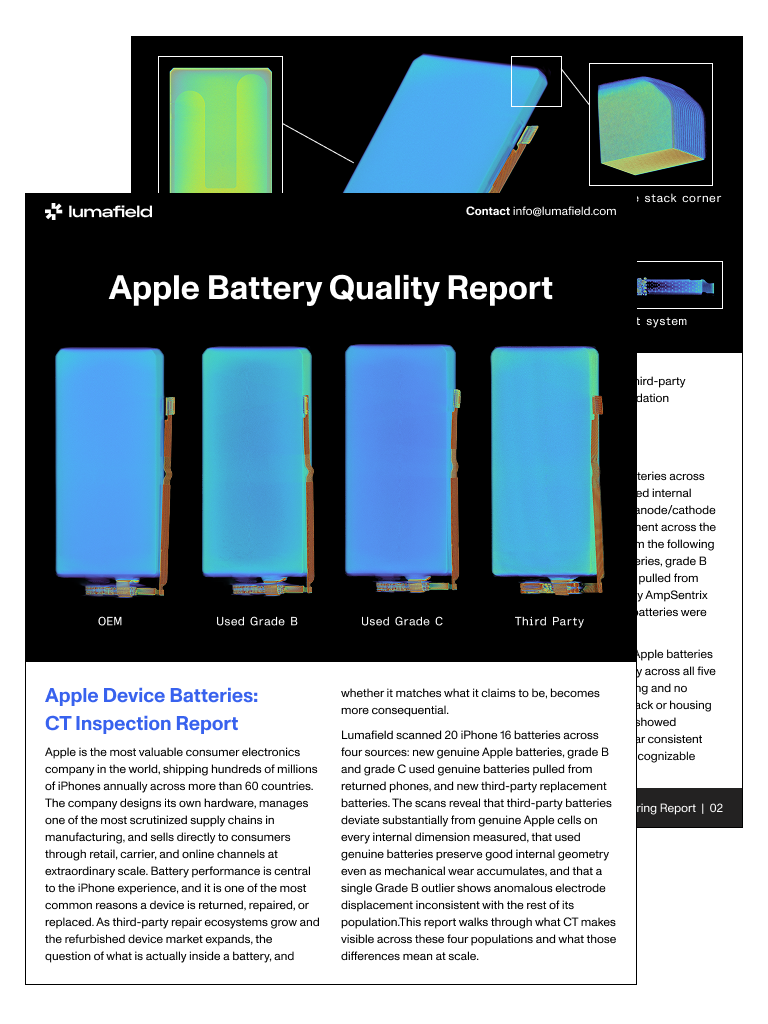
We CT scanned genuine Apple batteries, used batteries pulled from phones, and third-party replacements to examine the differences.
20
iPhone 16 batteries CT scanned across 4 source populations.
2x
higher anode overhang in third-party batteries compared to genuine Apple cells.
3x
worse edge alignment in the third-party replacement cells, versus OEM.
$7.4B
global mobile battery replacement services market in 2024.
247M
iPhones shipped worldwide in 2025.
$62.7B
global used and refurbished smartphone market in 2024.
Every lithium-ion battery degrades, and in no device is the gradual performance hit more apparent than in a mobile phone. Repairs and refurbishment allow users to extend the lifespan of their devices, but the internal quality of the battery replacement being installed is generally invisible.
Lumafield scanned 20 iPhone 16 batteries across four source populations: new genuine Apple batteries, grade B and grade C used cells pulled from returned phones, and new third-party replacements. The goal was to find out whether the differences that matter to battery performance and safety are visible before a phone fails.
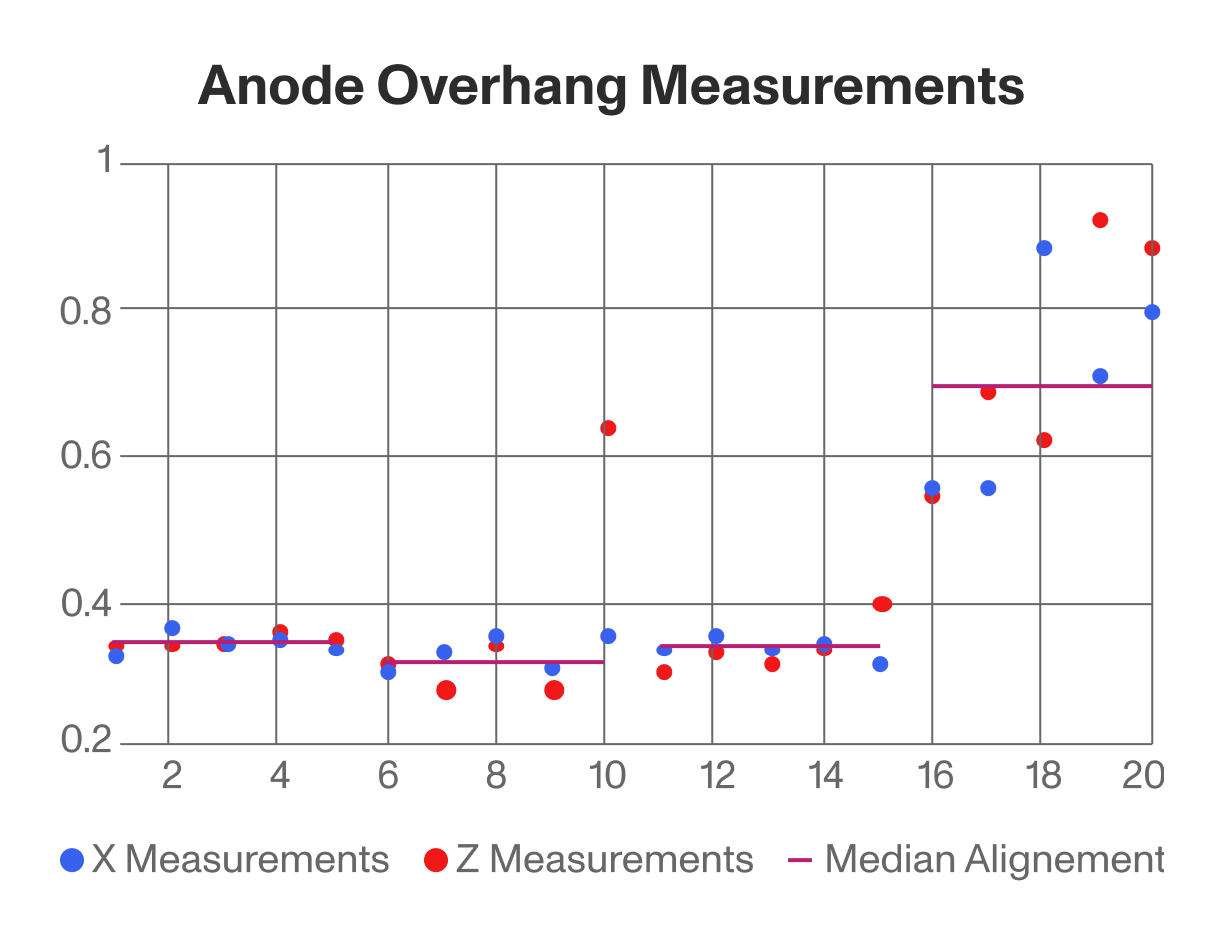
Our automated analysis focused on anode/cathode overhang and electrode edge alignment, two internal geometry parameters that directly govern cell performance and safety margin and are invisible to other inspection methods.
What we found:

Apple precision prevails
New genuine Apple cells showed tightly controlled anode overhang across all five units, with a standard deviation of just 0.013. The narrow spread reflects consistent, well-controlled manufacturing processes.

Genuine used holds up
Grade B and grade C batteries pulled from returned iPhones preserved good internal geometry through normal use, with overhang and alignment values comparable to new genuine cells.

Third-party lags behind
Third-party batteries showed anode overhang more than 2x that of genuine Apple cells, with a median of 0.697 mm versus 0.342 mm for new OEM units. Unit-to-unit variation was also substantially wider, pointing to looser manufacturing tolerances.
Download Lumafield's full Apple Report to discover:
- Detailed findings on battery quality across OEM, grade B and C iPhone pulls, and third-party cells
- How automated CT analysis turns internal battery geometry into measurable, traceable quality data
- Insights into the investigation methodology, including Lumafield's cutting-edge CT scanning and automated analysis techniques
- Recommendations for manufacturers and consumers to monitor process quality in the battery supply chain
Learn how industrial X-ray CT can identify and help reduce hidden hazards in the lithium-ion battery supply chain.