FREE WHITE PAPER

Heading

Date
This is some text inside of a div block.
FREE WHITE PAPER

Heading 1

Heading 2

Heading 3

Heading 4

Heading 5
Heading 6

Lorem ipsum dolor sit amet, consectetur adipiscing elit, sed do eiusmod tempor incididunt ut labore et dolore magna aliqua. Ut enim ad minim veniam, quis nostrud exercitation ullamco laboris nisi ut aliquip ex ea commodo consequat. Duis aute irure dolor in reprehenderit in voluptate velit esse cillum dolore eu fugiat nulla pariatur.

Block quote

Ordered list

  1. Item 1
  2. Item 2
  3. Item 3

Unordered list

  • Item A
  • Item B
  • Item C

Text link

Bold text

Emphasis

Superscript

Subscript

Heading 1

Heading 2

Heading 3

Heading 4

Heading 5
Heading 6

Lorem ipsum dolor sit amet, consectetur adipiscing elit, sed do eiusmod tempor incididunt ut labore et dolore magna aliqua. Ut enim ad minim veniam, quis nostrud exercitation ullamco laboris nisi ut aliquip ex ea commodo consequat. Duis aute irure dolor in reprehenderit in voluptate velit esse cillum dolore eu fugiat nulla pariatur.

Block quote

Ordered list

  1. Item 1
  2. Item 2
  3. Item 3

Unordered list

  • Item A
  • Item B
  • Item C

Text link

Bold text

Emphasis

Superscript

Subscript

Download Resource
Thank you! Your submission has been received!
Oops! Something went wrong while submitting the form.

Finding Hidden Risks in the Battery Supply Chain

Edited by
Date
September 24, 2025

Billions of 18650 lithium-ion cells move quietly into daily life each year, powering everything from toothbrushes and power tools to e-bikes and electric vehicles. All these batteries share the same 18 mm by 65 mm can, but their simple cylindrical packaging conceals the internal jelly roll structure that will ultimately decide how a cell behaves over time. In an increasingly electrified world, cell quality is critical. Every rechargeable device carries a small but real hazard, and when multiplied across billions of gadgets and the numerous cells inside many of them, that risk accumulates. Battery fires and explosions are serious events that cause injuries, fatalities, and substantial property damage.

Lumafield set out to measure the quality of batteries from different sources, and we’re publishing the results today in the Battery Quality Report. We CT-scanned and automatically analyzed 1,054 individual cells drawn from ten brands that ranged from established OEMs to rewraps and low-cost marketplace labels. This allowed us to look beyond advertised specifications, measuring the internal geometries that impact performance, degradation, and the risk of internal shorts. Two key quality features anchor the study: anode overhang (AOH) and edge alignment. In liquid-electrolyte lithium-ion cells, electrode misalignment is a known trigger for lithium plating. Plating promotes dendrite growth, which can potentially degrade performance and create internal shorts that escalate into thermal runaway.

Across the dataset, the contrasts were clear. Low-cost and counterfeit lots exhibited 7x lower anode-overhang quality relative to OEM cells, along with 50% worse edge alignment. Variability told the broader story: a few brands posted acceptable medians but featured wide distributions with considerable outliers, the signature of weak process control. Most concerning, negative AOH, also known as cathode overhang, appeared in 33 of the 1,054 cells we scanned. This defect significantly raises the likelihood of an internal short and a thermal event. All 33 of those defective cells came from low-cost or counterfeit brands. Within that segment, the rate was roughly 1 in 13 cells, close to 8%.
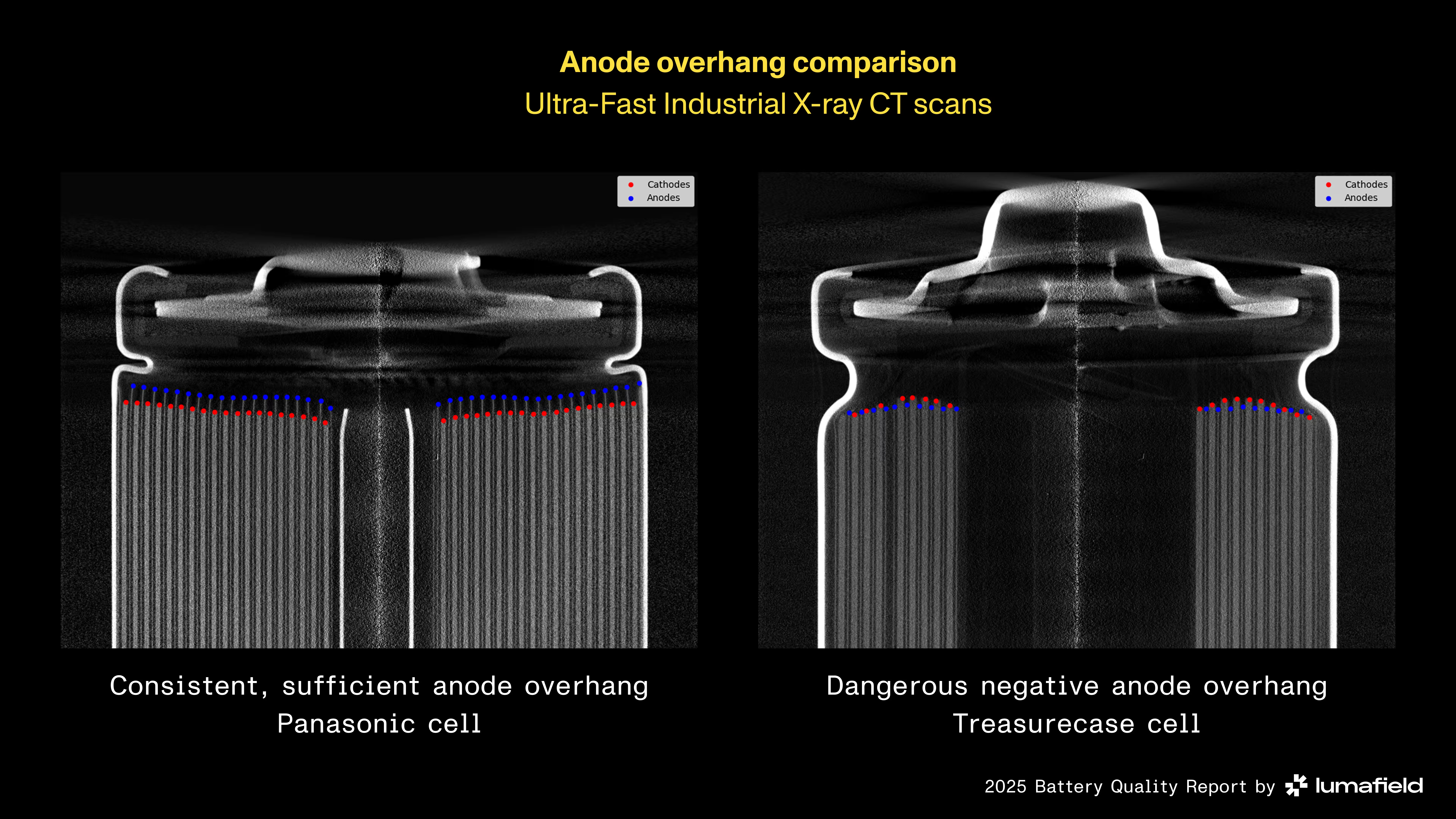
The pattern matches what the public experiences and what regulators record. The Consumer Product Safety Commission continues to issue frequent recalls and warnings linked to battery overheating and fires. A low per-cell failure rate can look reassuring in isolation, but once production reaches into the billions, even rare defects become common encounters in the field. When hazardous geometry hides behind a familiar name, the risk steps out of a factory and into a home, a garage, or a crowded street.

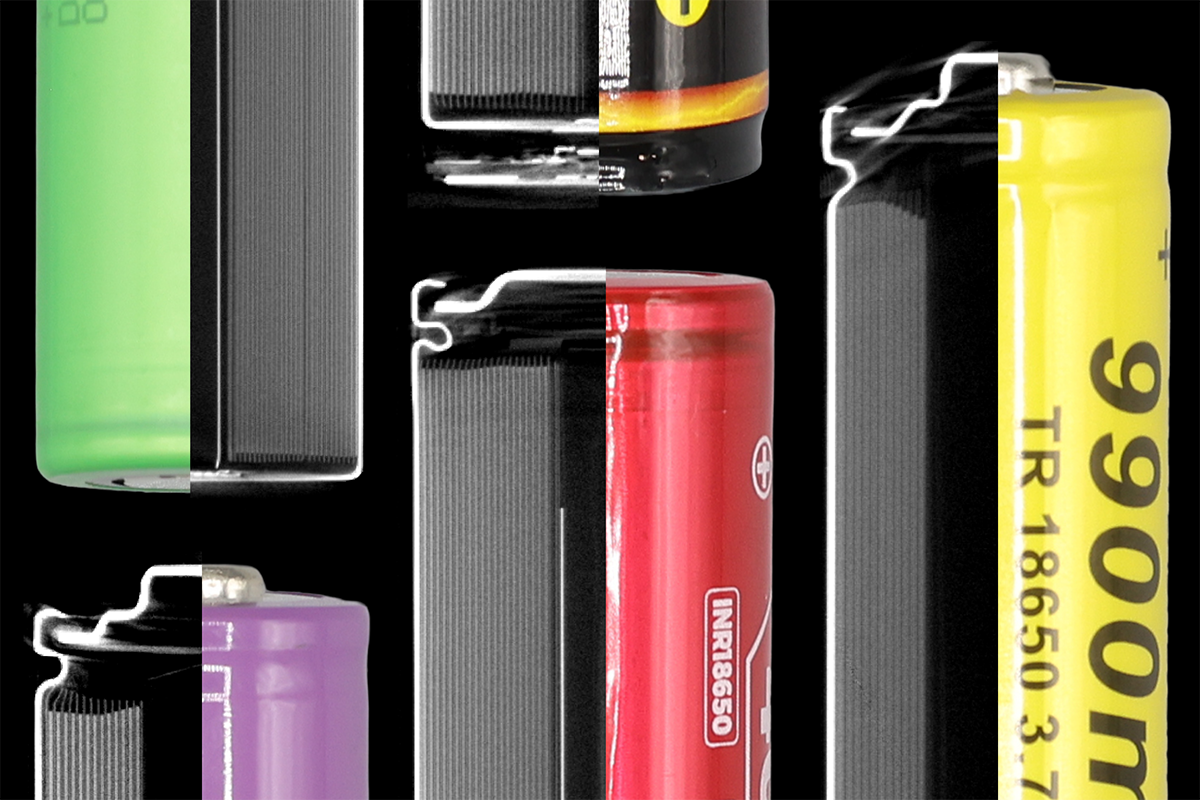
Shady actors exploit the trust that reputable original battery manufacturers have earned. We documented a marketplace listing that mimicked Samsung’s well-regarded 30Q product name, as well as vendors advertising capacities as high as 9900 mAh in a format that typically delivers around 3000 mAh. Packaging can make a promise, but CT data offers a verdict. Once the jelly roll is revealed by a CT scan, marketing gives way to measurable reality.

We conducted our study the same way that modern quality teams operate at best-in-class manufacturers. We captured high-resolution scans on Lumafield CT scanners and used our automated Battery Analysis Module to extract anode-overhang and edge-alignment metrics at scale. Because the measurements live in the browser alongside the 3D volumes, teams that cross engineering, reliability, and supplier quality can examine the same evidence, reach the same conclusion, and act without delay. The result is a practical screening workflow that fits vendor qualification, incoming inspection, and failure analysis while keeping parts intact and production moving.

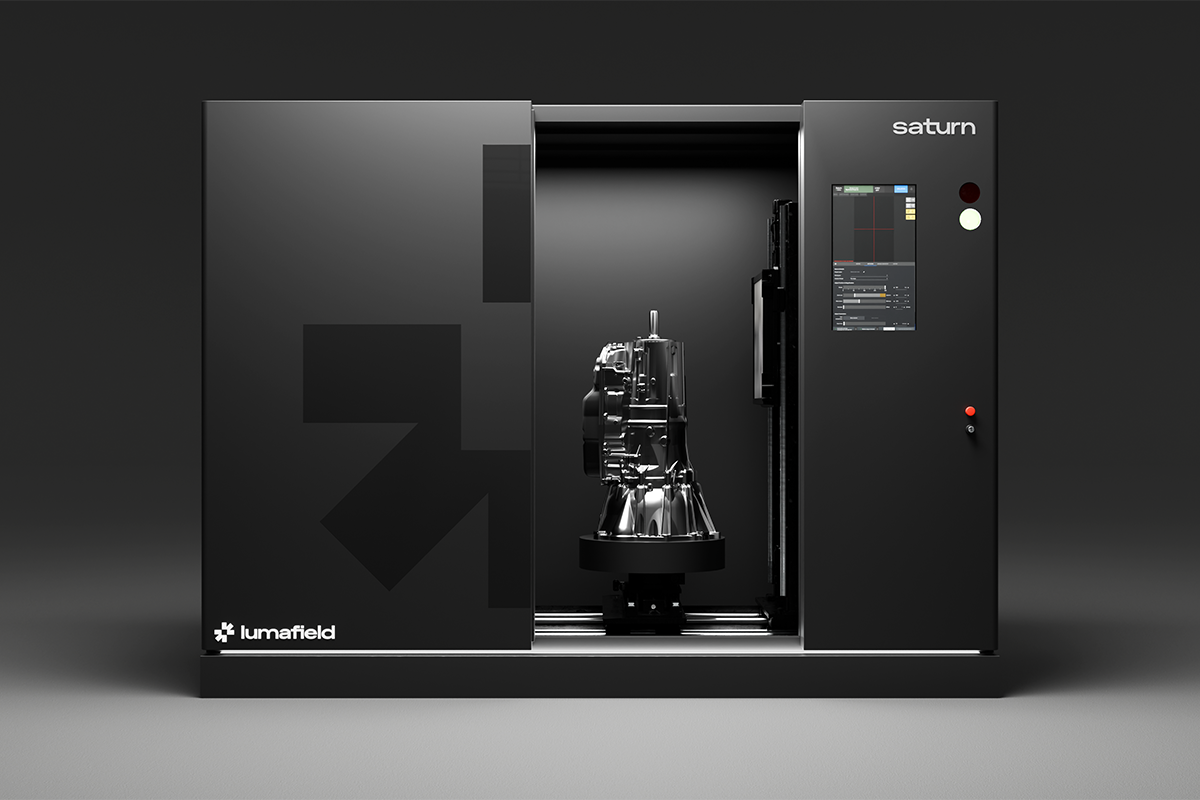
We built the study around production reality, prioritizing fast scan acquisition and automated measurement to match the pace of modern battery lines. With annual 18650 output exceeding 5 billion cells, speed is what makes an inspection method practical. The work was executed on Lumafield’s industrial X-ray CT platform, which includes the Neptune Industrial X-ray CT Scanner and Triton Automated Factory CT scanner. In production, Triton paired with Ultra-Fast CT delivers scans in under 5 seconds, enabling throughput above 720 cells per hour.
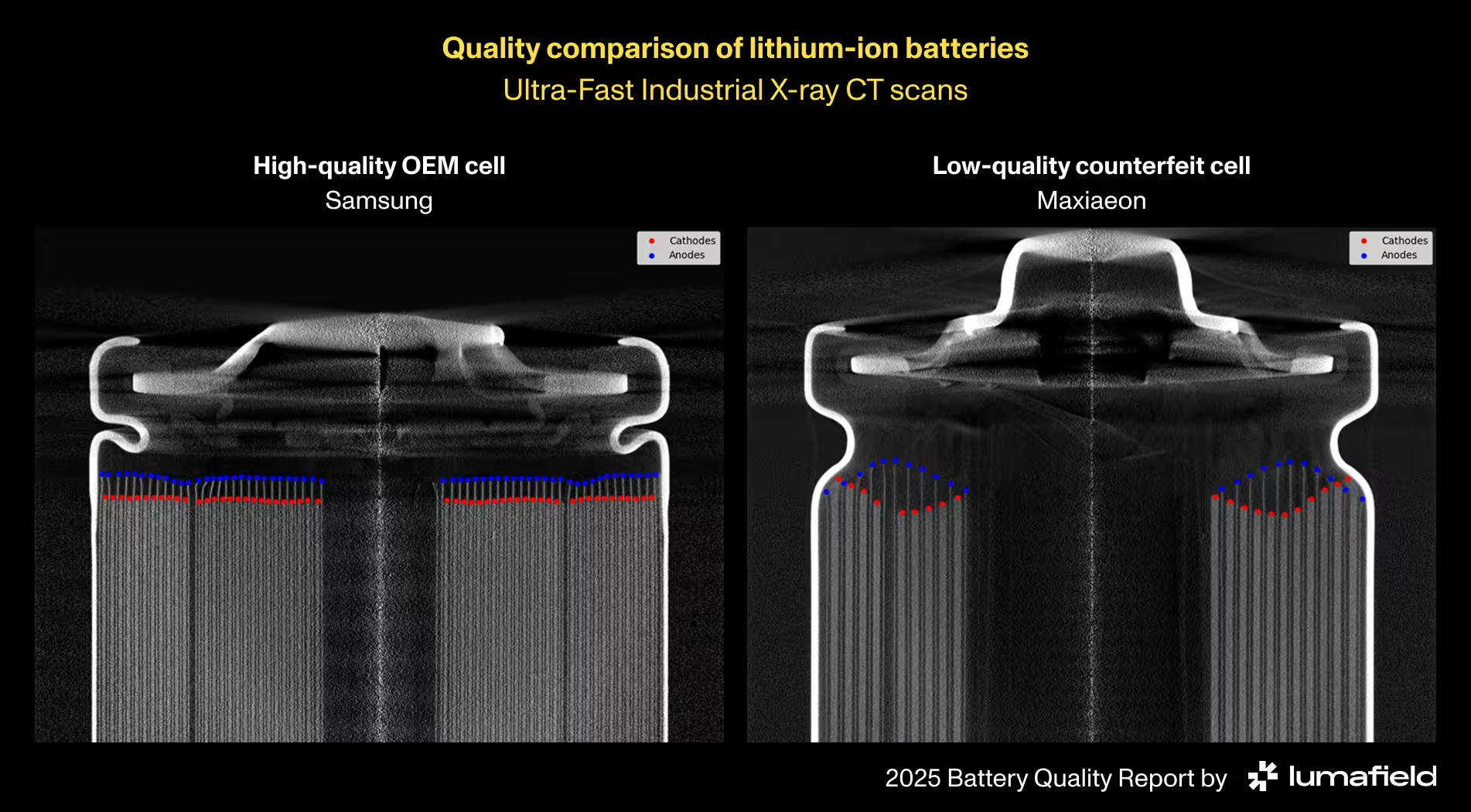
In a cylindrical cell supply chain that often obscures provenance, CT gives you a clear look at what you’re actually buying. X-ray CT inspection uncovers the secrets of rewraps, flags mixed lots, and surfaces process drift before it becomes a field problem. With Lumafield’s flexible and accessible CT solutions, manufacturers can raise sampling rates dramatically and screen a much larger share of incoming material without slowing production.

The findings in Lumafield’s Battery Quality Report drive home the real and present danger of uncertainty within a product that’s become an omnipresent fixture of contemporary life. An uncontrolled supply chain invites defects that put products and people at risk, so every stakeholder has a role to play. Cell makers, pack builders, device integrators, and the consumers who depend on this technology all benefit when quality becomes visible and measured, allowing everyone to take concrete steps to reduce risk.
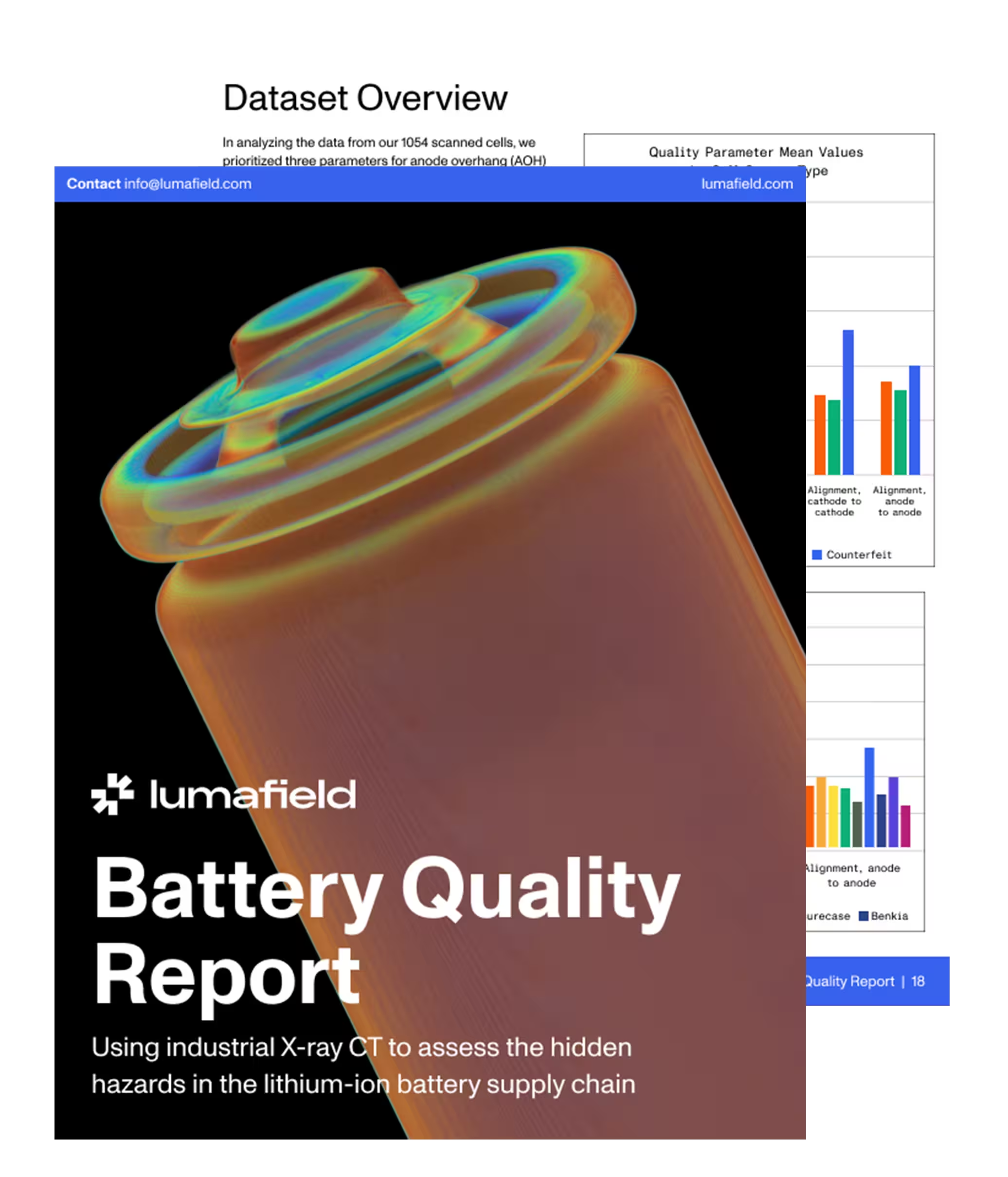
Download the full report now.
Article
Article

Finding Hidden Risks in the Battery Supply Chain

September 24, 2025
Article

Finding Hidden Risks in the Battery Supply Chain

Billions of 18650 lithium-ion cells move quietly into daily life each year, powering everything from toothbrushes and power tools to e-bikes and electric vehicles. All these batteries share the same 18 mm by 65 mm can, but their simple cylindrical packaging conceals the internal jelly roll structure that will ultimately decide how a cell behaves over time. In an increasingly electrified world, cell quality is critical. Every rechargeable device carries a small but real hazard, and when multiplied across billions of gadgets and the numerous cells inside many of them, that risk accumulates. Battery fires and explosions are serious events that cause injuries, fatalities, and substantial property damage.

Lumafield set out to measure the quality of batteries from different sources, and we’re publishing the results today in the Battery Quality Report. We CT-scanned and automatically analyzed 1,054 individual cells drawn from ten brands that ranged from established OEMs to rewraps and low-cost marketplace labels. This allowed us to look beyond advertised specifications, measuring the internal geometries that impact performance, degradation, and the risk of internal shorts. Two key quality features anchor the study: anode overhang (AOH) and edge alignment. In liquid-electrolyte lithium-ion cells, electrode misalignment is a known trigger for lithium plating. Plating promotes dendrite growth, which can potentially degrade performance and create internal shorts that escalate into thermal runaway.

Across the dataset, the contrasts were clear. Low-cost and counterfeit lots exhibited 7x lower anode-overhang quality relative to OEM cells, along with 50% worse edge alignment. Variability told the broader story: a few brands posted acceptable medians but featured wide distributions with considerable outliers, the signature of weak process control. Most concerning, negative AOH, also known as cathode overhang, appeared in 33 of the 1,054 cells we scanned. This defect significantly raises the likelihood of an internal short and a thermal event. All 33 of those defective cells came from low-cost or counterfeit brands. Within that segment, the rate was roughly 1 in 13 cells, close to 8%.

The pattern matches what the public experiences and what regulators record. The Consumer Product Safety Commission continues to issue frequent recalls and warnings linked to battery overheating and fires. A low per-cell failure rate can look reassuring in isolation, but once production reaches into the billions, even rare defects become common encounters in the field. When hazardous geometry hides behind a familiar name, the risk steps out of a factory and into a home, a garage, or a crowded street.

Shady actors exploit the trust that reputable original battery manufacturers have earned. We documented a marketplace listing that mimicked Samsung’s well-regarded 30Q product name, as well as vendors advertising capacities as high as 9900 mAh in a format that typically delivers around 3000 mAh. Packaging can make a promise, but CT data offers a verdict. Once the jelly roll is revealed by a CT scan, marketing gives way to measurable reality.

We conducted our study the same way that modern quality teams operate at best-in-class manufacturers. We captured high-resolution scans on Lumafield CT scanners and used our automated Battery Analysis Module to extract anode-overhang and edge-alignment metrics at scale. Because the measurements live in the browser alongside the 3D volumes, teams that cross engineering, reliability, and supplier quality can examine the same evidence, reach the same conclusion, and act without delay. The result is a practical screening workflow that fits vendor qualification, incoming inspection, and failure analysis while keeping parts intact and production moving.

We built the study around production reality, prioritizing fast scan acquisition and automated measurement to match the pace of modern battery lines. With annual 18650 output exceeding 5 billion cells, speed is what makes an inspection method practical. The work was executed on Lumafield’s industrial X-ray CT platform, which includes the Neptune Industrial X-ray CT Scanner and Triton Automated Factory CT scanner. In production, Triton paired with Ultra-Fast CT delivers scans in under 5 seconds, enabling throughput above 720 cells per hour.

In a cylindrical cell supply chain that often obscures provenance, CT gives you a clear look at what you’re actually buying. X-ray CT inspection uncovers the secrets of rewraps, flags mixed lots, and surfaces process drift before it becomes a field problem. With Lumafield’s flexible and accessible CT solutions, manufacturers can raise sampling rates dramatically and screen a much larger share of incoming material without slowing production.

The findings in Lumafield’s Battery Quality Report drive home the real and present danger of uncertainty within a product that’s become an omnipresent fixture of contemporary life. An uncontrolled supply chain invites defects that put products and people at risk, so every stakeholder has a role to play. Cell makers, pack builders, device integrators, and the consumers who depend on this technology all benefit when quality becomes visible and measured, allowing everyone to take concrete steps to reduce risk.

Download the full report now.
Voyager Inspection Workflows
Introduction to Voyager
Introduction to Neptune
Introduction to Industrial CT
Introducing Neptune Performance and Triton Performance
Manufacturers Know Quality Costs Money. Most Don't Know How Much.
The Real Cost of a Product Recall and How to Prevent One
What Industrial CT Scanning Does for Manufacturing Quality
Next-Generation Drones: Protecting Performance with Industrial CT
CPG Quality: Strengthening Brand Safety with Advanced X-ray + CT
Explore more posts
Skip to main content
New Performance scanners are here >
Platform
Solutions
All Industries
Aerospace and Defense
Agriculture and Food
Athletic Equipment
Automotive
Batteries
Consumer Packaged Goods
Electronics
Medical Devices
Applications
Resources
White Papers
Case Studies
Webinars
Blog
Insights from lumafield
Go/No-Go
Manufacturing podcast
First Article
Editorial Publication
Company
About
Careers
Press
Events
Launch Voyager
Contact Sales
Menu
PlatformSolutions
Industries
All Industries
Agriculture and Food
Electronics
Aerospace and Defense
Automotive
Athletic Equipment
Consumer Packaged Goods
Medical Devices
Batteries
Applications
Resources
Resources
White Papers
Case Studies
Webinars
Blog
Go/No-Go Podcast
First Article
Company
Company
About
Careers
Press
Events
Contact Sales
Launch Voyager
© 2000 Lumafield. All Rights Reserved.
changing the way
the world makes
everything
Solutions
Aerospace and Defense
Agriculture and Food
Athletic Equipment
Automotive
Batteries
Consumer Packaged Goods
Electronics
Medical Devices
All Industries
Applications
Assembly Verification
Competitive Benchmarking and Analysis
Defect Detection
Design Verification and Validation
Dimensional Measurement
Failure Analysis
First Article Inspection (FAI)
Material Characterization
Non-Destructive Testing (NDT)
Quality Assurance and Control (QA & QC)
Reverse Engineering
Supplier Qualification
All Applications
Products
NeptuneTritonVoyagerAtlas
Resources
LearnFirst ArticleWhite PapersEventsWebinarsSupportCase StudiesCT 101Engineers' Blog
Company
LoginAboutCareersPressBlogContact

Sign up for our newsletter

info@lumafield.com
PrivacyInformation SecurityDeployment Services Agreement
© 2000 Lumafield. All Rights Reserved.