FREE WHITE PAPER

Heading

Date
This is some text inside of a div block.
FREE WHITE PAPER

Heading 1

Heading 2

Heading 3

Heading 4

Heading 5
Heading 6

Lorem ipsum dolor sit amet, consectetur adipiscing elit, sed do eiusmod tempor incididunt ut labore et dolore magna aliqua. Ut enim ad minim veniam, quis nostrud exercitation ullamco laboris nisi ut aliquip ex ea commodo consequat. Duis aute irure dolor in reprehenderit in voluptate velit esse cillum dolore eu fugiat nulla pariatur.

Block quote

Ordered list

  1. Item 1
  2. Item 2
  3. Item 3

Unordered list

  • Item A
  • Item B
  • Item C

Text link

Bold text

Emphasis

Superscript

Subscript

Heading 1

Heading 2

Heading 3

Heading 4

Heading 5
Heading 6

Lorem ipsum dolor sit amet, consectetur adipiscing elit, sed do eiusmod tempor incididunt ut labore et dolore magna aliqua. Ut enim ad minim veniam, quis nostrud exercitation ullamco laboris nisi ut aliquip ex ea commodo consequat. Duis aute irure dolor in reprehenderit in voluptate velit esse cillum dolore eu fugiat nulla pariatur.

Block quote

Ordered list

  1. Item 1
  2. Item 2
  3. Item 3

Unordered list

  • Item A
  • Item B
  • Item C

Text link

Bold text

Emphasis

Superscript

Subscript

Download Resource
Thank you! Your submission has been received!
Oops! Something went wrong while submitting the form.

Finding Lead in Stanley's Quencher

Edited by
Date
March 14, 2024

In a remarkable story of product innovation, Stanley became, in the words of its Global President Terence Reilly, a “110-year-old overnight success.” The company’s journey from inventing the first vacuum-sealed water bottle in 1913 to becoming a TikTok sensation began with the launch of the Quencher tumbler in 2016. The Quencher initially saw modest success, but a strategic shift in 2020 towards vibrant new colors and finishes caught the eye of a new generation of consumers. This pivot, coupled with savvy social media marketing and influencer collaborations, caused Stanley's revenue to skyrocket from $70 million in 2019 to $750 million in 2023.

More recently, the same social media enthusiasm that propelled Stanley to new heights has revealed itself as a double-edged sword. Social media influencers have discovered that lead solder is used in the Quencher’s manufacturing process, jeopardizing Stanley’s success. 

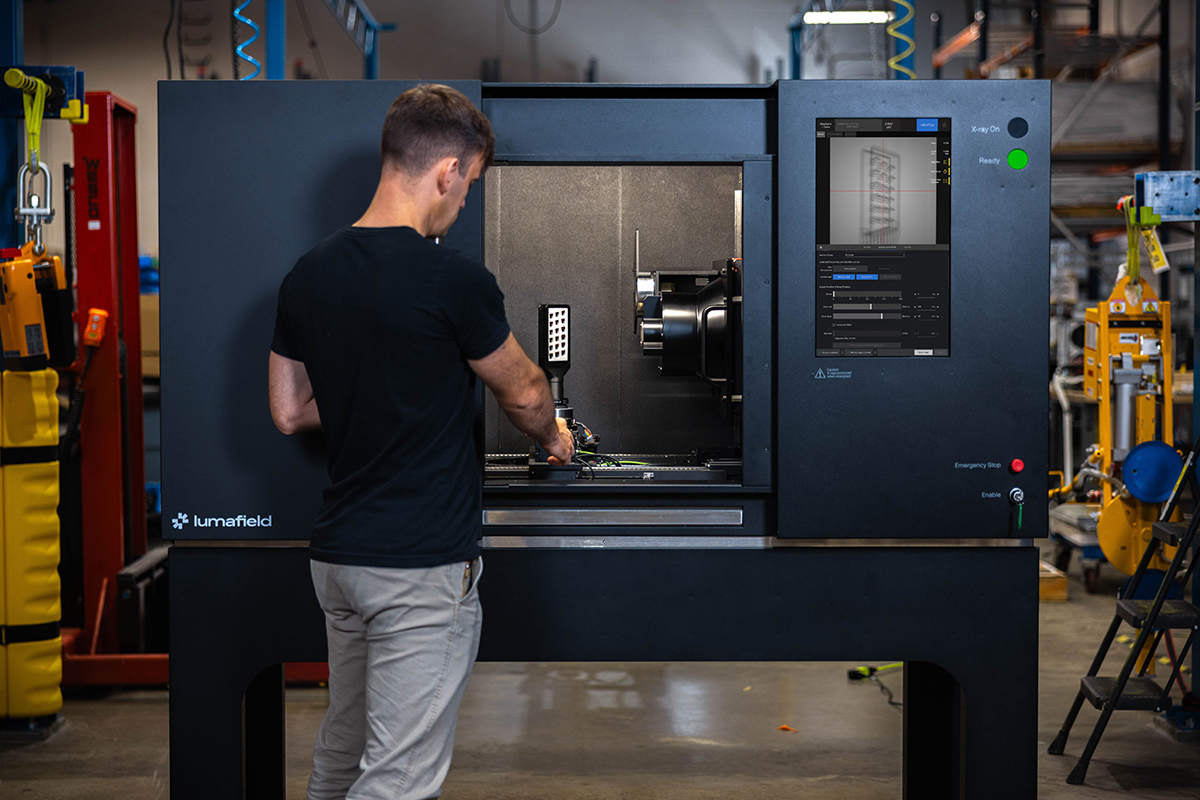
But is the lead in the Quencher actually dangerous? Our Neptune industrial X-ray CT scanner is the perfect tool to see inside Stanley’s tumbler to understand how it’s made and whether or not lead solder truly poses a risk to consumers.

Stanley’s cups have inner and outer walls made of stainless steel, separated by a vacuum that minimizes heat transfer. The manufacturing process for vacuum-insulated stainless steel containers starts by forming two separate stainless steel layers for the inner and outer walls, which are then welded together at the rim to create a sealed unit. The cup is placed in a vacuum chamber, and air is removed through a hole that’s left in the bottom of the outer layer.

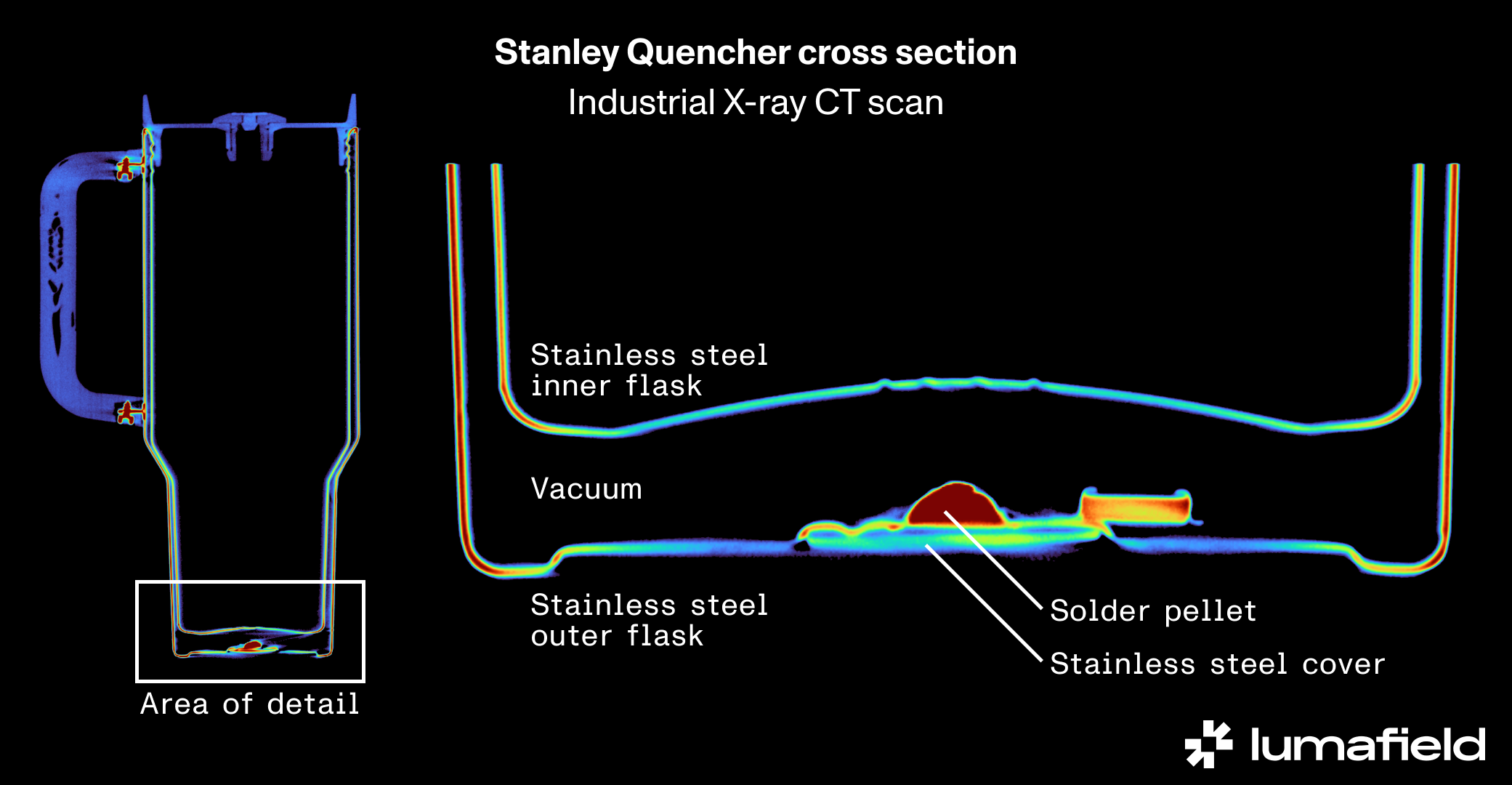
At this point, the hole through which air was evacuated must be sealed before the cup is removed from the vacuum chamber. Lead solder provides a reliable and cost-effective answer. During the assembly of the inner and outer layers, a small lead pellet is placed above the air-escape hole. After the air is pulled out of the cup, the vacuum chamber is heated just enough to melt the lead, causing it to flow into the air escape hole and seal it. When the vacuum chamber is opened, a vacuum remains between the cup’s walls.

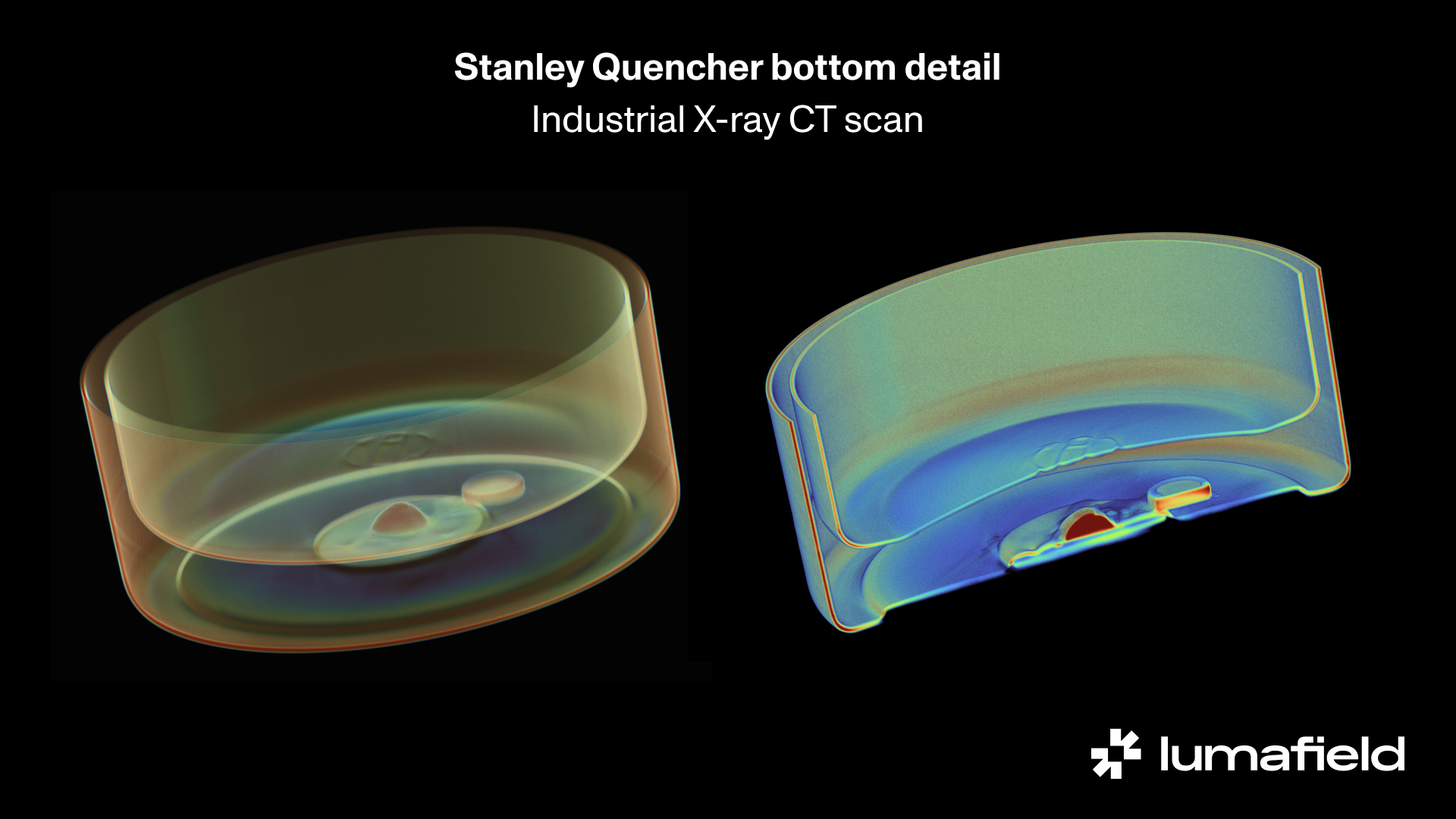
In our CT scans, we can clearly see the inner and outer stainless steel flask layers, as well as the solder point. We also see a metal disk attached to a welded tab, which may be a component used to position the solder and hold it in place before it’s melted. Dense materials or those made of elements with higher atomic numbers attenuate (absorb or scatter) X-rays more. Lead is very dense and tends to block X-rays, which is why it’s used to protect people from X-ray radiation. In Voyager, we’ve applied a color map to the reconstruction that corresponds to the range of material attenuation coefficients. Lead, the most attenuating, appears here as a solid red. The scan shows that the lead solder is completely shielded by a stainless steel cover just below it.
Stanley issued a statement saying, “Once sealed, this area is covered with a durable stainless steel layer, making it inaccessible to consumers. Rest assured that no lead is present on the surface of any Stanley product that comes into contact with the consumer nor the contents of the product. In the rare occurrence the base cap of a product comes off due to ordinary use and exposes this seal, it is eligible for our Lifetime Warranty.” 

Leaded solder, despite its known health risks, remains widely used in various industries, including electronics, due to its superior workability and lower melting point compared to unleaded alternatives. The Stanley revelation has sparked a debate on the difficult trade-offs manufacturers face between continuing with a well-established but potentially harmful material or investing in the development of safer—albeit more expensive and technically challenging—alternatives.

In response to the controversy, other reusable water bottle companies have been highlighting their lead-free manufacturing processes. Brands like Owala, Hydro Flask, and Klean Kanteen have successfully eliminated lead from their products, opting for alternative materials such as noncrystalline silica beads or proprietary sealants. These companies demonstrate that while the transition to lead-free manufacturing is complex and costly, it is feasible and aligns with growing consumer demand for environmentally friendly and safe products.
As consumers become more discerning about the products they buy, the pressure on companies to not compromise on safety or sustainability will only increase. Perhaps just as important as continued innovation is educating consumers on the relative risks associated with materials and manufacturing processes. Proactively demystifying the product's lifecycle and design choices could mean the difference between soaring success and a viral backlash.

Article
Article

Finding Lead in Stanley's Quencher

March 14, 2024
Article

Finding Lead in Stanley's Quencher

In a remarkable story of product innovation, Stanley became, in the words of its Global President Terence Reilly, a “110-year-old overnight success.” The company’s journey from inventing the first vacuum-sealed water bottle in 1913 to becoming a TikTok sensation began with the launch of the Quencher tumbler in 2016. The Quencher initially saw modest success, but a strategic shift in 2020 towards vibrant new colors and finishes caught the eye of a new generation of consumers. This pivot, coupled with savvy social media marketing and influencer collaborations, caused Stanley's revenue to skyrocket from $70 million in 2019 to $750 million in 2023.

More recently, the same social media enthusiasm that propelled Stanley to new heights has revealed itself as a double-edged sword. Social media influencers have discovered that lead solder is used in the Quencher’s manufacturing process, jeopardizing Stanley’s success. 

But is the lead in the Quencher actually dangerous? Our Neptune industrial X-ray CT scanner is the perfect tool to see inside Stanley’s tumbler to understand how it’s made and whether or not lead solder truly poses a risk to consumers.

Stanley’s cups have inner and outer walls made of stainless steel, separated by a vacuum that minimizes heat transfer. The manufacturing process for vacuum-insulated stainless steel containers starts by forming two separate stainless steel layers for the inner and outer walls, which are then welded together at the rim to create a sealed unit. The cup is placed in a vacuum chamber, and air is removed through a hole that’s left in the bottom of the outer layer.

At this point, the hole through which air was evacuated must be sealed before the cup is removed from the vacuum chamber. Lead solder provides a reliable and cost-effective answer. During the assembly of the inner and outer layers, a small lead pellet is placed above the air-escape hole. After the air is pulled out of the cup, the vacuum chamber is heated just enough to melt the lead, causing it to flow into the air escape hole and seal it. When the vacuum chamber is opened, a vacuum remains between the cup’s walls.

In our CT scans, we can clearly see the inner and outer stainless steel flask layers, as well as the solder point. We also see a metal disk attached to a welded tab, which may be a component used to position the solder and hold it in place before it’s melted. Dense materials or those made of elements with higher atomic numbers attenuate (absorb or scatter) X-rays more. Lead is very dense and tends to block X-rays, which is why it’s used to protect people from X-ray radiation. In Voyager, we’ve applied a color map to the reconstruction that corresponds to the range of material attenuation coefficients. Lead, the most attenuating, appears here as a solid red. The scan shows that the lead solder is completely shielded by a stainless steel cover just below it.

Stanley issued a statement saying, “Once sealed, this area is covered with a durable stainless steel layer, making it inaccessible to consumers. Rest assured that no lead is present on the surface of any Stanley product that comes into contact with the consumer nor the contents of the product. In the rare occurrence the base cap of a product comes off due to ordinary use and exposes this seal, it is eligible for our Lifetime Warranty.” 

Leaded solder, despite its known health risks, remains widely used in various industries, including electronics, due to its superior workability and lower melting point compared to unleaded alternatives. The Stanley revelation has sparked a debate on the difficult trade-offs manufacturers face between continuing with a well-established but potentially harmful material or investing in the development of safer—albeit more expensive and technically challenging—alternatives.

In response to the controversy, other reusable water bottle companies have been highlighting their lead-free manufacturing processes. Brands like Owala, Hydro Flask, and Klean Kanteen have successfully eliminated lead from their products, opting for alternative materials such as noncrystalline silica beads or proprietary sealants. These companies demonstrate that while the transition to lead-free manufacturing is complex and costly, it is feasible and aligns with growing consumer demand for environmentally friendly and safe products.

As consumers become more discerning about the products they buy, the pressure on companies to not compromise on safety or sustainability will only increase. Perhaps just as important as continued innovation is educating consumers on the relative risks associated with materials and manufacturing processes. Proactively demystifying the product's lifecycle and design choices could mean the difference between soaring success and a viral backlash.

Voyager Inspection Workflows
Introduction to Voyager
Introduction to Neptune
Introduction to Industrial CT
Advancing Automotive Inspection: Industrial CT for Better Outcomes
Introducing Neptune Performance and Triton Performance
Manufacturers Know Quality Costs Money. Most Don't Know How Much.
The Real Cost of a Product Recall and How to Prevent One
What Industrial CT Scanning Does for Manufacturing Quality
Next-Generation Drones: Protecting Performance with Industrial CT
Explore more posts
メインコンテンツへスキップ
World Cup Scan of the Month >
プラットフォーム
分野別ソリューション
すべての業界
バッテリー
医療機器
消費財
スポーツ用品
自動車
航空宇宙/防衛
農業と食品
電子機器
用途別アプリケーション
各種資料
技術資料
ケーススタディ
オンラインセミナー
Blog
Insights from lumafield
Go/No-Go
Manufacturing podcast
First Article
Editorial Publication
企業情報
会社概要
採用情報
プレスリリース
Events
Voyager を起動
お問い合わせはこちら
メニュー
製品業界
業界
すべての業界
電子機器
医療機器
自動車
消費財
バッテリー
農業と食品
航空宇宙/防衛
スポーツ用品
[アプリケーション]
リソース
リソース
ホワイトペーパー
101
オンラインセミナー
最初の記事
Go/No-Go Podcast
First Article
会社
会社
について
採用情報
プレス
Events
セールスに問い合わせる
ボイジャーを起動
© 2000 Lumafield. All Rights Reserved.
世界の”ものづくり”を変える。
分野別ソリューション
バッテリー
医療機器
消費財
スポーツ用品
自動車
航空宇宙/防衛
農業と食品
電子機器
すべての業界
用途別アプリケーション
リバースエンジニアリング
ファースト・アーティクル・インスペクション (FAI)
品質保証と品質管理
寸法測定
故障解析
材料特性評価
欠陥検出
競合ベンチマークと分析
組み立て検証
設計検証と妥当性の確認
サプライヤー適格性評価
非破壊検査 (NDT)
すべてのアプリケーション
製品
ネプチューントリトンボイジャーアトラス
各種資料
学習コンテンツメディア技術資料ウェビナーオンラインセミナー初回CTスキャン分析ガイドケーススタディCT入門エンジニアブログ
企業情報
ログイン会社概要採用情報プレスリリースブログお問い合わせ

ニュースレターに登録する

info@lumafield.com
プライバシー情報セキュリティ導入サービス契約
© 2000 ルマフィールド。全著作権所有。