FREE WHITE PAPER

Heading

Date
This is some text inside of a div block.
FREE WHITE PAPER

Heading 1

Heading 2

Heading 3

Heading 4

Heading 5
Heading 6

Lorem ipsum dolor sit amet, consectetur adipiscing elit, sed do eiusmod tempor incididunt ut labore et dolore magna aliqua. Ut enim ad minim veniam, quis nostrud exercitation ullamco laboris nisi ut aliquip ex ea commodo consequat. Duis aute irure dolor in reprehenderit in voluptate velit esse cillum dolore eu fugiat nulla pariatur.

Block quote

Ordered list

  1. Item 1
  2. Item 2
  3. Item 3

Unordered list

  • Item A
  • Item B
  • Item C

Text link

Bold text

Emphasis

Superscript

Subscript

Heading 1

Heading 2

Heading 3

Heading 4

Heading 5
Heading 6

Lorem ipsum dolor sit amet, consectetur adipiscing elit, sed do eiusmod tempor incididunt ut labore et dolore magna aliqua. Ut enim ad minim veniam, quis nostrud exercitation ullamco laboris nisi ut aliquip ex ea commodo consequat. Duis aute irure dolor in reprehenderit in voluptate velit esse cillum dolore eu fugiat nulla pariatur.

Block quote

Ordered list

  1. Item 1
  2. Item 2
  3. Item 3

Unordered list

  • Item A
  • Item B
  • Item C

Text link

Bold text

Emphasis

Superscript

Subscript

Download Resource
Thank you! Your submission has been received!
Oops! Something went wrong while submitting the form.

Introduction to Triton

Edited by
Date

Triton is designed for production environments that need fast, reliable inspection without slowing the line. It delivers industrial X-ray CT at high speed, with a compact footprint that fits comfortably beside or within existing workflows. The system measures about seven feet wide, just over six feet tall, and slightly under six feet deep. It runs on a standard 120-volt outlet, and its infeed and outfeed configurations can be arranged to suit a variety of factory layouts. Automated part handling supports lights-out operation, and Ultra Fast CT allows throughput of up to twelve parts per minute.

Inside the Machine

Parts enter Triton on pallets that travel along the infeed conveyor. Each pallet moves through the opening, follows a controlled path inside the machine, and arrives at the central chamber. During operation the door remains locked, though operators can open it during setup by pressing the unlatch button on the touchscreen.

Inside the chamber, the pallet is lifted into position for scanning. A motorized turntable rotates the part so the system can capture a complete set of radiographs. When the scan is finished, the pallet returns to the conveyor and proceeds to the outfeed. Here the scanner sorts parts automatically, using a rejector arm to separate pass and fail units based on the inspection criteria defined in software. While Triton is running, the touchscreen shows both the movement of parts through the machine and a live view of the radiographs being collected.

A Focus on Safety

Triton incorporates shielding and mechanical safeguards that protect operators and nearby personnel. Its internal path for parts has a maze-like shape that prevents radiation from leaving the chamber while still allowing open infeed and outfeed points. X-rays can only be generated when the door is locked and the system confirms that it is safe to proceed. Additional measures include an emergency stop and a keyed lockout switch. Every Lumafield scanner undergoes rigorous testing at installation and during service.
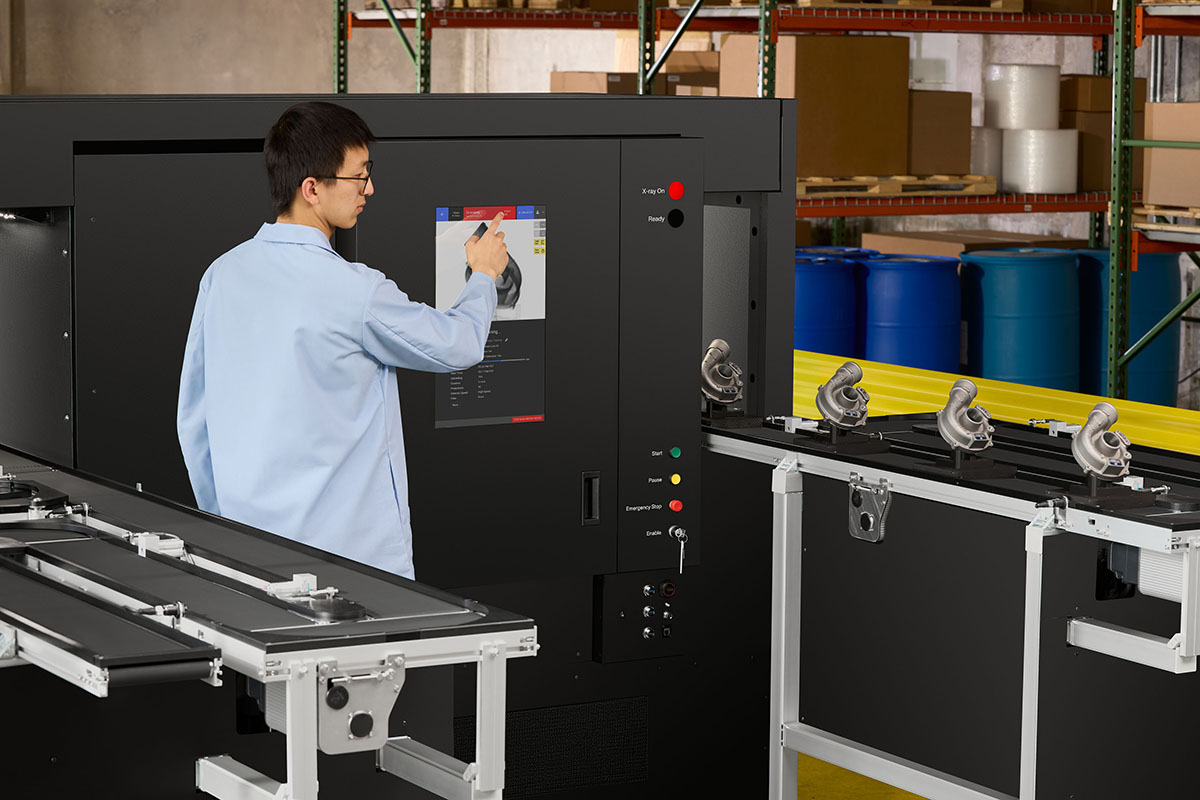
Triton can make instant pass/fail determinations about internal porosity within these cast aluminum parts.

Preparing for a Production Run

Triton is built for repeated inspection of high-volume SKUs, offering fast decisions on quality and clear visibility into trends on the factory floor. To make the most of this capability, it helps to establish a consistent workflow.

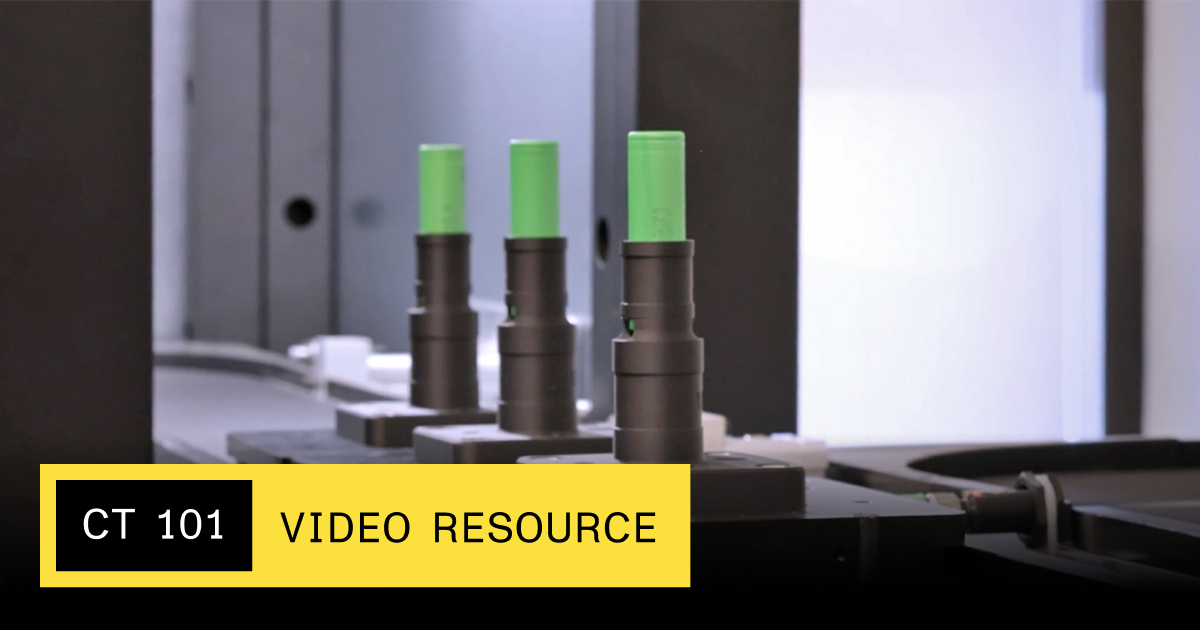
A dependable fixture keeps each part stable during scanning. For example, a dedicated holder for 18650 battery cells mounts directly onto the Triton pallets.

In software, organization begins with a Workspace, which collects all scan data for a project. Within that Workspace you create a Part Program containing the settings specific to the part you intend to inspect. A Part Program has three components. The Part Template holds metadata associated with the SKU. The Scan Recipe defines how the part sits in the chamber and sets the scan parameters, including beam settings, exposure, and the number of radiographs taken. The Analysis Recipe processes the resulting CT data and identifies the features you want to track, such as porosity or leak paths. Lumafield’s team can assist as you refine these parameters.

Continuous Scanning

Once the Part Program is ready, scanning can begin. Each run is labeled with a batch name, and the system uses RFID tags on the pallets to keep track of individual units. A barcode scanner can be connected if you want to record part numbers automatically, or you can enter information directly through the touchscreen or an attached keyboard.

With these elements in place, Triton is prepared for continuous inspection of hundreds or thousands of parts. All results are available in Lumafield’s Voyager software, giving you immediate insight into production quality. Triton brings high-speed CT to the manufacturing line, helping teams raise standards and resolve issues sooner.

Reach out to our team.

Are you a current customer? Head over to our Support site for detailed documentation and tutorials.

CT 101 Resource
Article

Introduction to Triton

CT 101 Resource

Introduction to Triton

Triton is designed for production environments that need fast, reliable inspection without slowing the line. It delivers industrial X-ray CT at high speed, with a compact footprint that fits comfortably beside or within existing workflows. The system measures about seven feet wide, just over six feet tall, and slightly under six feet deep. It runs on a standard 120-volt outlet, and its infeed and outfeed configurations can be arranged to suit a variety of factory layouts. Automated part handling supports lights-out operation, and Ultra Fast CT allows throughput of up to twelve parts per minute.

Inside the Machine

Parts enter Triton on pallets that travel along the infeed conveyor. Each pallet moves through the opening, follows a controlled path inside the machine, and arrives at the central chamber. During operation the door remains locked, though operators can open it during setup by pressing the unlatch button on the touchscreen.

Inside the chamber, the pallet is lifted into position for scanning. A motorized turntable rotates the part so the system can capture a complete set of radiographs. When the scan is finished, the pallet returns to the conveyor and proceeds to the outfeed. Here the scanner sorts parts automatically, using a rejector arm to separate pass and fail units based on the inspection criteria defined in software. While Triton is running, the touchscreen shows both the movement of parts through the machine and a live view of the radiographs being collected.

A Focus on Safety

Triton incorporates shielding and mechanical safeguards that protect operators and nearby personnel. Its internal path for parts has a maze-like shape that prevents radiation from leaving the chamber while still allowing open infeed and outfeed points. X-rays can only be generated when the door is locked and the system confirms that it is safe to proceed. Additional measures include an emergency stop and a keyed lockout switch. Every Lumafield scanner undergoes rigorous testing at installation and during service.

Triton can make instant pass/fail determinations about internal porosity within these cast aluminum parts.

Preparing for a Production Run

Triton is built for repeated inspection of high-volume SKUs, offering fast decisions on quality and clear visibility into trends on the factory floor. To make the most of this capability, it helps to establish a consistent workflow.

A dependable fixture keeps each part stable during scanning. For example, a dedicated holder for 18650 battery cells mounts directly onto the Triton pallets.

In software, organization begins with a Workspace, which collects all scan data for a project. Within that Workspace you create a Part Program containing the settings specific to the part you intend to inspect. A Part Program has three components. The Part Template holds metadata associated with the SKU. The Scan Recipe defines how the part sits in the chamber and sets the scan parameters, including beam settings, exposure, and the number of radiographs taken. The Analysis Recipe processes the resulting CT data and identifies the features you want to track, such as porosity or leak paths. Lumafield’s team can assist as you refine these parameters.

Continuous Scanning

Once the Part Program is ready, scanning can begin. Each run is labeled with a batch name, and the system uses RFID tags on the pallets to keep track of individual units. A barcode scanner can be connected if you want to record part numbers automatically, or you can enter information directly through the touchscreen or an attached keyboard.

With these elements in place, Triton is prepared for continuous inspection of hundreds or thousands of parts. All results are available in Lumafield’s Voyager software, giving you immediate insight into production quality. Triton brings high-speed CT to the manufacturing line, helping teams raise standards and resolve issues sooner.

Reach out to our team.

Are you a current customer? Head over to our Support site for detailed documentation and tutorials.

Voyager Inspection Workflows
Introduction to Voyager
Introduction to Neptune
Introduction to Industrial CT
Introducing Mars for 100% Production Inspection
Advancing Automotive Inspection: Industrial CT for Better Outcomes
Introducing Neptune Performance and Triton Performance
Manufacturers Know Quality Costs Money. Most Don't Know How Much.
The Real Cost of a Product Recall and How to Prevent One
What Industrial CT Scanning Does for Manufacturing Quality
Explore more posts
メインコンテンツへスキップ
Mars: In-line arrayed X-ray system >
プラットフォーム
分野別ソリューション
すべての業界
バッテリー
医療機器
消費財
スポーツ用品
自動車
航空宇宙/防衛
農業と食品
電子機器
用途別アプリケーション
各種資料
技術資料
ケーススタディ
オンラインセミナー
Blog
Insights from lumafield
Go/No-Go
Manufacturing podcast
First Article
Editorial Publication
企業情報
会社概要
採用情報
プレスリリース
Events
Voyager を起動
お問い合わせはこちら
メニュー
製品業界
業界
すべての業界
電子機器
医療機器
自動車
消費財
バッテリー
農業と食品
航空宇宙/防衛
スポーツ用品
[アプリケーション]
リソース
リソース
ホワイトペーパー
101
オンラインセミナー
最初の記事
Go/No-Go Podcast
First Article
会社
会社
について
採用情報
プレス
Events
セールスに問い合わせる
ボイジャーを起動
© 2000 Lumafield. All Rights Reserved.
世界の”ものづくり”を変える。
分野別ソリューション
バッテリー
医療機器
消費財
スポーツ用品
自動車
航空宇宙/防衛
農業と食品
電子機器
すべての業界
用途別アプリケーション
リバースエンジニアリング
ファースト・アーティクル・インスペクション (FAI)
品質保証と品質管理
寸法測定
故障解析
材料特性評価
欠陥検出
競合ベンチマークと分析
組み立て検証
設計検証と妥当性の確認
サプライヤー適格性評価
非破壊検査 (NDT)
すべてのアプリケーション
製品
ネプチューントリトンボイジャーMars
各種資料
学習コンテンツメディア技術資料ウェビナーオンラインセミナー初回CTスキャン分析ガイドケーススタディCT入門エンジニアブログ
企業情報
ログイン会社概要採用情報プレスリリースブログお問い合わせ

ニュースレターに登録する

info@lumafield.com
プライバシー情報セキュリティ導入サービス契約
© 2000 ルマフィールド。全著作権所有。