FREE WHITE PAPER

Heading

Date
This is some text inside of a div block.
FREE WHITE PAPER

Heading 1

Heading 2

Heading 3

Heading 4

Heading 5
Heading 6

Lorem ipsum dolor sit amet, consectetur adipiscing elit, sed do eiusmod tempor incididunt ut labore et dolore magna aliqua. Ut enim ad minim veniam, quis nostrud exercitation ullamco laboris nisi ut aliquip ex ea commodo consequat. Duis aute irure dolor in reprehenderit in voluptate velit esse cillum dolore eu fugiat nulla pariatur.

Block quote

Ordered list

  1. Item 1
  2. Item 2
  3. Item 3

Unordered list

  • Item A
  • Item B
  • Item C

Text link

Bold text

Emphasis

Superscript

Subscript

Heading 1

Heading 2

Heading 3

Heading 4

Heading 5
Heading 6

Lorem ipsum dolor sit amet, consectetur adipiscing elit, sed do eiusmod tempor incididunt ut labore et dolore magna aliqua. Ut enim ad minim veniam, quis nostrud exercitation ullamco laboris nisi ut aliquip ex ea commodo consequat. Duis aute irure dolor in reprehenderit in voluptate velit esse cillum dolore eu fugiat nulla pariatur.

Block quote

Ordered list

  1. Item 1
  2. Item 2
  3. Item 3

Unordered list

  • Item A
  • Item B
  • Item C

Text link

Bold text

Emphasis

Superscript

Subscript

Download Resource
Thank you! Your submission has been received!
Oops! Something went wrong while submitting the form.

Webinar: Advanced battery inspection with industrial X-ray CT

Edited by
Date
August 15, 2023
On-demand webinar

Industrial CT offers engineers a powerful tool to diagnose problems and discover hidden flaws in batteries. This webinar hosted by Battery Technology and Lumafield delves into applications in battery construction, manufacturing, and inspection to ease detection and inspection for many critical issues. These include internal short circuits; cell swelling and deformation; delamination; electrode damage; contamination and inclusions; and electrolyte leakage.

Join Lumafield's Andreas Bastian and learn:

  • How to quickly spot lithium-ion layer issues that can cause catastrophic failures
  • How to measure internal battery features without cutting batteries open
  • How industrial CT scanners work
  • How companies can inexpensively adopt industrial CT in product development and manufacturing workflows
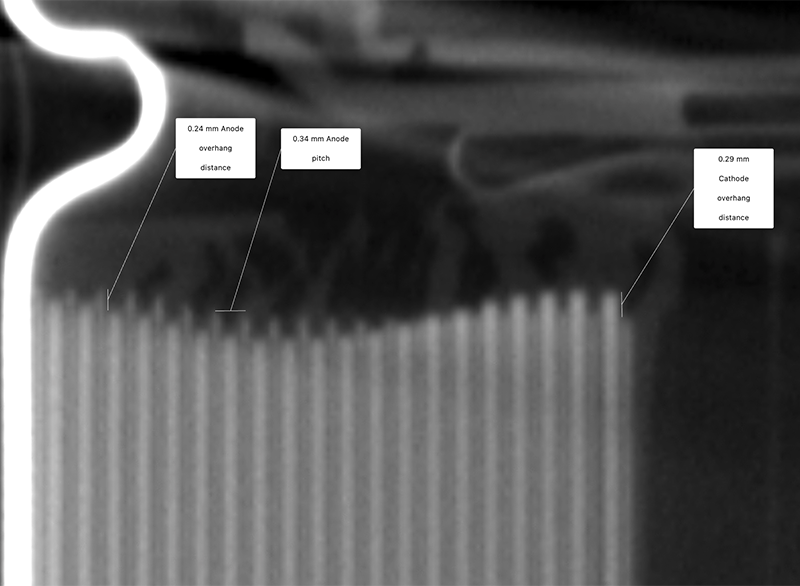
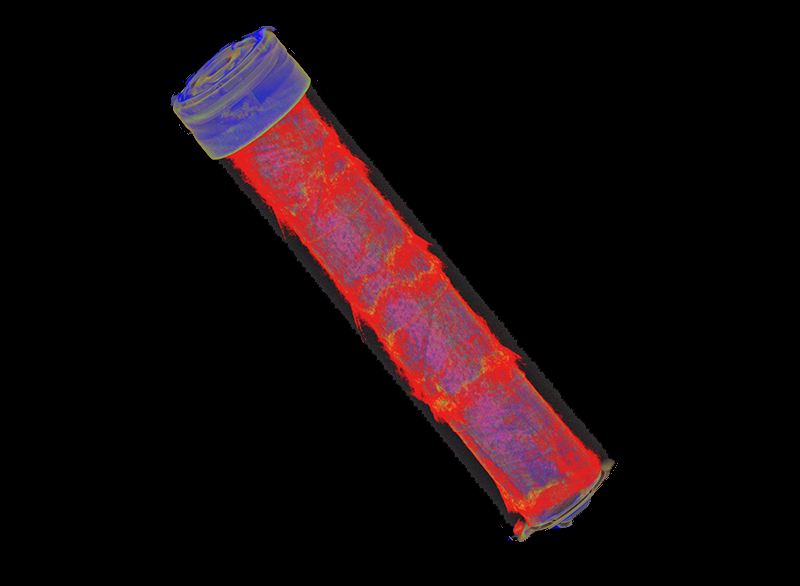
Industrial X-ray CT, akin to medical CT technology, captures a series of 2D X-ray images from various angles to reconstruct intricate 3D objects. X-ray CT reconstruction, a puzzle-like process, assembles these images into comprehensive 3D representations, opening up new avenues for analysis.

In battery engineering, CT has emerged as an indispensable tool for inspection and analysis. Destructive testing on batteries is not only dangerous; it also destroys vital evidence needed to understand failure causes. This makes CT the ideal inspection method to ensure both battery safety and performance.
CT allows engineers to address a wide range of the most common and consequential battery defects, including those that elude all other means of detection. It facilitates the identification of foreign debris within battery cells, a common culprit for reduced capacity and operational hazards. CT lets you assess the condition of electrode and current collector components, revealing any folds, tears, or wrinkles they may have. The ability to measure anode overhang distance and alignment also provides critical insights into battery quality and function.

The integrity of tab welds, which ensures optimal energy transfer, can be characterized with exceptional precision using CT scans. Deflected anodes prove to be a major problem for batteries, but with CT, engineers can pinpoint and correct misalignments that could potentially lead to uneven energy transfer or premature battery failure.
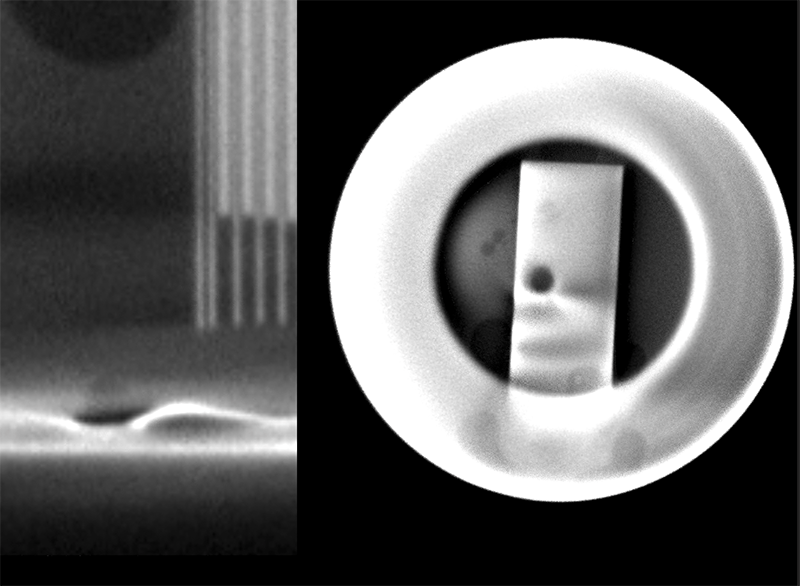
Delving deeper, CT scans offer comprehensive characterizations of anode and cathode materials, their dispersion, and structural integrity. With these insights, engineers can enhance the uniformity and effectiveness of battery components, ultimately boosting cell reliability and lifespan. As an all-encompassing inspection tool, CT empowers battery engineers to scrutinize and enhance battery quality, without compromising safety or performance.

For more, explore our earlier batteries webinarinspired by our Scan of the Month from October 2022.

‍

About the presenter

Andreas Bastian is co-founder and Head of Product at Lumafield. Prior to Lumafield, he led research in machine learning for engineering for aerospace and product design at Autodesk. In collaboration with NASA JPL, he developed generative design for space applications.

Webinar
Article

Webinar: Advanced battery inspection with industrial X-ray CT

August 15, 2023
Webinar

Webinar: Advanced battery inspection with industrial X-ray CT

On-demand webinar

Industrial CT offers engineers a powerful tool to diagnose problems and discover hidden flaws in batteries. This webinar hosted by Battery Technology and Lumafield delves into applications in battery construction, manufacturing, and inspection to ease detection and inspection for many critical issues. These include internal short circuits; cell swelling and deformation; delamination; electrode damage; contamination and inclusions; and electrolyte leakage.

Join Lumafield's Andreas Bastian and learn:

  • How to quickly spot lithium-ion layer issues that can cause catastrophic failures
  • How to measure internal battery features without cutting batteries open
  • How industrial CT scanners work
  • How companies can inexpensively adopt industrial CT in product development and manufacturing workflows

Industrial X-ray CT, akin to medical CT technology, captures a series of 2D X-ray images from various angles to reconstruct intricate 3D objects. X-ray CT reconstruction, a puzzle-like process, assembles these images into comprehensive 3D representations, opening up new avenues for analysis.

In battery engineering, CT has emerged as an indispensable tool for inspection and analysis. Destructive testing on batteries is not only dangerous; it also destroys vital evidence needed to understand failure causes. This makes CT the ideal inspection method to ensure both battery safety and performance.

CT allows engineers to address a wide range of the most common and consequential battery defects, including those that elude all other means of detection. It facilitates the identification of foreign debris within battery cells, a common culprit for reduced capacity and operational hazards. CT lets you assess the condition of electrode and current collector components, revealing any folds, tears, or wrinkles they may have. The ability to measure anode overhang distance and alignment also provides critical insights into battery quality and function.

The integrity of tab welds, which ensures optimal energy transfer, can be characterized with exceptional precision using CT scans. Deflected anodes prove to be a major problem for batteries, but with CT, engineers can pinpoint and correct misalignments that could potentially lead to uneven energy transfer or premature battery failure.

Delving deeper, CT scans offer comprehensive characterizations of anode and cathode materials, their dispersion, and structural integrity. With these insights, engineers can enhance the uniformity and effectiveness of battery components, ultimately boosting cell reliability and lifespan. As an all-encompassing inspection tool, CT empowers battery engineers to scrutinize and enhance battery quality, without compromising safety or performance.

For more, explore our earlier batteries webinarinspired by our Scan of the Month from October 2022.

‍

About the presenter

Andreas Bastian is co-founder and Head of Product at Lumafield. Prior to Lumafield, he led research in machine learning for engineering for aerospace and product design at Autodesk. In collaboration with NASA JPL, he developed generative design for space applications.

Voyager Inspection Workflows
Introduction to Voyager
Introduction to Neptune
Introduction to Industrial CT
Advancing Automotive Inspection: Industrial CT for Better Outcomes
Introducing Neptune Performance and Triton Performance
Manufacturers Know Quality Costs Money. Most Don't Know How Much.
The Real Cost of a Product Recall and How to Prevent One
What Industrial CT Scanning Does for Manufacturing Quality
Next-Generation Drones: Protecting Performance with Industrial CT
Explore more posts
メインコンテンツへスキップ
World Cup Scan of the Month >
プラットフォーム
分野別ソリューション
すべての業界
バッテリー
医療機器
消費財
スポーツ用品
自動車
航空宇宙/防衛
農業と食品
電子機器
用途別アプリケーション
各種資料
技術資料
ケーススタディ
オンラインセミナー
Blog
Insights from lumafield
Go/No-Go
Manufacturing podcast
First Article
Editorial Publication
企業情報
会社概要
採用情報
プレスリリース
Events
Voyager を起動
お問い合わせはこちら
メニュー
製品業界
業界
すべての業界
電子機器
医療機器
自動車
消費財
バッテリー
農業と食品
航空宇宙/防衛
スポーツ用品
[アプリケーション]
リソース
リソース
ホワイトペーパー
101
オンラインセミナー
最初の記事
Go/No-Go Podcast
First Article
会社
会社
について
採用情報
プレス
Events
セールスに問い合わせる
ボイジャーを起動
© 2000 Lumafield. All Rights Reserved.
世界の”ものづくり”を変える。
分野別ソリューション
バッテリー
医療機器
消費財
スポーツ用品
自動車
航空宇宙/防衛
農業と食品
電子機器
すべての業界
用途別アプリケーション
リバースエンジニアリング
ファースト・アーティクル・インスペクション (FAI)
品質保証と品質管理
寸法測定
故障解析
材料特性評価
欠陥検出
競合ベンチマークと分析
組み立て検証
設計検証と妥当性の確認
サプライヤー適格性評価
非破壊検査 (NDT)
すべてのアプリケーション
製品
ネプチューントリトンボイジャーアトラス
各種資料
学習コンテンツメディア技術資料ウェビナーオンラインセミナー初回CTスキャン分析ガイドケーススタディCT入門エンジニアブログ
企業情報
ログイン会社概要採用情報プレスリリースブログお問い合わせ

ニュースレターに登録する

info@lumafield.com
プライバシー情報セキュリティ導入サービス契約
© 2000 ルマフィールド。全著作権所有。