



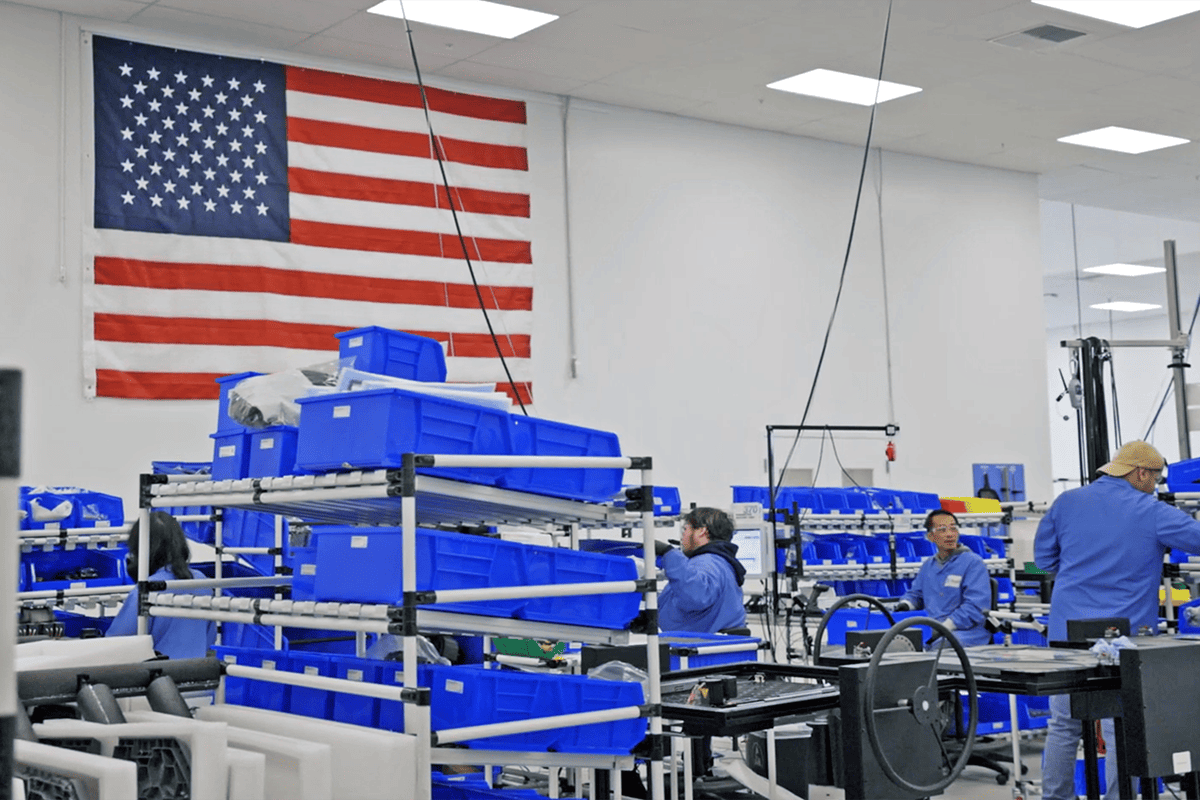


Manufacturing enters 2026 under a heavy load of expectation. Industry headlines have been promising a wave of transformation for a while now: smart factories, reshoring booms, and autonomous production lines that will finally close the loop between design and reality.
The truth is less cinematic and far more instructive. As Lumafield’s leadership sees it, this year will not bring sweeping reinvention. It will bring slow, deliberate progress and the inevitable friction that comes when soaring promises collide with physical limits.
Manufacturing is now entering a phase of realism. The technologies shaping 2026 are significant, but so are the boundaries that define them. What's coming is not disruption but discipline.
The slow burn of automation and AI
For years, analysts have treated AI as an epochal wave poised to wash over industry. The reality looks more like a rising tide than a flood.

“Geopolitical and regulatory changes will likely outweigh the more incremental changes coming to market from new technology and product development,” says Andreas Bastian, Co-founder and Head of Product at Lumafield. “However, I expect to see steady adoption of automation in manufacturing, whether it’s more automated inspection technology, including CT, or document-processing applications. We will also see continued experimentation with LLM-based AI, but it will not fully displace anything at an industry level in 2026.”
AI is already proving useful in narrow contexts such as inspection, quoting, and documentation, but it remains bounded by physical processes. The next twelve months will be less about revolution and more about integration that improves existing workflows.
According to Dan Pipe-Mazo, Head of Engineering at Lumafield, “The barrier to customizing and building manufacturing software is significantly lower with AI tools such as Cursor, Claude, and ChatGPT. We’ll see more companies ditching traditional manufacturing software providers and rolling their own systems in-house, customized to their needs.”
That shift is significant. AI will not yet replace human labor or factory control, but it will begin to replace the brittle, one-size-fits-all software that has dominated manufacturing technology for decades.
Reshoring isn’t here just yet
The return of manufacturing to North America has been on everyone’s minds for at least the last year. The narrative sells optimism: new factories, secure supply chains, and national renewal. The timelines, however, don’t add up.

“The uncomfortable truth is that the jobs are not coming back on the timelines people keep talking about,” says Eduardo Torrealba, Co-founder and CEO of Lumafield. “Manufacturing operates on multi-year cycles. If it takes five years to move a single production line from China to Vietnam, two countries that already know how to scale, then a one-year forecast isn’t realistic.”
Even with historic incentives like the CHIPS Act, transformation remains slow.
“TSMC announced its Arizona fab in 2020 and only began real volume production this October,” said Torrealba. “That’s five years, with extraordinary incentive. If $53 billion barely moves the needle on semiconductors, it will not solve reshoring everywhere else.”
When it comes to reshoring in 2026, expect announcements, not achievements. The groundwork for regional diversification will continue, but progress will remain incremental, limited by logistics, skilled labor, and the deep interdependence of global supply chains.
The real constraint is geopolitical and electrical

Even as factories experiment with new automation and AI tools, the pressures ultimately shaping global production are coming from external forces. Policy and infrastructure are starting to define the limits of manufacturing flexibility. “Supply chain risk due to geopolitical conflict is very top of mind,” says Pipe-Mazo. “Things move much quicker in politics than supply chains, and any changes that restrict purchases from countries such as China entirely will be very disruptive.”
Energy scarcity in particular will compound that tension. AI’s demand for computation is already straining power grids. “Power consumption and energy supply is the key bottleneck to AI data center buildout at the moment,” Pipe-Mazo adds. “We don’t have the grid capacity to meet demand. Electricity for data centers will become the new oil.” For that reason, efficiency may become a decisive factor.
“I’m really fascinated by measures of information or intelligence per watt (IPW),” says Bastian, “and what new compute technologies, mathematical frameworks, compression techniques, and training strategies can open up.”
Manufacturers planning large-scale digital initiatives such as AI-assisted process control, simulation, or data-heavy inspection will need to design around these constraints. The year ahead will be defined as much by what factories cannot run as by what they can automate.
Clean data becomes imperative
Even amid global complexity, the most advanced manufacturers are quietly expanding their advantage.
“Customers who are changing how they measure their processes are making deep discoveries about their products and processes that weren’t previously possible,” says Bastian.
The most advanced manufacturers are moving beyond off-the-shelf tools and building proprietary datasets that give them a competitive edge. As Dan Pipe-Mazo notes, “They’re building datasets of their products using CT and surface capture in order to build their own AI models.” These custom datasets become the foundation for more accurate predictions, better process control, and ultimately differentiation in the AI race.
This approach represents a more measurable kind of transformation. In 2026, the leaders will not be those with the flashiest tools, but those with the cleanest, best-labeled data.
AI’s next phase: augmentation instead of replacement
If 2024 was the year of AI experimentation and 2025 the year of inflated expectation, then 2026 will be the year of pragmatic adoption.
“We’re in a pragmatic portion of the hype cycle,” says Pipe-Mazo. “Reliable solutions aren’t quite there yet. We’ll find AI settling into a niche where it doesn’t replace work but instead handles the easier cases and helps teams be more efficient.”
AI is unlikely to take over any manufacturing workflow this year, but that should not count against it. “None,” Pipe-Mazo answers when asked what processes AI will fully control by 2026. “Full takeover is not a great fit for manufacturing use cases that value determinism.”
Bastian agrees. “A 2025 MIT study found 95 percent of AI pilots in organizations fail. This should not be interpreted as an indictment of the technology, but of our misunderstanding of its capabilities,” he says. “It would be a mistake to give up on the technology based on one bad experience. A single data point becomes stale within weeks given the pace the technology is moving at.”
The message is clear. AI’s value lies in its partnership with human expertise, not its replacement.
The discipline of real progress
By the end of 2026, the headlines may look familiar: AI adoption rising, reshoring on the march, and greater automation. Behind those stories will be something bigger but more lasting, a new kind of operational discipline.
Manufacturers are learning (or remembering) that even when it comes to AI, transformation is a marathon, not a sprint. It requires patience, measurement, and a deep understanding of the physical limits that advances in software cannot erase overnight.
As Torrealba puts it, “Manufacturing doesn’t change in single-year increments. Yes, automation will advance, but the underlying industrial structure won’t shift nearly as quickly as the headlines imply.”